Quantum Weather Forecasting
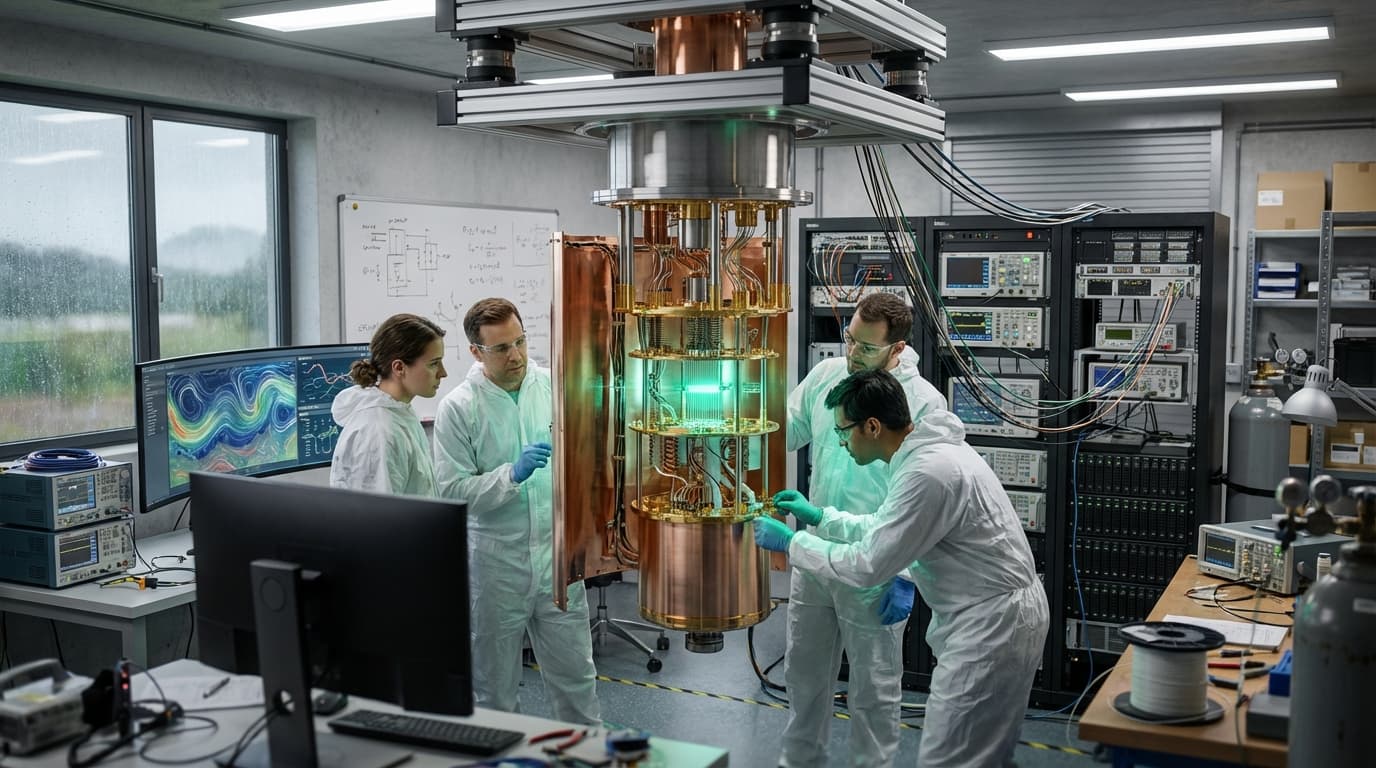
Quantum weather forecasting uses quantum machine learning and optimization to handle vast variables in climate models for more accurate long-term predictions, where climate models involve chaotic fluid dynamics (complex, unpredictable fluid behavior) and massive datasets (huge amounts of weather and climate data). Quantum machine learning (using quantum algorithms for machine learning) and optimization (using quantum algorithms to find optimal solutions) could help process this data more efficiently (potentially faster than classical methods), improving the accuracy of long-term climate change models (predictions of how climate will change over decades) and extreme weather prediction (forecasting severe weather events), potentially enabling better climate predictions that could help society prepare for climate change and extreme weather, making weather and climate forecasting more accurate and useful.
This innovation addresses the computational challenge of climate modeling, where classical computers struggle with the complexity. By using quantum algorithms, these systems could process data more efficiently. Climate research institutions and quantum computing companies are exploring these applications.
The technology is particularly significant for improving climate predictions, where better forecasts could help society prepare. As quantum computers improve, these applications will become more powerful. However, ensuring accuracy, managing complexity, and achieving practical advantages remain challenges. The technology represents an interesting application of quantum computing, but requires extensive development to prove practical benefits. Success could improve climate predictions, but the technology must prove its advantages. Quantum weather forecasting is an early-stage application with significant potential but many challenges.
Related Organizations
United Kingdom · Consortium
An independent intergovernmental organisation supported by 35 states, actively researching quantum computing applications for numerical weather prediction.
United Kingdom · Government Agency
The UK's national weather service, which has a dedicated team exploring quantum computing for next-generation atmospheric modeling.

Develops neutral atom quantum processors and associated software for Quantum Evolution Kernel methods.

Provides watsonx.governance for managing AI risk and compliance.
United States · Company
Building a utility-scale quantum computer using silicon photonics and fusion-based architecture.

Swiss quantum technology company offering 'Quantum as a Service'.

Develops 'Singularity', a software platform containing tensor network and quantum machine learning algorithms for finance.

Developing foundation models for robotics (Project GR00T) and vision-language models like VILA.

A pioneer in quantum annealing hardware and software, offering the Ocean SDK for solving optimization problems on their annealing processors.

The first pure-play public quantum computing company, developing trapped-ion systems using Ytterbium ions.
Supporting Evidence
Research this in Signals
Signals turns a topic into a sourced research record you can inspect and rerun. Your first scan is free, and this one starts with Quantum Weather Forecasting already loaded, so edit it or scan as is.