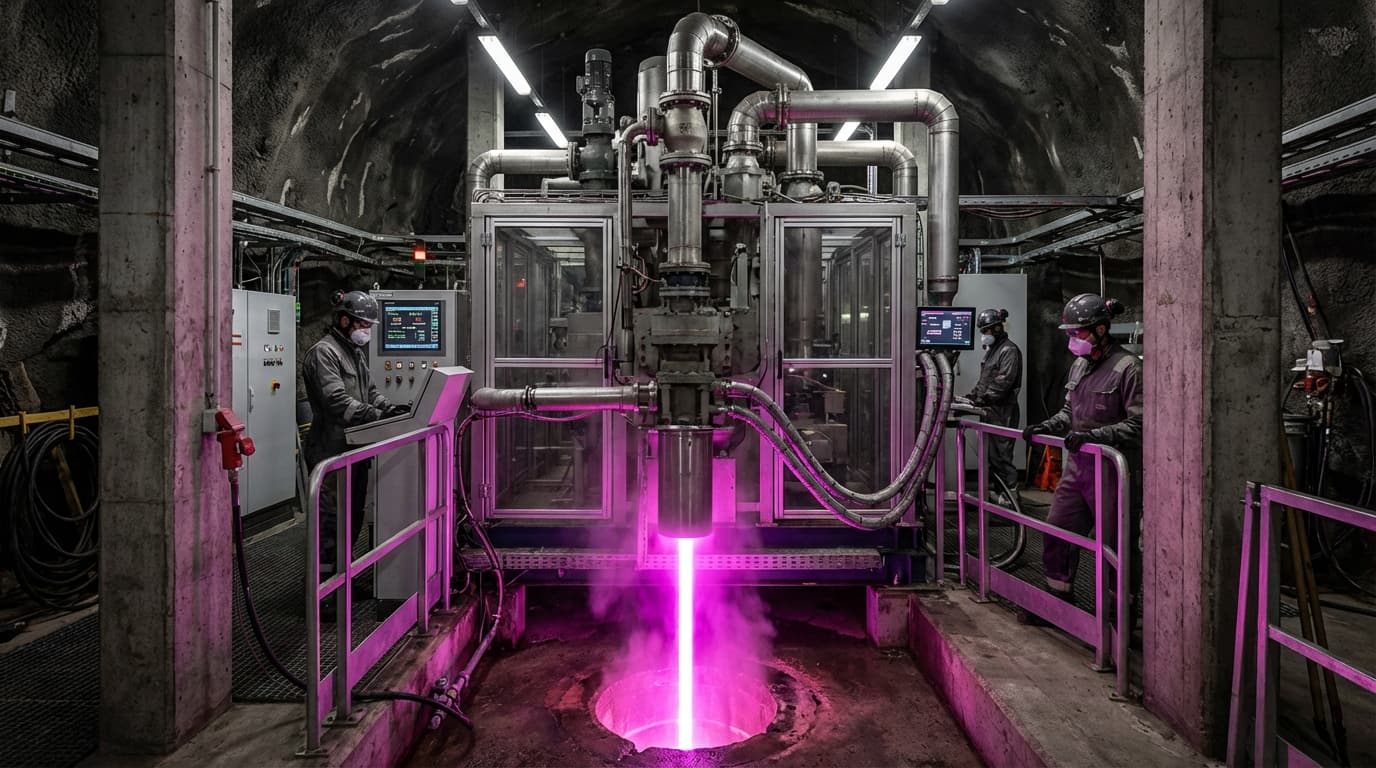
Deep Geothermal via Millimeter-Wave Drilling
Deep geothermal energy has long promised clean, reliable baseload power, but conventional drilling technologies face severe limitations beyond depths of 5-7 kilometers, where extreme temperatures and pressures destroy mechanical drill bits and dramatically increase costs. Traditional rotary drilling becomes prohibitively expensive and technically challenging in the hard crystalline rock formations that contain the most valuable geothermal resources. This bottleneck has confined geothermal development to rare locations with naturally occurring hydrothermal systems near the surface, leaving the vast majority of Earth's subsurface heat inaccessible. Millimeter-wave drilling technology addresses this fundamental constraint by replacing mechanical contact with directed electromagnetic energy, enabling access to supercritical geothermal resources—water and steam exceeding 374°C and 221 bar pressure—that exist virtually everywhere at sufficient depth.
The technology employs high-power gyrotron devices, microwave generators originally developed for plasma heating in fusion reactors, to produce focused beams of millimeter-wavelength electromagnetic radiation. When directed at rock, these beams transfer energy so rapidly that the target material vaporizes and fractures rather than merely heating, creating a borehole without physical drill bits that wear, break, or require replacement. The gyrotron beam can be precisely controlled and directed through specialized waveguides, allowing for directional drilling and the creation of complex wellbore geometries. This approach eliminates the need for drill string rotation, mud circulation systems, and the frequent bit changes that slow conventional deep drilling operations. By accessing depths of 20 kilometers or more, the technology reaches temperatures sufficient to produce supercritical fluids, which carry significantly more energy than conventional steam and enable dramatically higher power generation efficiency from smaller wellbore volumes.
Early research programs have demonstrated the fundamental physics of millimeter-wave rock vaporization in laboratory settings, though commercial deployment remains in development stages. The most compelling near-term application involves retrofitting existing fossil fuel power plants, which already possess the turbines, cooling systems, transmission infrastructure, and grid connections necessary for power generation. By drilling deep geothermal wells at these sites, operators could potentially replace coal or gas boilers with zero-carbon heat sources while preserving existing capital investments and workforce expertise. This approach could accelerate decarbonization in regions lacking conventional geothermal resources while providing the continuous baseload power that intermittent renewables cannot deliver. As the technology matures, it aligns with broader energy transition strategies seeking to maintain grid stability while eliminating emissions, potentially unlocking terawatts of geothermal capacity in locations previously considered unsuitable for renewable baseload generation.
Related Organizations

Developing millimeter-wave drilling technology to vaporize rock and reach superhot geothermal depths.

University research center focused on plasma physics and fusion energy.


Global manufacturer of electronic components and subsystems.

Manufacturer of terahertz technology and gyrotrons.


US Department of Energy lab that has historically run FACE experiments and currently models data from them.

Focuses on SuperHot Rock (SHR) geothermal energy technology development.

Develops PLASMABIT technology for contactless plasma drilling and milling of hard rock.
Supporting Evidence
Research this in Signals
Signals turns a topic into a sourced research record you can inspect and rerun. Your first scan is free, and this one starts with Deep Geothermal via Millimeter-Wave Drilling already loaded, so edit it or scan as is.