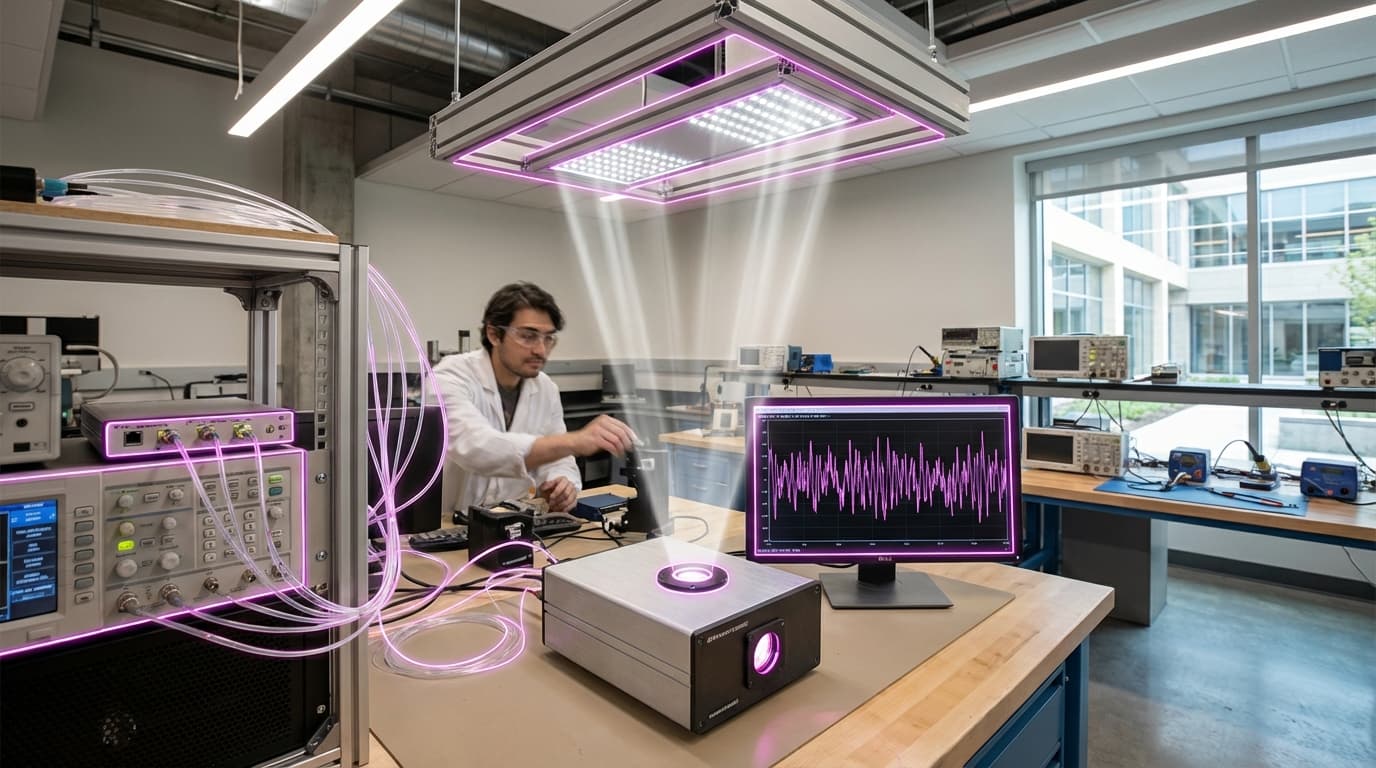
Li-Fi & Optical Wireless Communication
Light Fidelity (Li-Fi) and optical wireless communication represent a paradigm shift in data transmission, leveraging the visible light spectrum alongside infrared and ultraviolet wavelengths to create high-speed wireless networks. Unlike traditional radio frequency (RF) systems, these technologies modulate light-emitting diodes (LEDs) or laser diodes at frequencies imperceptible to the human eye—typically millions of times per second—to encode and transmit data. The fundamental mechanism relies on rapid intensity modulation of light sources, where binary data is represented by subtle variations in brightness that photodetectors can capture and decode. This approach transforms ordinary lighting infrastructure into dual-purpose systems that simultaneously illuminate spaces and provide network connectivity. The technology operates across different parts of the optical spectrum: visible light communication (VLC) uses standard LED bulbs, while infrared and ultraviolet variants enable specialized applications where visible light transmission would be impractical or undesirable.
The emergence of optical wireless communication addresses critical limitations inherent in conventional RF-based networks, particularly in environments where electromagnetic interference poses safety risks or operational challenges. Hospitals, for instance, face ongoing concerns about RF signals potentially disrupting sensitive medical equipment, while aircraft cabins require communication systems that don't interfere with avionics. Industrial facilities with heavy machinery and electromagnetic noise similarly benefit from interference-free optical links. Beyond safety considerations, Li-Fi offers inherent security advantages since light cannot penetrate opaque barriers like walls, creating naturally confined network boundaries that reduce vulnerability to external eavesdropping. The technology also alleviates spectrum congestion issues plaguing traditional wireless networks, as the visible light spectrum is approximately 10,000 times larger than the entire radio frequency spectrum and remains largely unregulated. This abundance enables multi-gigabit data rates that can exceed current Wi-Fi capabilities, with laboratory demonstrations achieving speeds beyond 100 Gbps under optimal conditions.
Current deployments of optical wireless communication span both indoor and outdoor applications, with early commercial implementations appearing in specialized settings. Indoor Li-Fi systems have been piloted in office buildings, museums, and retail environments where existing LED lighting infrastructure can be retrofitted with communication capabilities. Free-space optical (FSO) links have gained traction in urban areas as a solution for high-capacity backhaul connections between buildings, offering an alternative to fiber optic cables in locations where trenching is prohibitively expensive or physically impossible. These point-to-point outdoor systems can deliver fiber-equivalent bandwidth across distances of several kilometers, making them particularly valuable for connecting cellular base stations in dense metropolitan areas. Industry analysts note growing interest from telecommunications providers exploring hybrid networks that combine optical and RF technologies to optimize coverage and capacity. As LED adoption continues to expand globally and the demand for secure, high-bandwidth connectivity intensifies, optical wireless communication is positioned to complement rather than replace existing wireless infrastructure, creating heterogeneous networks that leverage the strengths of multiple transmission technologies to meet diverse connectivity requirements across urban environments.
Related Organizations
Develops LiFi components and systems, co-founded by the 'father of LiFi' Harald Haas.

Parent company of Philips Hue, which offers the 'Hue Sync' protocol to align smart lighting with HDMI video signals.

German research institute developing advanced algorithms for 3D Human Body Reconstruction and volumetric video coding.

French company specializing in LiFi solutions for secure environments and aerospace.
Develops laser light sources for automotive and specialty lighting.

Develops optical wireless communication solutions for industrial and defense applications.
Supporting Evidence
Research this in Signals
Signals turns a topic into a sourced research record you can inspect and rerun. Your first scan is free, and this one starts with Li-Fi & Optical Wireless Communication already loaded, so edit it or scan as is.