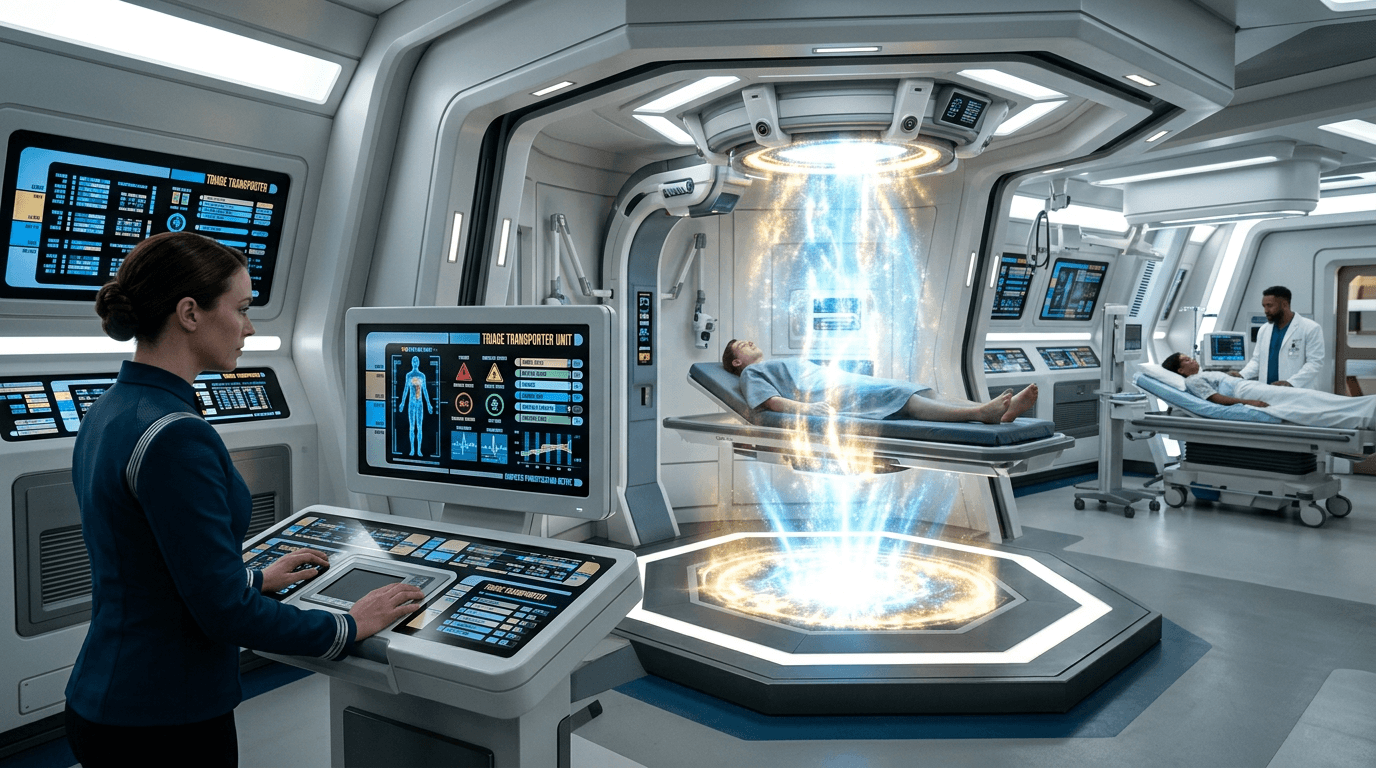
Emergency Medical Transporter
An emergency medical transporter is a speculative rapid-response system that prioritizes life-preserving transfer of injured or unstable patients from hazardous locations to clinical care zones. In the Star Trek framing, it combines continuous patient-state monitoring, triage-aware targeting, and transport execution optimized for physiological stability rather than routine logistics. Conceptually, this is not just transportation hardware: it is a coordinated medical decision stack that links detection, routing, intervention timing, and post-transfer handoff into a single critical-care pipeline.
Its strategic significance lies in compressing the interval between trauma and definitive treatment. Across emergency medicine, disaster response, and remote operations, outcomes often hinge on minutes; the emergency transporter imagines a system where extraction latency approaches zero. Real-world analogues can be seen in medevac networks, telemedicine-supported triage, drone-assisted supply delivery, and autonomous dispatch systems that allocate resources dynamically. The speculative extension is that patient movement itself becomes programmable and context-aware, enabling response architectures that maintain continuity of care even in contested, inaccessible, or rapidly degrading environments.
Full Star Trek implementation remains fictional, but the underlying direction is practical: tighter integration of sensing, decision support, and rapid transport modalities around patient safety objectives. Key constraints include reliability under stress, identity and consent safeguards, mis-targeting risk, and robust fallback pathways when automation fails. For futures planning, emergency medical transporter concepts are useful as a benchmark for resilient health systems, especially in climate disasters, offshore energy, frontier settlements, and other domains where conventional evacuation capacity is fragile. They clarify what high-performance emergency care could look like when logistics, diagnostics, and clinical coordination are designed as one system rather than separate stages.
Research this in Signals
Signals turns a topic into a sourced research record you can inspect and rerun. Your first scan is free, and this one starts with Emergency Medical Transporter already loaded, so edit it or scan as is.