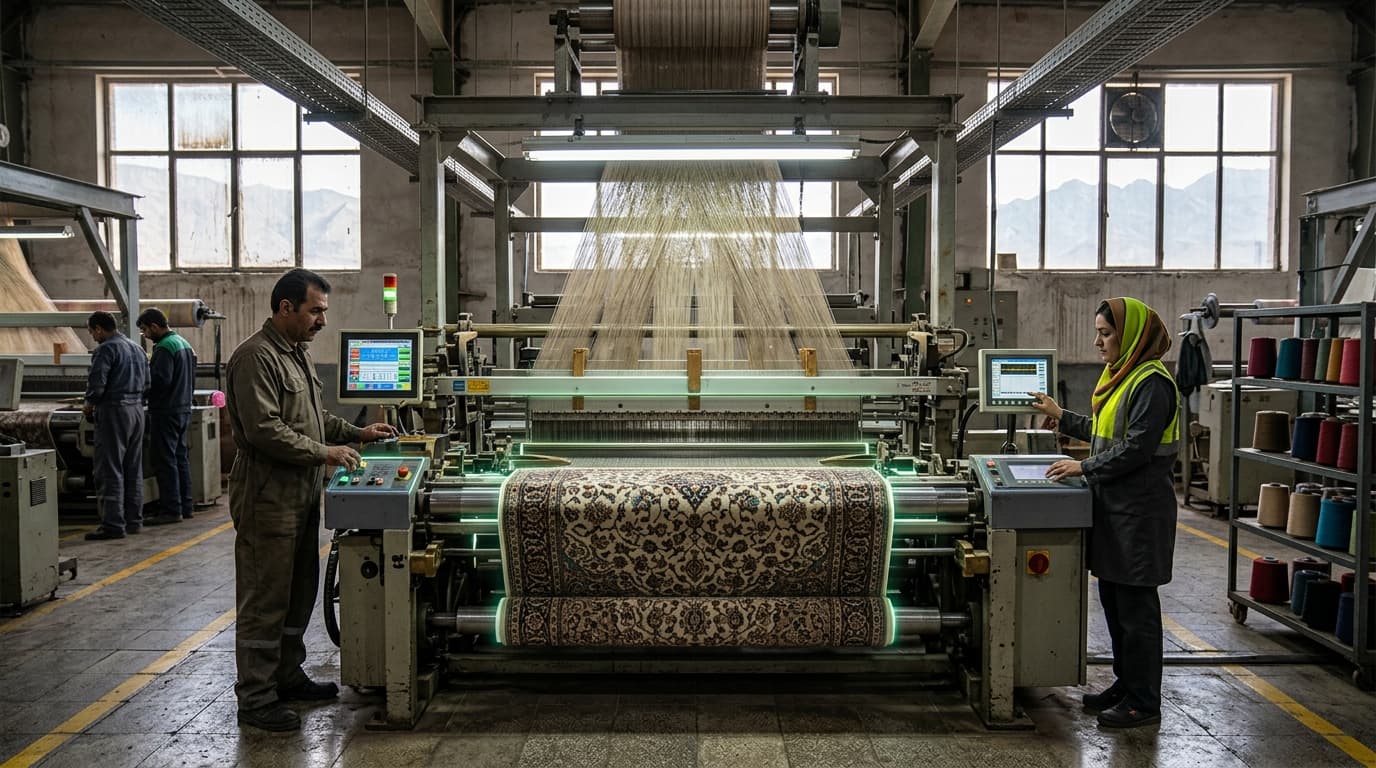
Advanced Machine-Made Carpet Weaving Technology
Geography: Emea · Middle East · Iran
Iran has built one of the world's largest machine-made carpet industries, producing hundreds of thousands of tons annually for domestic use and export. Machine-made carpet exports reached approximately $550 million in 2018, with products shipped to over 50 countries. The industry operates primarily from industrial zones in Mashhad, Isfahan, and Kashan, using high-density weaving machines that Iranian manufacturers have adapted and in some cases domestically produced, achieving technology parity with leading producers in Belgium and Turkey.
The machine-made carpet industry represents a fascinating case of technology disrupting tradition. For centuries, hand-knotted Persian carpets were Iran's most iconic export product. Machine-made carpets were once illegal in Iran to protect the handcraft industry. Today, the machine-made sector has far surpassed hand-knotted carpets in export volume, though at lower per-unit value. Iranian manufacturers have focused on producing high-density machine carpets (up to 1200 reeds) that approximate the look of hand-knotted designs using synthetic and blended yarns, achieving a price-quality combination that is competitive in Middle Eastern, Central Asian, and African markets.
The technology ecosystem includes domestic production of polypropylene and acrylic yarns (leveraging Iran's petrochemical industry), computerized pattern design software, and high-speed Jacquard and Wilton weaving machines. While core weaving machinery was initially imported, sanctions have driven increasing localization of machine components, control systems, and spare parts production. The industry sits at the intersection of Iran's petrochemical capabilities (yarn feedstock), traditional design expertise (pattern libraries), and manufacturing scale — a distinctive combination that few competing countries can replicate.
Research this in Signals
Signals turns a topic into a sourced research record you can inspect and rerun. Your first scan is free, and this one starts with Advanced Machine-Made Carpet Weaving Technology already loaded, so edit it or scan as is.