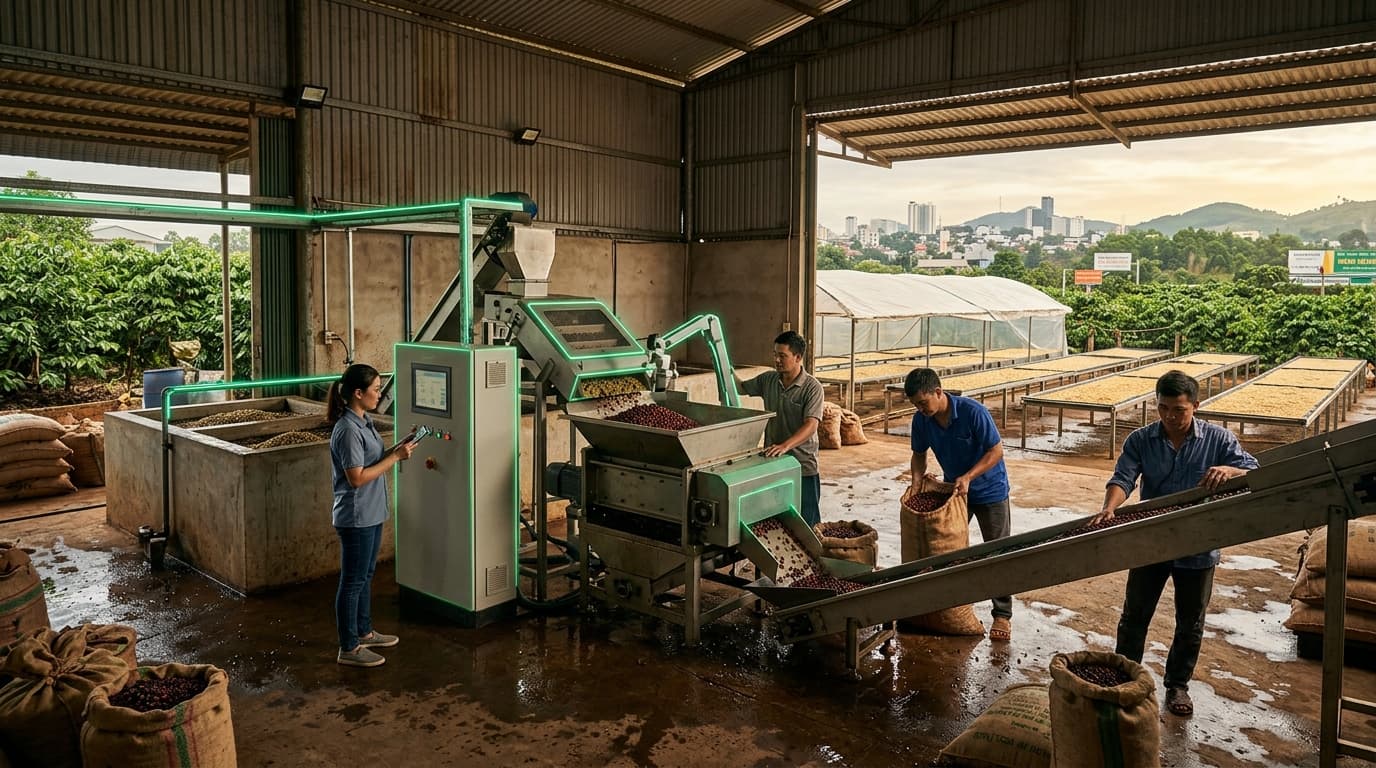
Specialty Robusta Coffee Processing Technology
Geography: Asia Pacific · Southeast Asia · Southeast Asia
Vietnam produces approximately 40% of the world's Robusta coffee, concentrated in the Central Highlands around Dak Lak province. Traditionally, Vietnamese Robusta was sun-dried and sold as commodity-grade beans for instant coffee. A technological shift is underway: producers are applying honey processing, wet processing, and controlled fermentation techniques — previously reserved for premium Arabica — to Robusta beans. Companies like Golden Robusta have demonstrated that processed Vietnamese Robusta can score 80+ on the Specialty Coffee Association scale, qualifying as 'specialty' grade.
This matters because it disrupts the global coffee value chain. Robusta has historically traded at 40-60% of Arabica prices due to perceived inferior quality. By applying post-harvest processing innovations, Vietnamese producers can command Arabica-level prices for Robusta — a potential $2-3 billion value uplift for a country where 2.6 million people depend on coffee farming. Modern wet-processing systems handle 3.5 tons/hour with optical sorting and density grading that were unthinkable a decade ago.
The strategic implication extends beyond Vietnam. As climate change pushes Arabica cultivation to higher altitudes and reduces yields in traditional growing regions (Colombia, Ethiopia, Central America), heat-tolerant Robusta becomes increasingly important for global coffee supply security. Vietnam's processing innovations position it not just as a volume supplier but as a quality leader — potentially reshaping the $450 billion global coffee industry's quality hierarchy.
Research this in Signals
Signals turns a topic into a sourced research record you can inspect and rerun. Your first scan is free, and this one starts with Specialty Robusta Coffee Processing Technology already loaded, so edit it or scan as is.