Precision Coffee Processing Technology
Geography: Americas · South America · Latin America
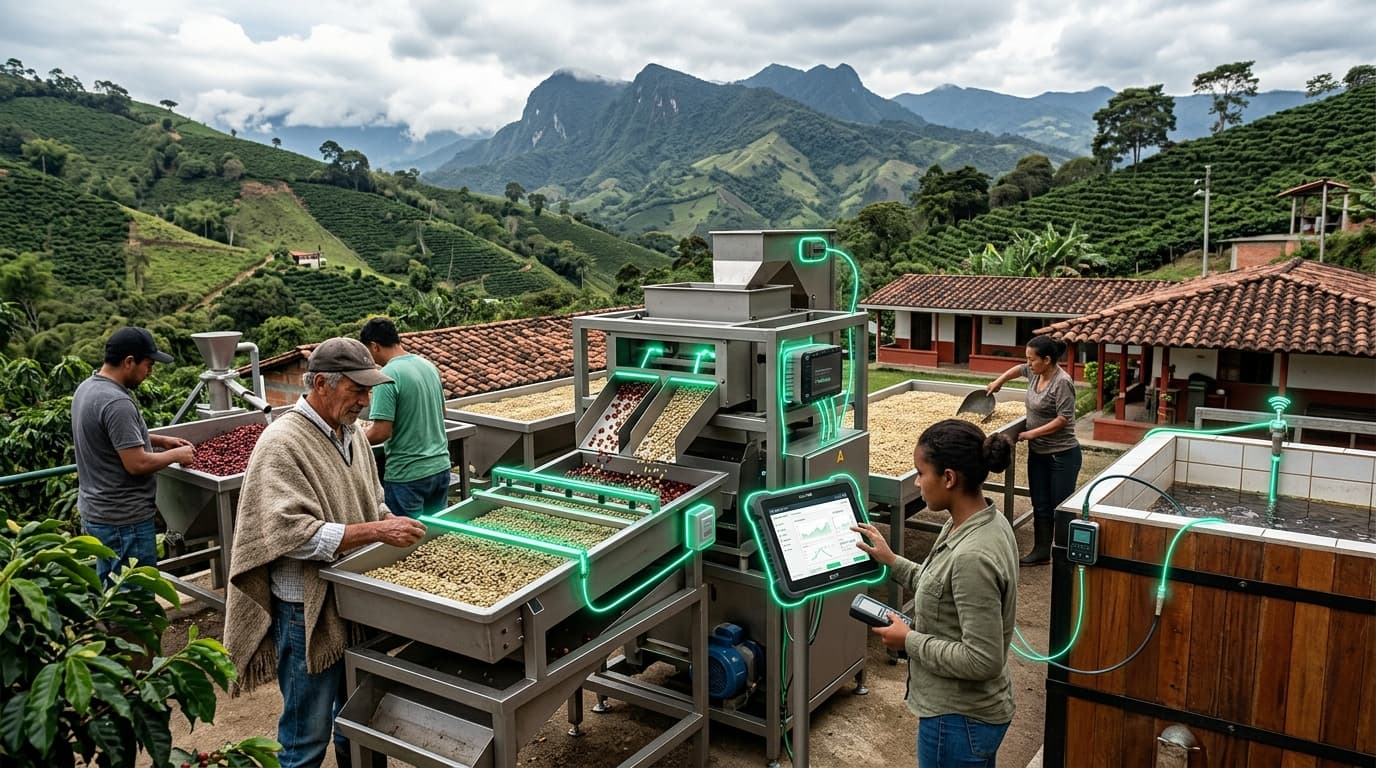
Colombia's coffee industry — the world's third-largest producer and the standard-bearer for premium arabica — is being transformed by precision processing technology. Fermentation monitoring sensors track pH, temperature, and microbial activity during coffee cherry processing, enabling repeatable flavor profiles that were previously left to artisanal intuition. Near-infrared spectroscopy sorts green beans by density and moisture content, while blockchain-based traceability systems link individual farm lots to retail packaging.
The technology enables the specialty coffee value proposition: when a roaster can guarantee that a specific lot from a specific farm in Huila was fermented at controlled temperatures for exactly 72 hours and dried to precisely 11% moisture, the resulting consistency commands 200-400% premiums over commodity-grade coffee. Colombian coffee tech companies develop IoT sensor networks, mobile apps for smallholder farmers to access market data, and quality prediction models trained on cupping scores.
Strategically, precision processing is Colombia's defense against commoditization — the country's higher production costs compared to Brazil and Vietnam can only be justified by premium quality. Technology that converts artisanal craft into reproducible science enables Colombia to scale its quality advantage. The 500,000+ smallholder farmers who produce most Colombian coffee need affordable, smartphone-accessible versions of these tools, creating a massive addressable market for agricultural technology adapted to small-scale tropical farming.
Research this in Signals
Signals turns a topic into a sourced research record you can inspect and rerun. Your first scan is free, and this one starts with Precision Coffee Processing Technology already loaded, so edit it or scan as is.