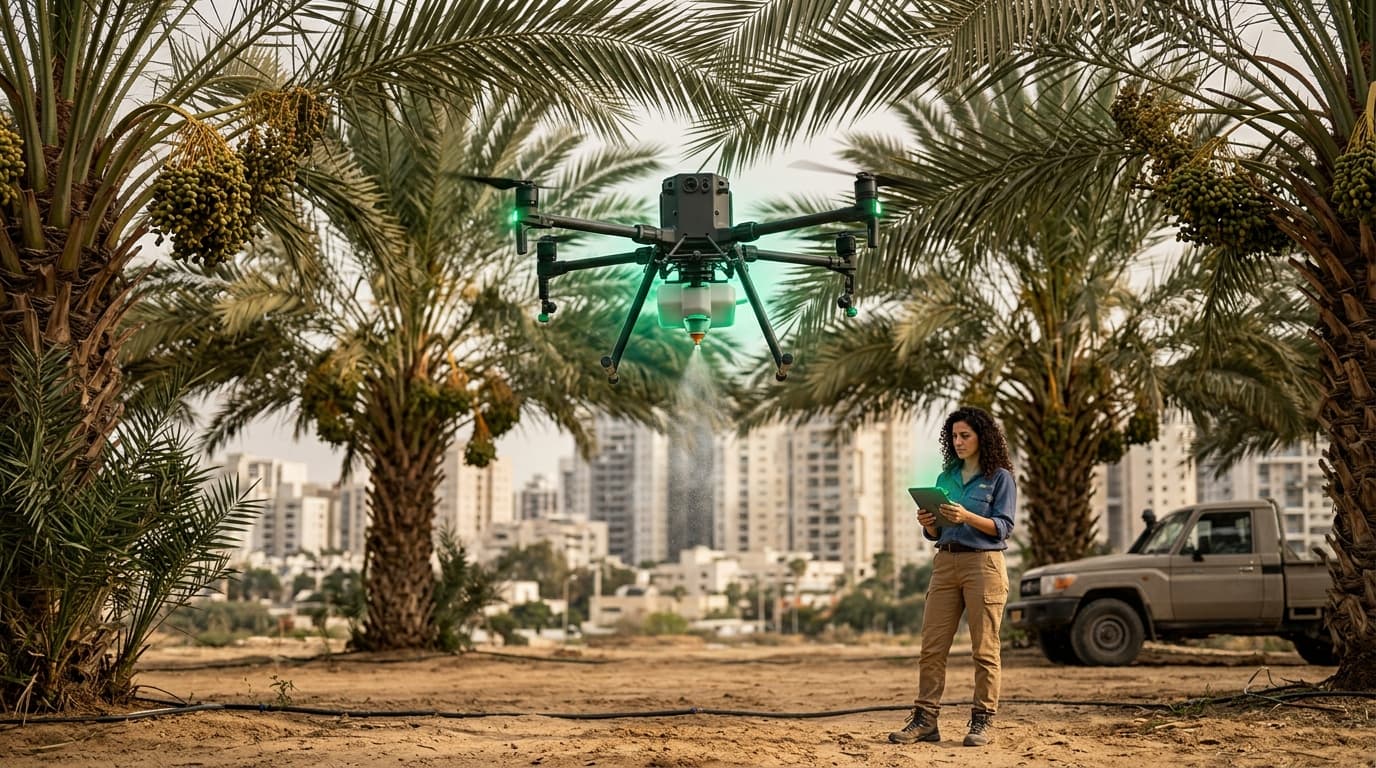
Drone-Based Precision Pollination Technology
Geography: Emea · Middle East · Israel
Israeli agricultural technology firms have developed autonomous drone systems for precision crop pollination — using UAVs to distribute pollen directly onto date palms, avocados, and other crops that traditionally require manual or insect pollination. Blue White Robotics (now Bluewhite) completed Israel's first commercial drone pollination of date palms, demonstrating that autonomous systems can achieve more uniform pollen distribution and 30% higher fruit set rates than traditional hand-pollination methods.
The technology addresses a converging crisis: global pollinator populations (bees, butterflies) are declining due to pesticides, habitat loss, and climate change, while demand for pollination-dependent crops grows. Date palms — a significant Middle Eastern crop — are particularly labor-intensive to pollinate manually, requiring workers to climb tall trees. Drone pollination eliminates this dangerous labor, reduces cost, and improves consistency through AI-controlled distribution patterns.
Strategically, precision pollination technology has global relevance as pollinator decline threatens $235 billion worth of annual crop production worldwide. Israel's development of the technology reflects its characteristic pattern: taking a constraint (limited agricultural labor in security-sensitive border areas) and engineering a solution with global export potential. The convergence of Israeli drone expertise (defense-derived), agricultural knowledge, and AI-based crop monitoring creates a technology package that addresses food security challenges from California to Saudi Arabia.
Research this in Signals
Signals turns a topic into a sourced research record you can inspect and rerun. Your first scan is free, and this one starts with Drone-Based Precision Pollination Technology already loaded, so edit it or scan as is.