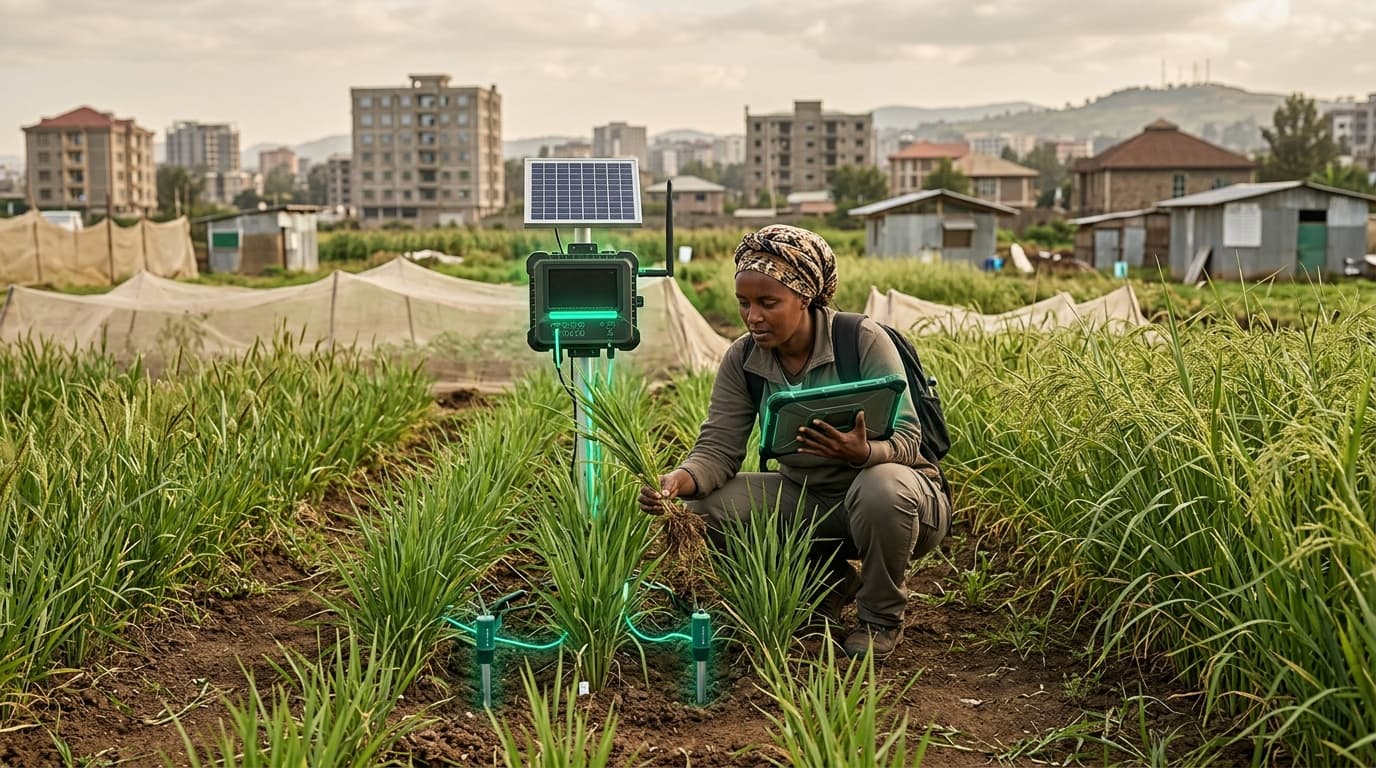
Gene-Edited Teff Crop Improvement Technology
Geography: Emea · Africa · Africa
Teff (Eragrostis tef) is Ethiopia's most important food crop — a tiny-grained cereal that feeds 80+ million Ethiopians as injera flatbread — but yields only 1.5 tonnes/hectare, partly because tall plants fall over (lodge) before harvest, destroying 20-30% of production. Ethiopian researchers at the Ethiopian Institute of Agricultural Research (EIAR), in collaboration with Corteva Agriscience, are using CRISPR-Cas9 gene editing to develop semi-dwarf teff varieties that resist lodging while maintaining the grain's exceptional nutritional profile (high iron, calcium, and complete amino acid composition).
The technology innovation targets specific height-determining genes: by editing gibberellic acid signaling pathways, researchers produce plants 30-40% shorter that channel more energy into grain production rather than stem growth. Combined with conventional breeding, gene-edited lines are being tested in Ethiopian field conditions. A row-planting technology co-developed with IDEO and the Gates Foundation — a hand-pulled precision planter for teff's minuscule seeds (1mm diameter) — complements the genetic improvement by enabling proper spacing and fertilizer placement.
The strategic significance is dual. First, teff is an 'orphan crop' — critical for African food security but ignored by global seed companies because the market is concentrated in one country. African-led gene editing for African crops represents agricultural technology sovereignty. Second, teff is gaining global demand as a 'superfood' (gluten-free, high protein, high mineral content), with new processing technologies increasing nutrient bioavailability. If Ethiopia can dramatically increase teff yields through gene editing, it could become a significant grain exporter rather than a food aid recipient.
Research this in Signals
Signals turns a topic into a sourced research record you can inspect and rerun. Your first scan is free, and this one starts with Gene-Edited Teff Crop Improvement Technology already loaded, so edit it or scan as is.