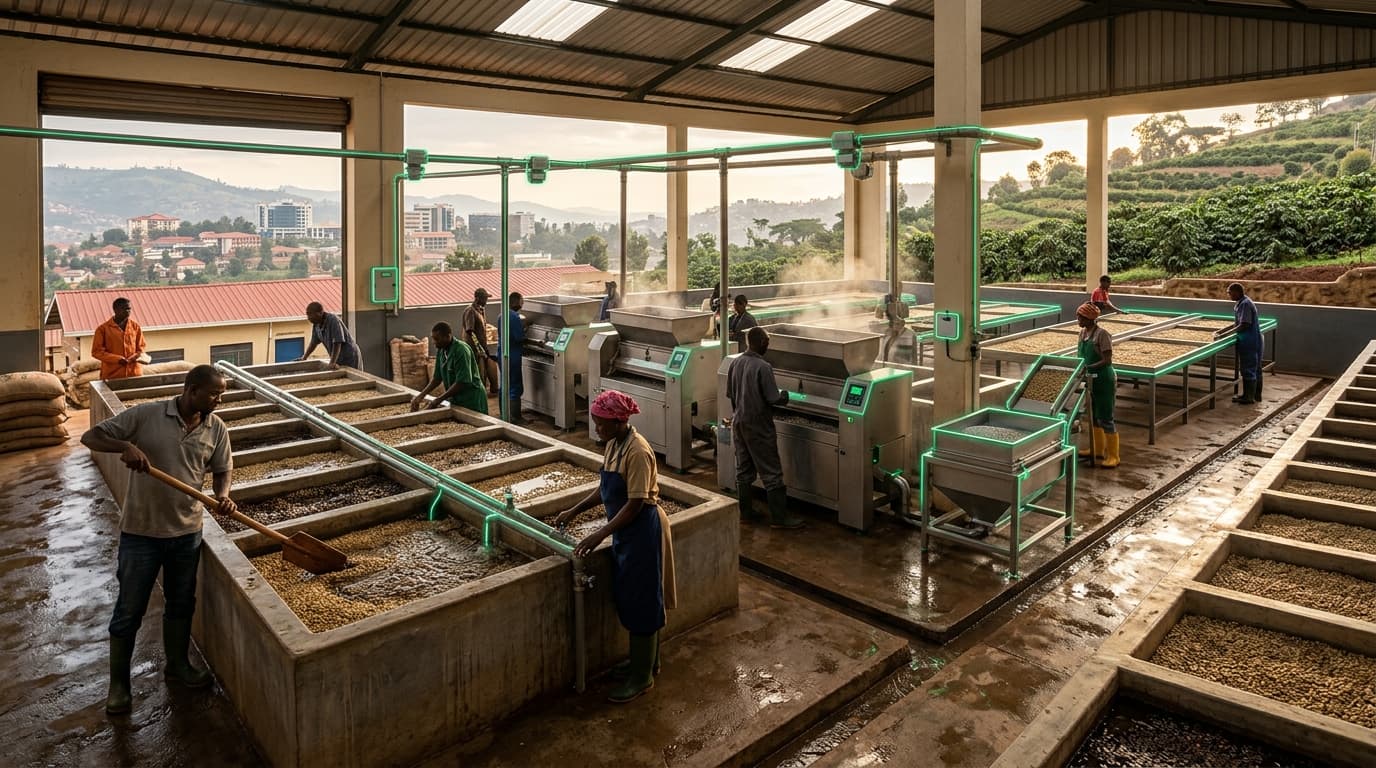
Cooperative Coffee Washing Station Technology
Geography: Emea · Africa · Africa
Rwanda's coffee sector was revolutionized by the rapid deployment of coffee washing stations (CWS) — wet processing facilities where cherries are pulped, fermented in tanks for 12-72 hours, washed in grading channels, and dried on raised African beds. The country went from a single washing station in 2002 to over 245 by 2015, with both cooperative-owned and private CWS now producing fully washed specialty coffee that commands $3-8/lb at international auctions versus $1-2/lb for semi-washed grades. The technology includes mechanical pulpers, fermentation tanks with controlled drainage, density-graded washing channels, and solar drying tables.
The innovation is as much systems engineering as hardware. Rwanda's washing stations incorporate quality control at every stage: cherry intake selection (only ripe red cherries), flotation separation of defective beans, controlled fermentation timing monitored by simple pH testing, multi-stage washing for clean cup profiles, and slow drying over 14-21 days on raised beds that allow air circulation. TechnoServe's Rwanda INC project introduced data-driven quality management — tracking lot provenance, cupping scores, and processing parameters to create feedback loops that continuously improve output quality.
The strategic implication is value capture. By upgrading processing technology, Rwanda shifted from selling undifferentiated commodity coffee to competing in the specialty market — where African coffees (Rwandan, Ethiopian, Kenyan) command some of the world's highest prices. The cooperative CWS model ensures smallholders share in the premium. This is agricultural technology upgrading that directly increases farmer income, and the model is being replicated in Burundi, DRC, and Uganda.
Research this in Signals
Signals turns a topic into a sourced research record you can inspect and rerun. Your first scan is free, and this one starts with Cooperative Coffee Washing Station Technology already loaded, so edit it or scan as is.