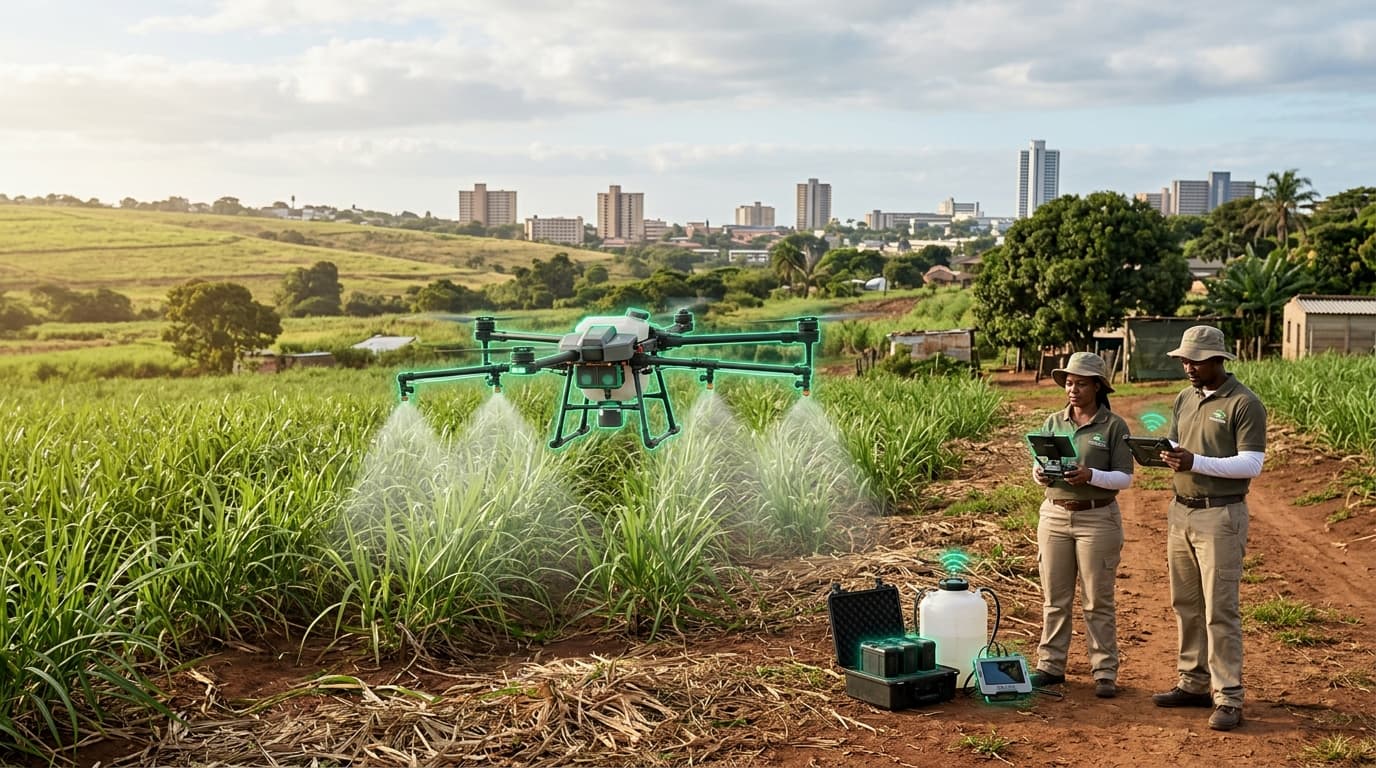
Smallholder Precision Agriculture Drone Systems
Geography: Emea · Africa · Africa
Precision drone spraying is being adapted for Africa's smallholder farming context, where the average farm is 2-5 hectares — too small for traditional precision agriculture equipment but large enough to benefit from aerial application. In KwaZulu-Natal, South Africa, a shared-service model allows cooperatives of smallholder sugarcane farmers to access drone spraying technology collectively, with documented yield increases of up to 1.78 tons per hectare from uniform ripener application.
The African adaptation is the business model, not just the hardware. Global precision agriculture assumes large commercial farms with individual equipment ownership. African innovators have developed cooperative drone-as-a-service models where a single operator serves dozens of small farms, making the technology economically viable at scales that would be impossible for individual farmers. Companies across Kenya, Nigeria, Uganda, and South Africa are deploying these shared models for crop monitoring, spraying, and mapping.
The technology addresses a critical gap: Africa produces only 60% of the food it needs, yet has 60% of the world's uncultivated arable land. Closing this gap requires dramatically improving yields on existing smallholder farms — which produce 80% of Africa's food. Precision agriculture adapted for the smallholder context is not a luxury; it's a food security imperative for a continent whose population will double by 2050.
Research this in Signals
Signals turns a topic into a sourced research record you can inspect and rerun. Your first scan is free, and this one starts with Smallholder Precision Agriculture Drone Systems already loaded, so edit it or scan as is.