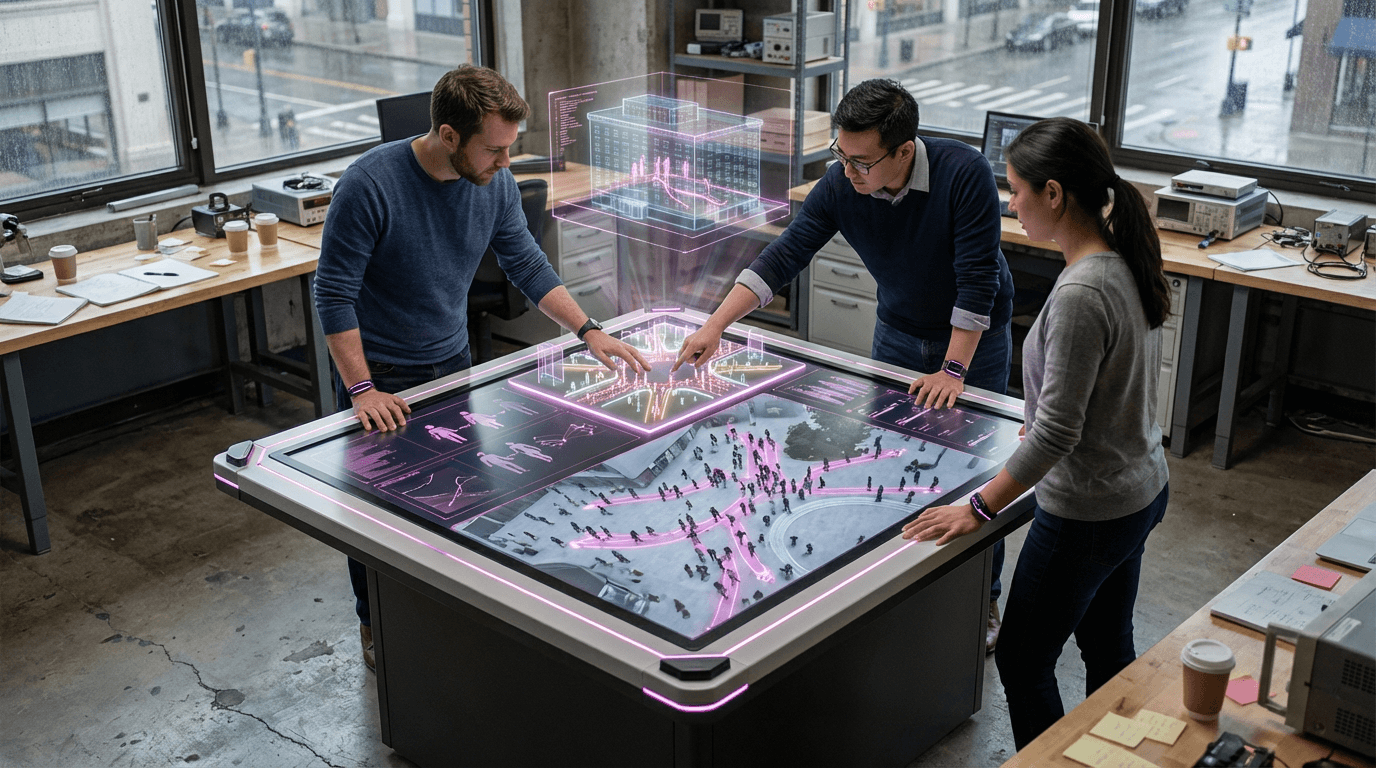
Behavioral Digital Twins
Behavioral Digital Twins represent a sophisticated convergence of data analytics, machine learning, and simulation technology that creates dynamic, virtual representations of how individuals or groups behave, interact, and move through physical and digital spaces. Unlike traditional demographic models that rely on static categories and averages, these systems continuously ingest streams of behavioral data—from smartphone location traces and social media interactions to transit card usage and building access patterns—to construct evolving models that capture the nuances of human routines, preferences, and social dynamics. The underlying architecture typically combines sensor networks, privacy-preserving data aggregation techniques, and advanced algorithms that identify patterns in seemingly chaotic human behavior, translating raw activity traces into predictive models that can simulate how people might respond to changes in their environment or circumstances.
The primary value of Behavioral Digital Twins lies in their ability to address a fundamental challenge in urban planning, public policy, and service design: the difficulty of predicting how interventions will actually affect real people before committing significant resources. Traditional planning methods often rely on surveys, focus groups, or simplified assumptions about human behavior that fail to capture the complexity of how communities actually function. By creating high-fidelity simulations grounded in observed behavior patterns, these digital twins enable planners and designers to test scenarios virtually—whether evaluating how a new transit route might shift commuting patterns, how changes to public space design could influence social interaction, or how cultural events might affect neighborhood dynamics. This capability is particularly valuable for culture-aware service design, where understanding the specific behavioral norms and routines of diverse communities is essential to creating solutions that people will actually adopt and use.
Early implementations of this technology have emerged in smart city initiatives and corporate research labs, where pilot programs explore applications ranging from optimizing retail layouts based on customer movement patterns to designing more effective public health interventions by simulating how information spreads through social networks. Some municipalities have begun experimenting with behavioral twins to model pedestrian flows and test urban design modifications before construction, while researchers use similar approaches to understand community resilience and social cohesion. As concerns about privacy and surveillance intensify, the development of federated learning approaches and differential privacy techniques has become central to the field, enabling behavioral modeling without centralizing sensitive personal data. Looking forward, the integration of Behavioral Digital Twins with other emerging technologies—from augmented reality interfaces that visualize predicted behaviors in situ to generative AI that can propose design alternatives optimized for human wellbeing—suggests a future where human-centered design becomes genuinely predictive rather than merely reactive, though realizing this potential will require careful navigation of ethical considerations around consent, representation, and the risk of reinforcing existing biases in behavioral data.
Related Organizations

A leading provider of multimethod simulation modeling software.

A data platform that models the built environment and human movement patterns to help public agencies make informed decisions.

Creates 'Prognostic Digital Twins' of patients to populate control arms in clinical trials, reducing the need for placebo patients.

Software corporation specializing in 3D design and digital mock-ups.

Software company for traffic planning and transport logistics.

Provides agent-based simulation software for banks and regulators to model complex economic systems and stress scenarios.

Provides simulation digital twin software for enterprise decision making.

A metaverse technology company known for SpatialOS, enabling massive simulations with thousands of concurrent agents.

Created the U.S. Synthetic Population Data, a statistically accurate representation of the US population for modeling.

Industrial giant offering the 'Senseye Predictive Maintenance' suite and MindSphere IoT platform.
Supporting Evidence
Research this in Signals
Signals turns a topic into a sourced research record you can inspect and rerun. Your first scan is free, and this one starts with Behavioral Digital Twins already loaded, so edit it or scan as is.