










Content Verification in a Deepfake Era
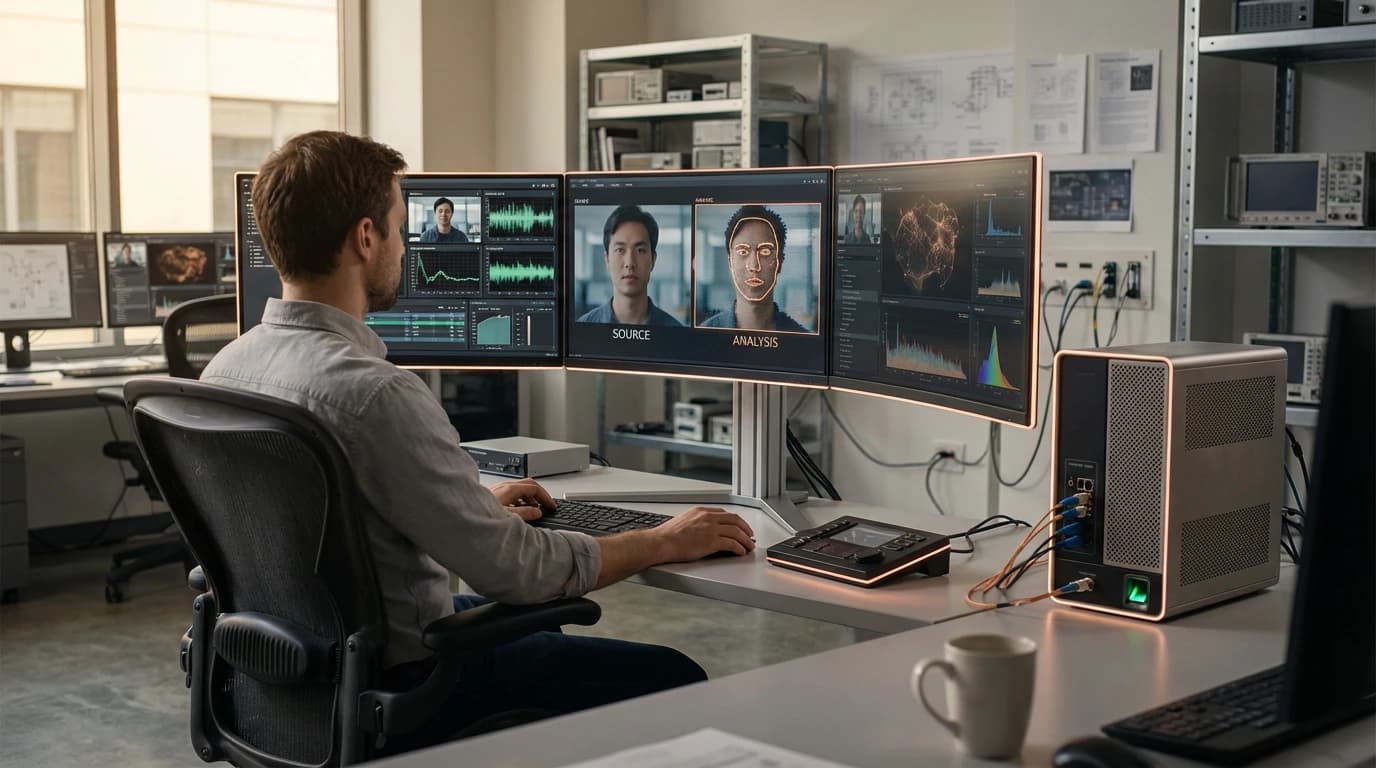
Deepfake Detection Platforms
AI systems that analyze media to identify synthetic or manipulated content
Deepfake Detection Platforms represent a sophisticated category of artificial intelligence systems designed to identify and flag synthetically generated or manipulated media content. These platforms employ advanced machine learning models, particularly convolutional neural networks and transformer architectures, to analyze digital media at multiple levels of granularity. The detection process typically involves examining visual artifacts such as inconsistent lighting patterns, unnatural facial movements, temporal discontinuities between frames, and biological signals that are difficult for generative models to replicate accurately. Some systems analyze subtle physiological indicators like the micro-variations in skin tone caused by blood flow, eye reflection patterns, and the natural asymmetries present in authentic human faces. Audio analysis components examine voice patterns, breathing rhythms, and phonetic transitions that may reveal synthetic generation. By combining multiple detection methodologies, these platforms create a comprehensive assessment of media authenticity, often providing confidence scores and highlighting specific regions or timestamps where manipulation is detected.
The proliferation of accessible generative AI tools has created an urgent need for reliable verification mechanisms across numerous sectors. Financial institutions face risks from synthetic identity fraud in remote account opening and transaction verification. News organizations and social media platforms struggle to maintain content integrity as manipulated videos can spread misinformation rapidly, influencing public opinion and undermining democratic processes. Legal systems require authenticated evidence, making deepfake detection essential for courtroom proceedings and investigations. Human resources departments need assurance that remote job interviews involve genuine candidates rather than AI-generated imposters. These platforms address the fundamental challenge of maintaining trust in digital communications when the barrier to creating convincing fake content has dropped dramatically. They enable organizations to establish verification layers that can operate at scale, processing thousands of media files to identify potential manipulations before they cause reputational damage, financial loss, or security breaches.
Several technology companies and research institutions have deployed deepfake detection systems, with some platforms now available as commercial services offering API access for real-time media verification. Early implementations have appeared in content moderation workflows for major social platforms, though detection remains an ongoing arms race as generative models continue to improve. Industry analysts note that hybrid approaches combining automated detection with human review currently provide the most reliable results, particularly for high-stakes applications. The technology is increasingly being integrated into identity verification systems used by financial services and government agencies, where remote authentication has become standard practice. Research suggests that future developments will likely incorporate blockchain-based provenance tracking and cryptographic signing at the point of capture, creating layered verification systems that combine detection with authentication. As synthetic media generation becomes more sophisticated, these platforms represent an essential component of digital infrastructure, helping preserve the integrity of visual evidence and maintaining the possibility of trusted remote interactions in an increasingly digital world.
TRL
6/9Demonstrated
Impact
5/5
Investment
5/5
Category
Applications
Related Organizations
Provides an enterprise platform for deepfake detection across audio, video, and image formats using multi-model analysis.
Developer
Specializes in visual threat intelligence and deepfake detection, monitoring the web for malicious synthetic media.
Developer
Provides a deepfake scanner tool designed to detect synthetic manipulation in videos.
Developer
Provides passive facial and voice liveness detection that can be deployed on-device/edge.
Developer
Specializes in voice security and authentication, actively developing liveness detection to stop audio deepfakes.
Developer
Generative voice AI platform for cloning and localization.
Developer
Focuses on image provenance and authentication, helping verify that media has not been altered (the inverse of detection).
Developer
Provides liveness detection software to prevent identity theft via deepfakes or masks during biometric verification.
Developer
Provides cloud-based AI models for content moderation, including detection of NSFW content, hate symbols, and AI-generated media.
Developer
Develops silicon spin qubits using advanced 300mm wafer manufacturing processes.
Developer
What was expected
Published forecasts about this technology, graded against what happened in Hindsight.
Deepfake detection
Deepfake Detectors
Realtime Deepfake Detectors
This page is broader than it.
Deepfakes and synthetic media defense
This page is a narrower case of it.
Supporting Evidence
Evidence data is not available for this technology yet.
Research this in Signals
Scan Deepfake Detection Platforms for yourself.
Signals turns a topic into a sourced research record you can inspect and rerun. Your first scan is free, and this one starts with Deepfake Detection Platforms already loaded, so edit it or scan as is.