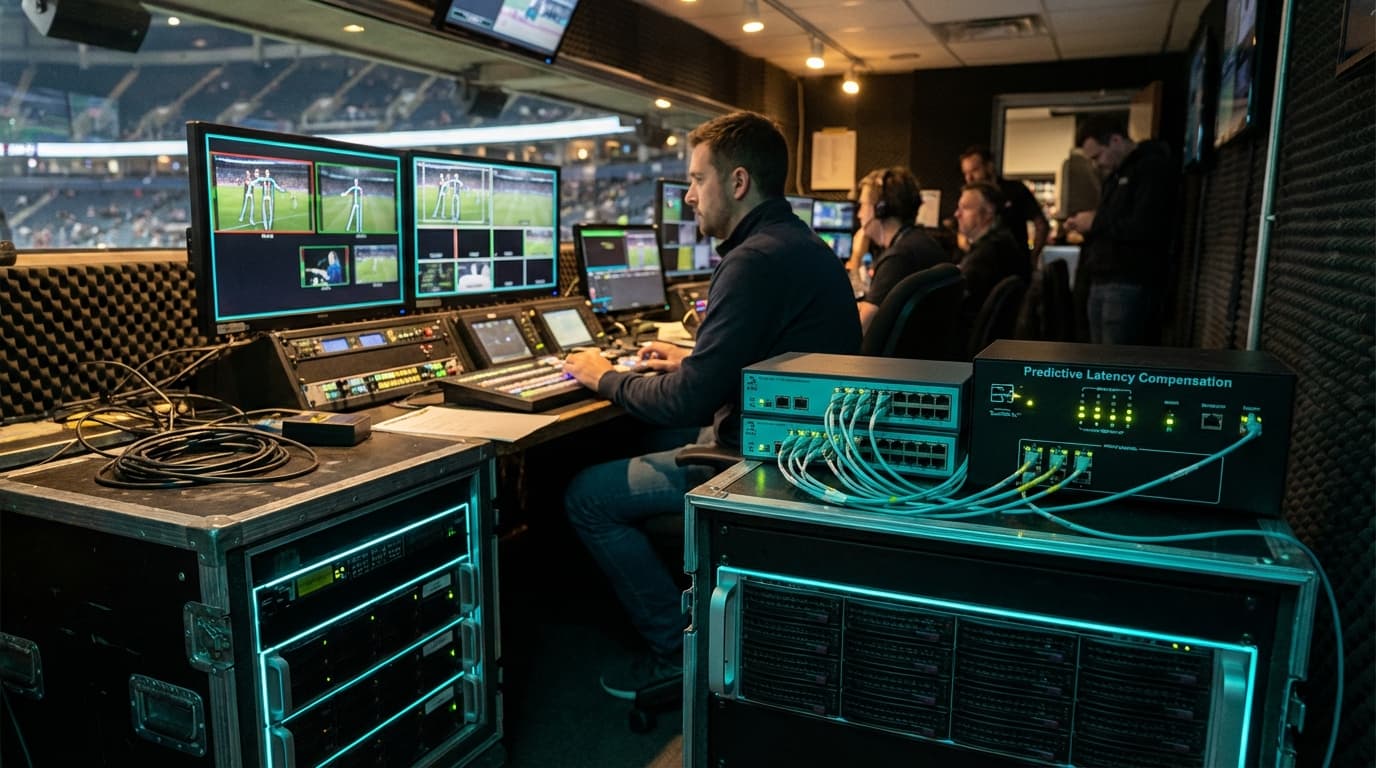
Predictive Latency Compensation
Predictive latency compensation engines observe controller telemetry, gaze vectors, and historical play patterns to forecast the next few frames of user intent. They render speculative frames locally or at the edge, blending them with authoritative frames from the cloud when they arrive. Confidence scores determine whether to keep or discard the prediction, minimizing artifacts while masking network jitter. Techniques include motion field extrapolation, reinforcement-learning policies, and dynamic bitrate allocation tied to predicted motion.
Cloud gaming platforms, VR streaming services, and remote production tools use these engines to make remote sessions feel local even on variable networks. Competitive esports streams rely on them to keep casters in sync with gameplay, while telepresence robots use prediction to pre-plan trajectories through tight spaces. Beyond entertainment, surgical teleoperation and industrial maintenance benefit from the same “negative latency” techniques.
The approach (TRL 5–6) raises fairness and safety questions: what happens when predictions misfire? Vendors implement rollback systems, transparency overlays, and regulatory compliance for sectors like gambling. Network standards bodies such as the IETF are exploring APIs that expose network quality hints to prediction engines. As 5G/6G and edge compute proliferate, predictive latency compensation will be table stakes for immersive streaming.
Related Organizations

Developing foundation models for robotics (Project GR00T) and vision-language models like VILA.


Develops the RDNA architecture with Ray Accelerators, powering ray tracing on PC and current-gen consoles (PS5, Xbox Series X).

Through Copilot and the 'Recall' feature in Windows, Microsoft is integrating persistent memory and agentic capabilities directly into the operating system.

Offers the AI Stack which includes tools for hardware-aware model efficiency and architecture search.

Develops silicon spin qubits using advanced 300mm wafer manufacturing processes.

Ubitus
Taiwan · Company
Cloud gaming technology provider for Nintendo Switch and other platforms.

Provides the High Definition Render Pipeline (HDRP) which supports real-time ray tracing for gaming and industrial visualization.

Creator of SteamVR and its Motion Smoothing technology.

Supporting Evidence
Research this in Signals
Signals turns a topic into a sourced research record you can inspect and rerun. Your first scan is free, and this one starts with Predictive Latency Compensation already loaded, so edit it or scan as is.