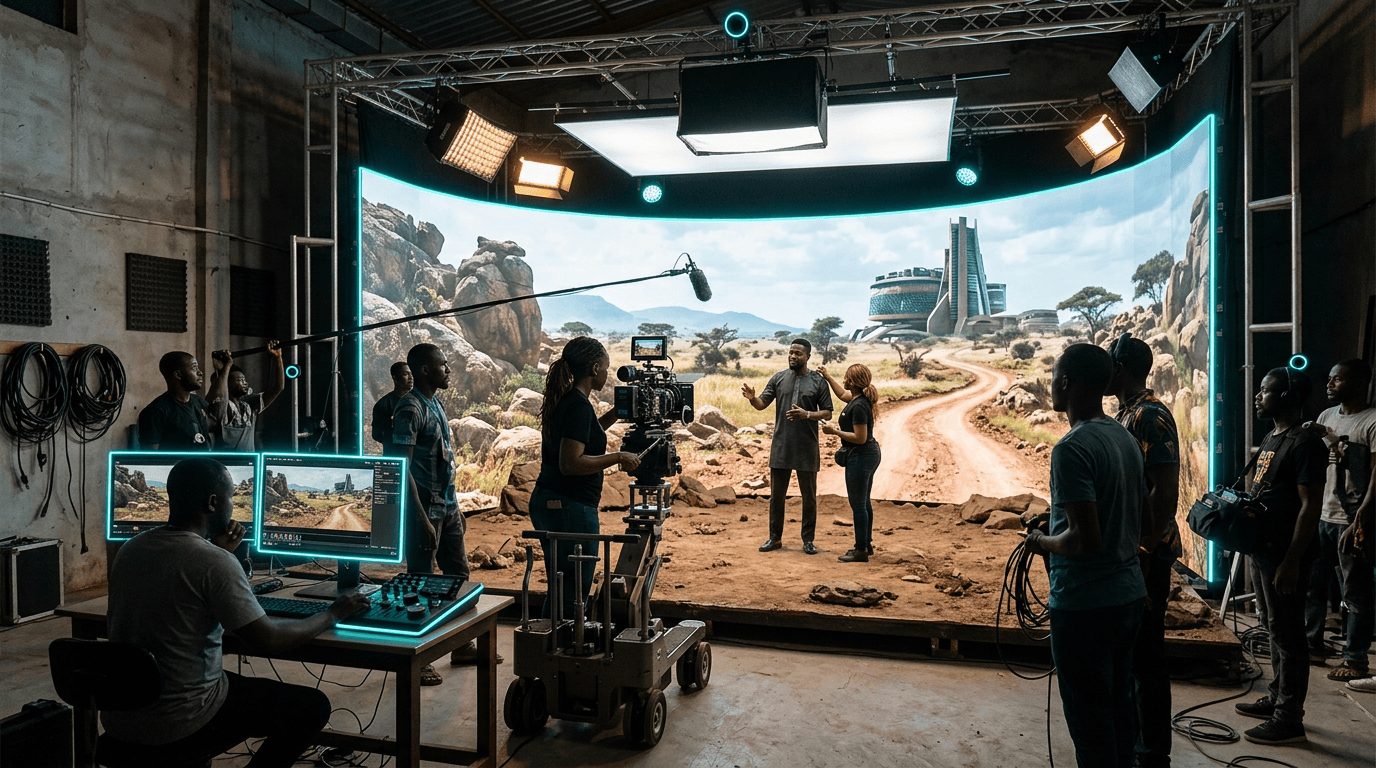
LED Volume Virtual Production for African Cinema
Geography: Emea · Africa · Africa
Nigerian filmmakers are adopting LED volume (LED wall) virtual production technology — the same approach used in The Mandalorian — to create high-quality visual environments at a fraction of traditional VFX costs. LED walls display real-time rendered backgrounds that interact with camera perspective, eliminating the need for expensive location shoots, green screen compositing, and post-production VFX. Combined with AI-assisted editing, color grading, and generative tools for concept art and storyboarding, Nollywood is leapfrogging a generation of production technology.
The adoption is driven by economics: Nollywood's average production budget is $25,000-75,000, compared to $100M+ for Hollywood blockbusters. LED volume technology lets a Lagos-based production simulate historical settings, fantasy worlds, or international locations without travel. Real-time rendering engines (Unreal Engine, Unity) run on consumer-grade GPU hardware, making the technology accessible to Nigerian studios. AI tools like runway and local adaptations are being used for rotoscoping, background generation, and even script analysis.
The strategic implication is the democratization of cinematic quality for the world's second-largest film industry by volume. If Nollywood can achieve Hollywood-adjacent visual quality at 1% of the budget, it fundamentally changes the economics of global content production. Combined with Nollywood's existing strengths — prolific storytelling, massive African diaspora audience, and streaming platform demand for diverse content — virtual production technology could make Nigerian studios globally competitive in a way that was impossible with purely practical production methods.
Research this in Signals
Signals turns a topic into a sourced research record you can inspect and rerun. Your first scan is free, and this one starts with LED Volume Virtual Production for African Cinema already loaded, so edit it or scan as is.