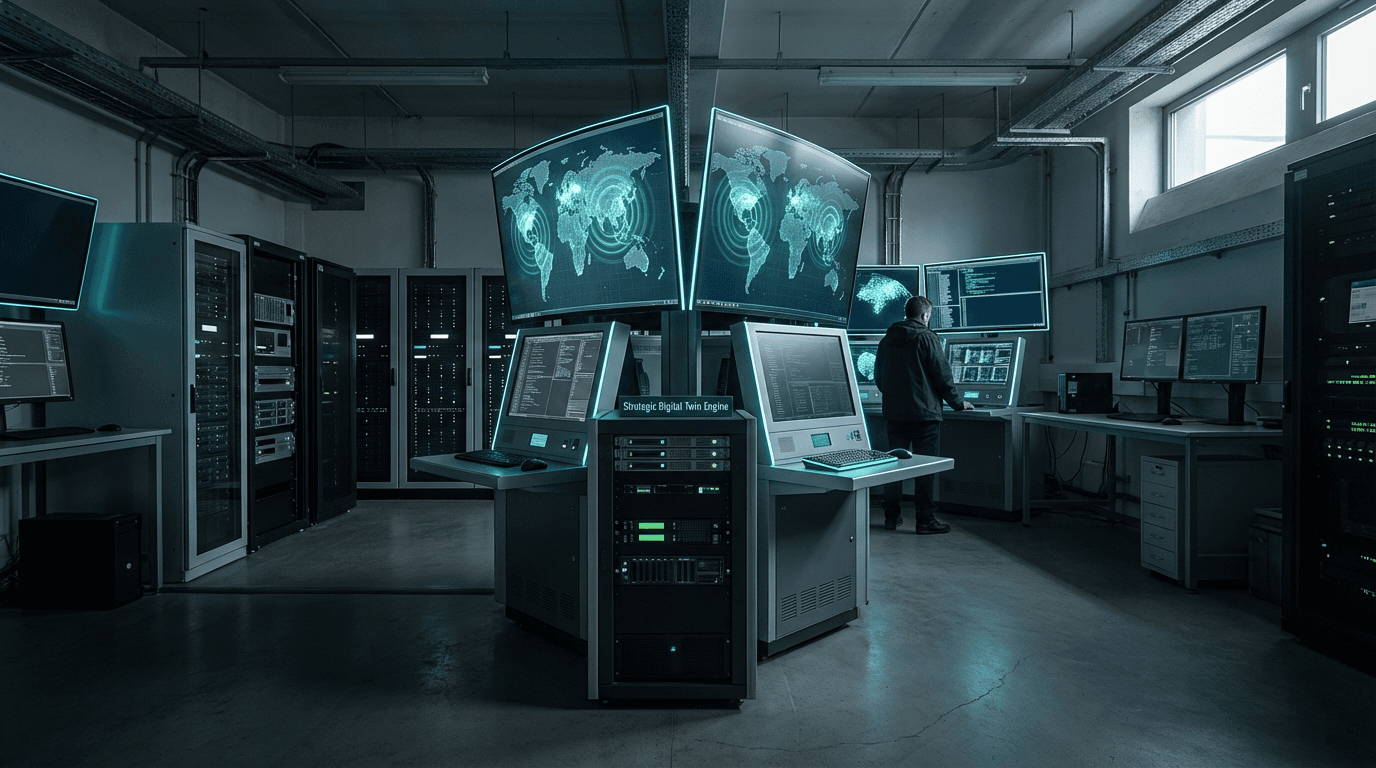
Strategic Digital Twin Engines
Strategic Digital Twin Engines represent a convergence of advanced simulation technologies designed to model the complex interdependencies between economic systems, military capabilities, cyber infrastructure, and information networks as a unified whole. Unlike traditional modeling approaches that examine these domains in isolation, these engines create dynamic, multi-layered representations of entire geopolitical systems, capturing feedback loops and cascading effects that emerge when one domain influences another. The technical foundation relies on agent-based modeling, network analysis algorithms, and high-performance computing infrastructure capable of processing millions of variables simultaneously. These systems ingest real-time data feeds from financial markets, satellite imagery, telecommunications networks, and open-source intelligence to maintain current baselines, then apply perturbations to explore how shocks propagate across domains. The modeling architecture typically incorporates machine learning components that identify emergent patterns and non-linear relationships that human analysts might overlook, while maintaining the transparency needed for strategic decision-making.
The primary challenge these engines address is the growing difficulty of predicting systemic risk in an era of deep interdependence between previously separate spheres of national power. Traditional strategic planning tools struggle to account for how a cyberattack on financial infrastructure might trigger military posturing, or how information operations could amplify economic sanctions into broader instability. Strategic Digital Twin Engines enable defense planners, intelligence agencies, and policy institutions to conduct rigorous scenario analysis and wargaming exercises that stress-test crisis response protocols before real events unfold. This capability proves particularly valuable for exploring escalation pathways in contested domains like space and cyber, where rules of engagement remain ambiguous and the potential for miscalculation runs high. By simulating thousands of potential futures under different initial conditions and decision points, these systems help identify fragile nodes in global systems and reveal which interventions might stabilize or destabilize crisis situations.
Current deployments remain concentrated within defense research institutions and strategic planning organizations, though the technology is gradually expanding to support multilateral coordination efforts and public-private partnerships focused on systemic resilience. Early applications have focused on modeling supply chain vulnerabilities, critical infrastructure dependencies, and the intersection of climate shocks with geopolitical tensions. As computational power continues to advance and data integration improves, these engines are evolving toward near-real-time operational support, potentially informing decisions during active crises rather than merely planning for hypothetical scenarios. The trajectory points toward increasingly sophisticated representations of human decision-making, social dynamics, and the information environment, creating tools that can anticipate not just technical system failures but the complex interplay of perception, narrative, and strategic choice that shapes modern conflict and cooperation.
Related Organizations

Developing foundation models for robotics (Project GR00T) and vision-language models like VILA.

A metaverse technology company known for SpatialOS, enabling massive simulations with thousands of concurrent agents.

Builds software that empowers organizations to integrate their data, decisions, and operations (Foundry and AIP).
Provides simulation digital twin software for enterprise decision making.

Provides agent-based simulation software for banks and regulators to model complex economic systems and stress scenarios.

Spatial computing company providing infrastructure for massive virtual worlds.

A global leader in simulation and training for civil aviation, defense, and healthcare.

A management and information technology consulting firm.

Software corporation specializing in 3D design and digital mock-ups.

Builds space simulation and analytics platforms for training and mission planning.
Supporting Evidence
Research this in Signals
Signals turns a topic into a sourced research record you can inspect and rerun. Your first scan is free, and this one starts with Strategic Digital Twin Engines already loaded, so edit it or scan as is.