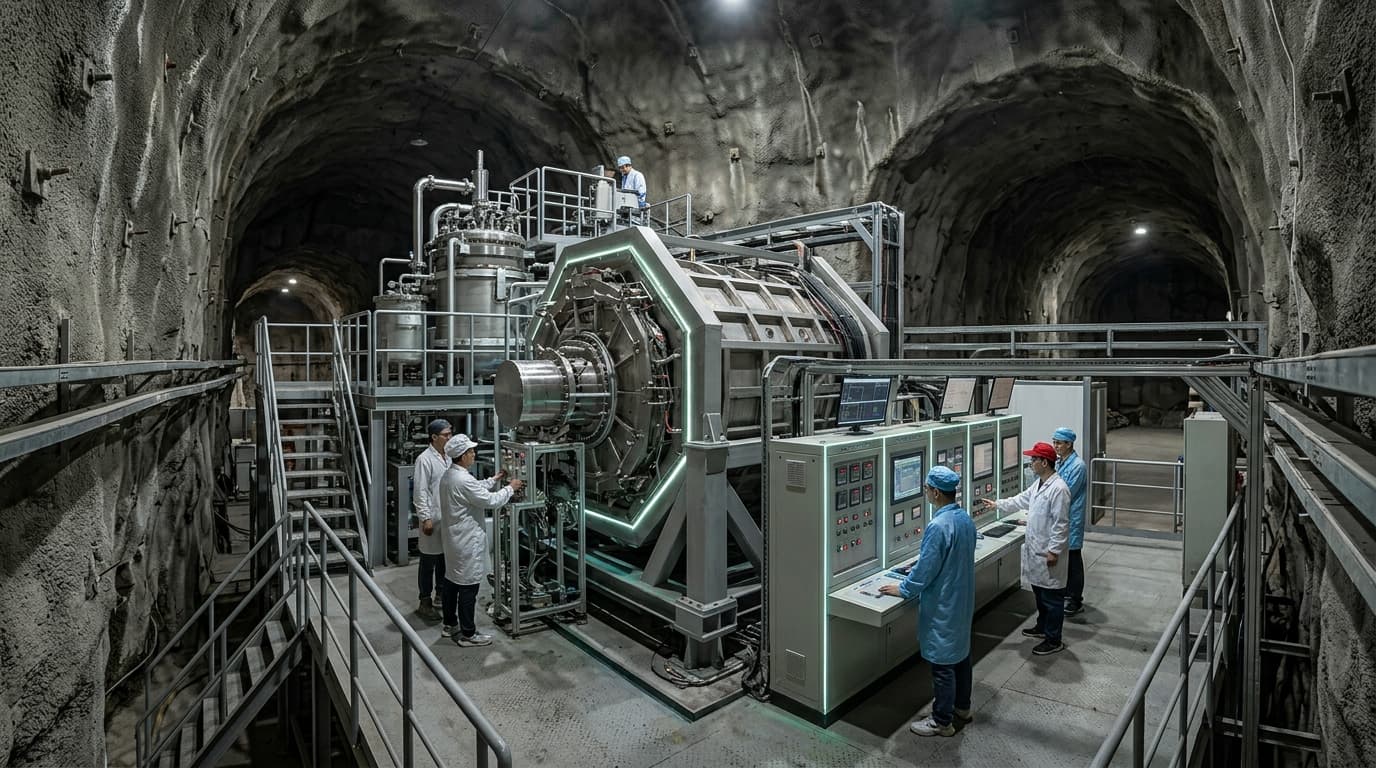
Ultra-Deep Underground Particle Detection
Geography: Asia Pacific · East Asia · China
The China Jinping Underground Laboratory Phase II (CJPL-II), located 2,400 meters below the Jinping Mountains in Sichuan province, opened in December 2023 as the world's deepest and largest underground physics laboratory. The facility has the lowest cosmic ray muon flux of any laboratory on Earth — two orders of magnitude lower than surface level — providing an ideal environment for detecting extremely rare particle interactions.
CJPL-II hosts experiments searching for dark matter (PandaX-4T, CDEX), which constitutes roughly 27% of the universe but has never been directly detected. The extreme depth shields detectors from the cosmic ray noise that overwhelms surface-based experiments. Nature reported the lab's opening in January 2024, noting it surpasses Italy's Gran Sasso National Laboratory in both depth and volume.
The laboratory's significance extends beyond fundamental physics. The detection technologies developed for dark matter — ultra-sensitive photomultipliers, xenon time-projection chambers, germanium detectors — have applications in nuclear nonproliferation monitoring, medical imaging, and materials science. China's investment in big science facilities (CJPL, FAST, EAST) signals its intent to compete at the frontier of fundamental research, not just applied technology.
Research this in Signals
Signals turns a topic into a sourced research record you can inspect and rerun. Your first scan is free, and this one starts with Ultra-Deep Underground Particle Detection already loaded, so edit it or scan as is.