








Vehicle-to-Vehicle Communications
This page is broader than it.
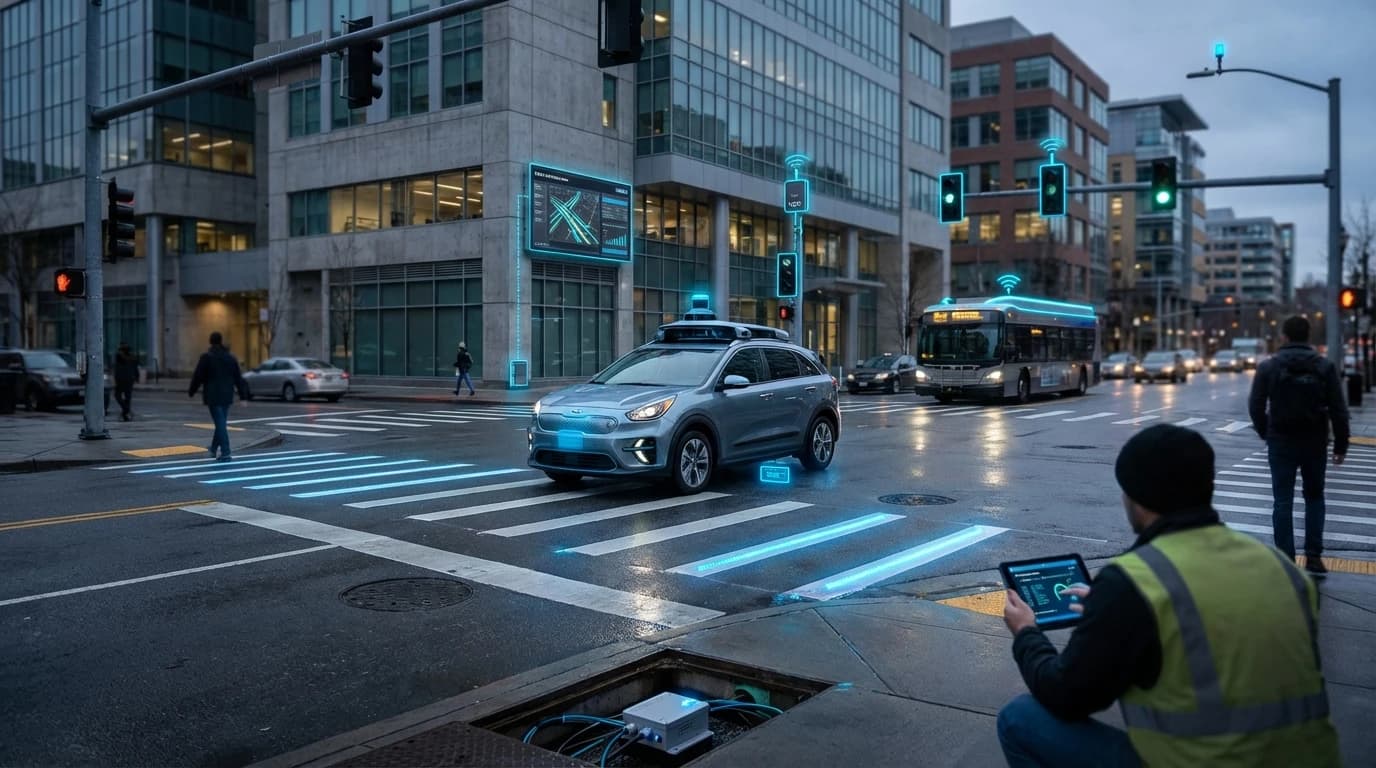
Vehicle-to-Everything (V2X) communication represents a fundamental shift in how transportation systems operate, moving from isolated vehicles to interconnected mobility ecosystems. This technology enables vehicles to communicate not only with each other (V2V) but also with infrastructure (V2I), pedestrians (V2P), networks (V2N), and cloud services, creating a comprehensive information exchange framework. The system operates through two primary technical standards: Dedicated Short-Range Communications (DSRC), which uses dedicated spectrum in the 5.9 GHz band for low-latency local communications, and Cellular V2X (C-V2X), which leverages existing cellular networks including 4G LTE and emerging 5G infrastructure. These protocols transmit critical safety messages, traffic conditions, signal timing, and environmental data at rates of up to ten times per second, creating a real-time awareness layer that extends far beyond what individual vehicle sensors can detect. The architecture typically involves onboard units in vehicles, roadside units at intersections and along highways, and backend systems that aggregate and process data to generate actionable intelligence for both human drivers and autonomous systems.
The transportation sector faces mounting pressures from congestion, safety concerns, and the environmental impact of inefficient traffic flow. Traditional approaches to these challenges—adding lanes, installing more traffic signals, or relying solely on vehicle-based sensors—have proven insufficient as urban populations grow and mobility demands increase. V2X networks address these limitations by enabling cooperative awareness, where vehicles share their position, speed, heading, and intentions with surrounding road users and infrastructure. This capability transforms collision avoidance from a reactive process into a predictive one, allowing vehicles to anticipate hazards before they enter sensor range. For instance, a vehicle approaching an intersection can receive warnings about cross-traffic running a red light or a pedestrian stepping into a crosswalk around a blind corner. Beyond safety, V2X enables traffic optimization at a system level, with vehicles adjusting speeds to create green waves through coordinated signals, merging more efficiently, and reducing the stop-and-go patterns that waste fuel and create emissions. For autonomous vehicles, this connectivity layer is particularly crucial, as it provides redundancy to onboard sensors and enables coordination between multiple autonomous systems sharing the same road space.
Early deployments of V2X technology are already underway in several regions, with roadside infrastructure being installed along major corridors and new vehicle models beginning to include V2X capabilities as standard equipment. Pilot programs in urban areas have demonstrated measurable improvements in intersection safety and traffic flow efficiency, while highway deployments focus on platooning applications where connected vehicles travel in coordinated groups to reduce aerodynamic drag and improve throughput. The technology is increasingly viewed as essential infrastructure for the transition to higher levels of vehicle automation, as fully autonomous vehicles will need to coordinate with both legacy human-driven vehicles and each other to operate safely in mixed traffic environments. Industry analysts note that the value of V2X networks grows exponentially with adoption rates—the more vehicles and infrastructure nodes participate, the more comprehensive and reliable the system becomes. This network effect is driving regulatory discussions in multiple countries about mandating V2X capabilities in new vehicles and accelerating infrastructure deployment. As 5G networks mature and edge computing capabilities expand, V2X systems are expected to support increasingly sophisticated applications, from dynamic route optimization across entire metropolitan areas to coordinated emergency vehicle priority systems, positioning this technology as a cornerstone of future intelligent transportation systems.
A global cross-industry organization of automotive, technology, and telecommunications companies working to develop end-to-end solutions for future mobility.
Specializes in V2X (Vehicle-to-Everything) hardware and software that enables infrastructure to broadcast pedestrian presence to connected vehicles.
Offers the AI Stack which includes tools for hardware-aware model efficiency and architecture search.
Develops V2X software stacks that enable vehicles and infrastructure to detect vulnerable road users even when outside line-of-sight.
Automotive supplier researching road condition monitoring via tire sensors (eTIS) and smart infrastructure interaction.
Developing V2X connectivity solutions for vulnerable road users (cyclists, pedestrians).
Developer of smart cities and connected vehicle infrastructure technology.
A global provider of intelligent transportation systems, specializing in tolling, traffic management, and urban access management solutions required for emission zones.
A leading provider of intelligent traffic systems, Yunex develops the camera and software infrastructure used to enforce Low Emission Zones in major cities like London.
Published forecasts about this technology, graded against what happened in Hindsight.
Vehicle-to-Vehicle Communications
This page is broader than it.
Signals turns a topic into a sourced research record you can inspect and rerun. Your first scan is free, and this one starts with V2X & Autonomous Mobility Networks already loaded, so edit it or scan as is.