









Monitoring Orbital Debris
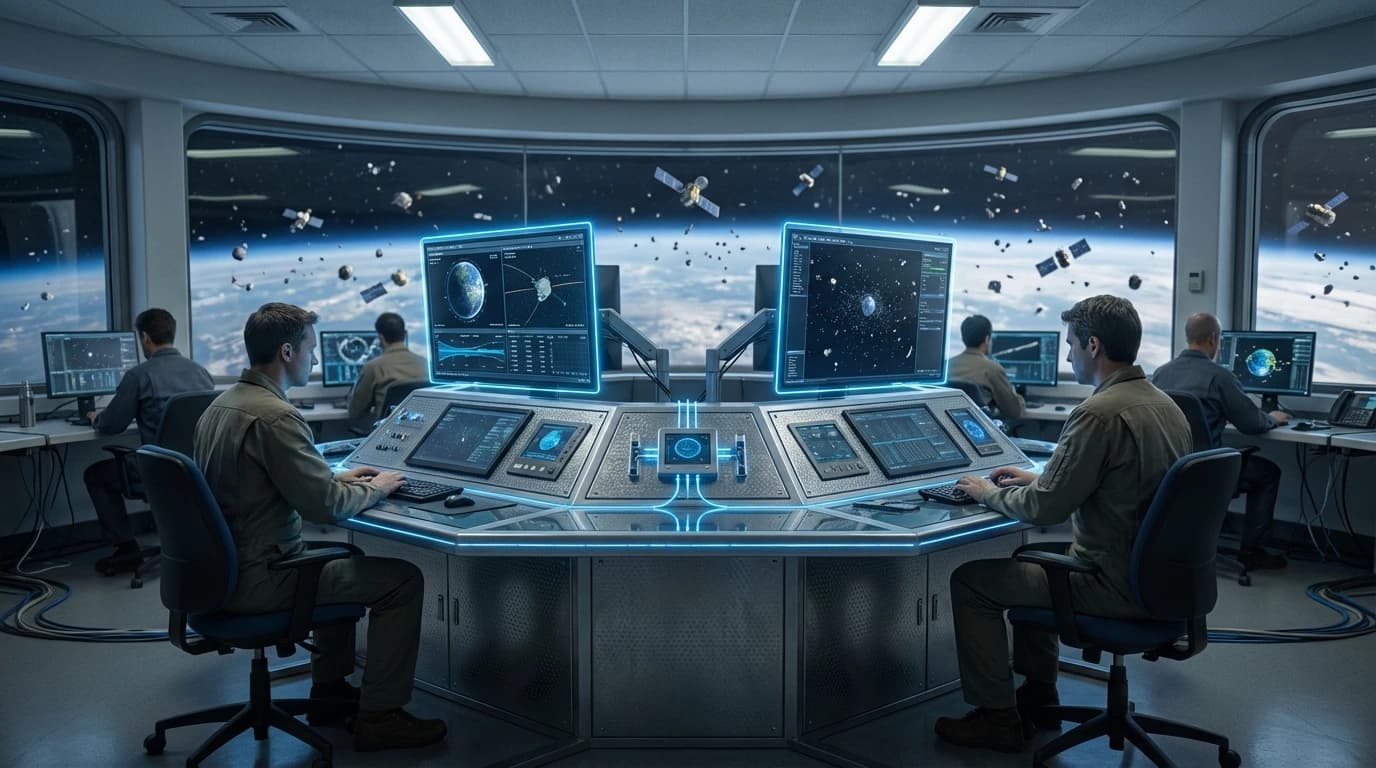
Space Debris & Collision Avoidance for Mega-Constellations
Tracking and maneuvering systems that prevent satellite collisions in crowded low Earth orbit
The rapid expansion of low Earth orbit (LEO) satellite constellations has introduced unprecedented challenges in orbital traffic management and debris mitigation. As commercial operators deploy mega-constellations comprising thousands of satellites to provide global broadband connectivity, the risk of catastrophic collisions and cascading debris events has escalated dramatically. Space debris and collision avoidance systems represent a critical infrastructure layer designed to prevent the Kessler syndrome—a theoretical scenario where the density of objects in orbit becomes so high that collisions generate additional debris, triggering a self-sustaining cascade that could render entire orbital shells unusable for generations. These systems integrate ground-based radar and optical tracking networks, onboard autonomous navigation capabilities, and coordinated deorbiting protocols to maintain the long-term sustainability of space operations. The technical architecture combines precise orbital determination algorithms, predictive collision probability calculations, and automated maneuver planning that can execute evasive actions without human intervention when conjunction warnings exceed safety thresholds.
The proliferation of satellites in LEO has transformed space traffic management from a niche concern into an urgent operational necessity. Traditional approaches to collision avoidance relied on manual coordination between operators and infrequent maneuvers, but this model becomes untenable when thousands of satellites share overlapping orbital planes. Modern debris tracking systems address this challenge by continuously monitoring objects as small as ten centimeters in diameter, generating conjunction data messages when potential collisions are detected, and enabling satellite operators to execute coordinated avoidance maneuvers. The problem extends beyond active satellites to include defunct spacecraft, spent rocket stages, and fragmentation debris from historical collisions and anti-satellite tests. Industry stakeholders have recognised that without robust debris management protocols, the economic viability of space-based telecommunications infrastructure faces existential risk. This has driven the development of international coordination frameworks, automated collision avoidance algorithms that can process thousands of conjunction assessments daily, and end-of-life disposal requirements that mandate controlled deorbiting within specified timeframes after mission completion.
Several major constellation operators have begun implementing advanced debris mitigation strategies, including propulsion systems designed for active debris removal, AI-driven maneuver optimisation that minimises fuel consumption while maintaining safety margins, and inter-operator data sharing agreements that improve tracking accuracy. Early deployments indicate that autonomous collision avoidance can reduce operator workload while improving response times to conjunction warnings, though challenges remain in standardising communication protocols and liability frameworks across international boundaries. Research suggests that passive deorbiting technologies, such as drag sails and electrodynamic tethers, may complement active propulsion systems for end-of-life disposal, particularly for smaller satellites with limited fuel reserves. As regulatory bodies develop updated orbital debris mitigation guidelines and space situational awareness capabilities continue to improve, the industry trajectory points toward increasingly sophisticated, automated systems capable of managing the complex orbital choreography required to sustain mega-constellations. The successful implementation of these technologies will determine whether LEO remains a viable domain for telecommunications infrastructure or succumbs to the self-inflicted tragedy of orbital pollution, making debris management a foundational requirement for the future of space-based connectivity.
TRL
5/9Validated
Impact
4/5
Investment
3/5
Category
Ethics Security
Related Organizations
Market leader in satellite servicing and long-term orbital sustainability, known for the ELSA-d demonstration mission.
Developer
Leads the EAGLE-1 mission and the SAGA program to build a European quantum communication infrastructure in space.
Investor
Operates a global network of phased-array radars to track LEO objects and debris.
Developer
Swiss startup selected by ESA for the ClearSpace-1 mission to remove a Vega payload adapter from orbit.
Developer
Develops the Pathfinder platform, which automates satellite collision avoidance by analyzing conjunction data and generating optimal maneuver plans.
Developer
Builds space simulation and analytics platforms for training and mission planning.
Developer
Building a space-based surveillance platform and associated software for orbital insights and collision prediction.
Developer
Deploying a constellation of satellites to monitor space traffic from space.
Developer
Developed 'Wayfinder', an open-access visualization and data engine for space traffic and debris tracking.
Developer
Provides electric propulsion systems integrated with mission planning software for autonomous route optimization and collision avoidance.
Developer
What was expected
Published forecasts about this technology, graded against what happened in Hindsight.
Supporting Evidence
Evidence data is not available for this technology yet.
Research this in Signals
Scan Space Debris & Collision Avoidance for Mega-Constellations for yourself.
Signals turns a topic into a sourced research record you can inspect and rerun. Your first scan is free, and this one starts with Space Debris & Collision Avoidance for Mega-Constellations already loaded, so edit it or scan as is.