








Software-Defined Networking
This page is a narrower case of it.
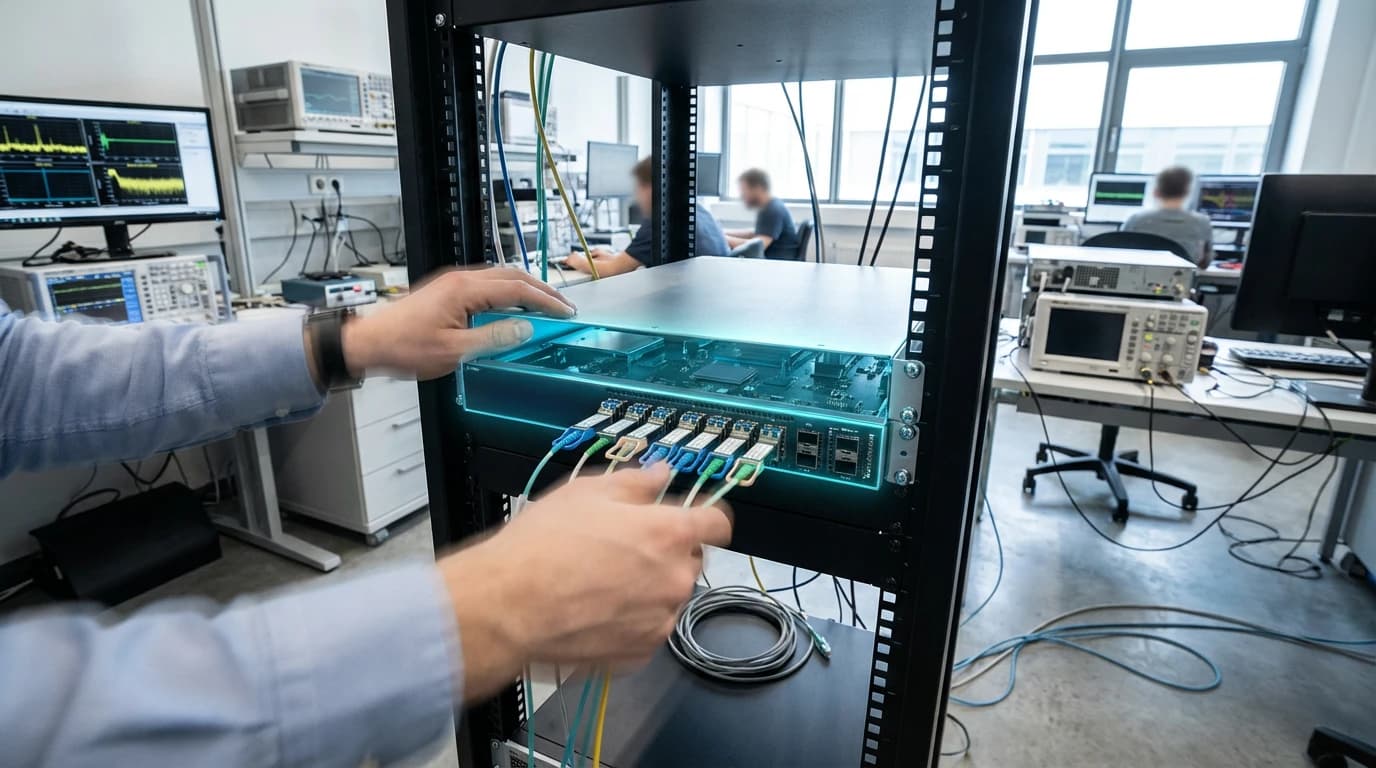
Traditional network infrastructure has long been constrained by rigid, vendor-specific hardware that makes it difficult to adapt to evolving traffic patterns and emerging protocol requirements. Network operators typically face months-long cycles to deploy new features or optimize packet forwarding behavior, as these capabilities are hardcoded into specialized silicon. Programmable data planes represent a fundamental shift in this paradigm by decoupling the control logic from the underlying hardware. At the technical core, these systems utilize domain-specific programming languages—most notably P4 (Programming Protocol-independent Packet Processors)—that allow network engineers to define exactly how switches and routers should process, parse, and forward packets. Unlike conventional networking equipment where forwarding behavior is fixed at manufacturing time, programmable data planes can be reconfigured in the field through software updates. The architecture typically separates the data plane (which handles packet forwarding at line rate) from the control plane (which makes routing decisions), with software-defined networking controllers orchestrating the overall behavior. This separation enables the data plane itself to be reprogrammed to recognize new packet headers, implement custom forwarding logic, or modify traffic handling policies without replacing physical hardware.
The telecommunications and data center industries face mounting pressure to support diverse workloads, from ultra-low-latency applications to massive IoT deployments, each with distinct network requirements. Programmable data planes address these challenges by enabling operators to implement fine-grained traffic engineering policies that can be adjusted dynamically based on real-time conditions. Network operators can deploy new protocols or modify existing ones in days rather than years, responding rapidly to emerging standards or proprietary requirements. This flexibility proves particularly valuable for in-network telemetry, where switches can be programmed to collect detailed performance metrics as packets traverse the network, providing visibility that was previously impossible without dedicated monitoring hardware. The technology also facilitates network slicing, allowing a single physical infrastructure to support multiple virtual networks with different characteristics—a critical capability for 5G deployments and multi-tenant cloud environments. By eliminating the need for costly hardware upgrades to introduce new features, programmable data planes reduce capital expenditure while simultaneously improving operational agility.
Major cloud providers and telecommunications operators have begun deploying programmable data plane technology in production environments, particularly within large-scale data centers where the ability to optimize traffic flows directly impacts application performance and infrastructure costs. Early implementations have demonstrated significant improvements in network utilization and the ability to implement custom congestion control mechanisms tailored to specific workloads. Research institutions and industry consortia continue to expand the P4 language specification and develop reference implementations for various hardware platforms, from high-performance switches to programmable network interface cards. The technology aligns closely with broader industry trends toward disaggregation and open networking, where operators seek to break free from proprietary ecosystems and gain greater control over their infrastructure. As edge computing architectures proliferate and network requirements become increasingly heterogeneous, programmable data planes are positioned to become a foundational technology for next-generation telecommunications infrastructure, enabling the kind of rapid innovation and customization that modern applications demand.
A non-profit operator-led consortium driving the transformation of network infrastructure, heavily involved in P4 and the Stratum project.
Develops silicon spin qubits using advanced 300mm wafer manufacturing processes.
Provides a fully programmable and automated cloud-native edge center networking software solution, including a P4-based 5G UPF.
Delivers high-performance SDN networking software and programmable network fabrics based on P4 and OpenFlow.
Developing foundation models for robotics (Project GR00T) and vision-language models like VILA.
Develops the RDNA architecture with Ray Accelerators, powering ray tracing on PC and current-gen consoles (PS5, Xbox Series X).
Major supplier of Co-Packaged Optics (CPO) switches and optical interconnect components.
A provider of open networking solutions and P4-programmable switches in the EMEA region.
Data center networking leader offering CloudVision, which provides network-wide state and automation capabilities aligned with IBN.
Offers the Quantum Engineering Toolkit (QET) and Labber software for instrument control and pulse generation.
Published forecasts about this technology, graded against what happened in Hindsight.
Software-Defined Networking
This page is a narrower case of it.
Signals turns a topic into a sourced research record you can inspect and rerun. Your first scan is free, and this one starts with Programmable Data Planes (SDN/P4) already loaded, so edit it or scan as is.