








Public safety technology
This page is a narrower case of it.
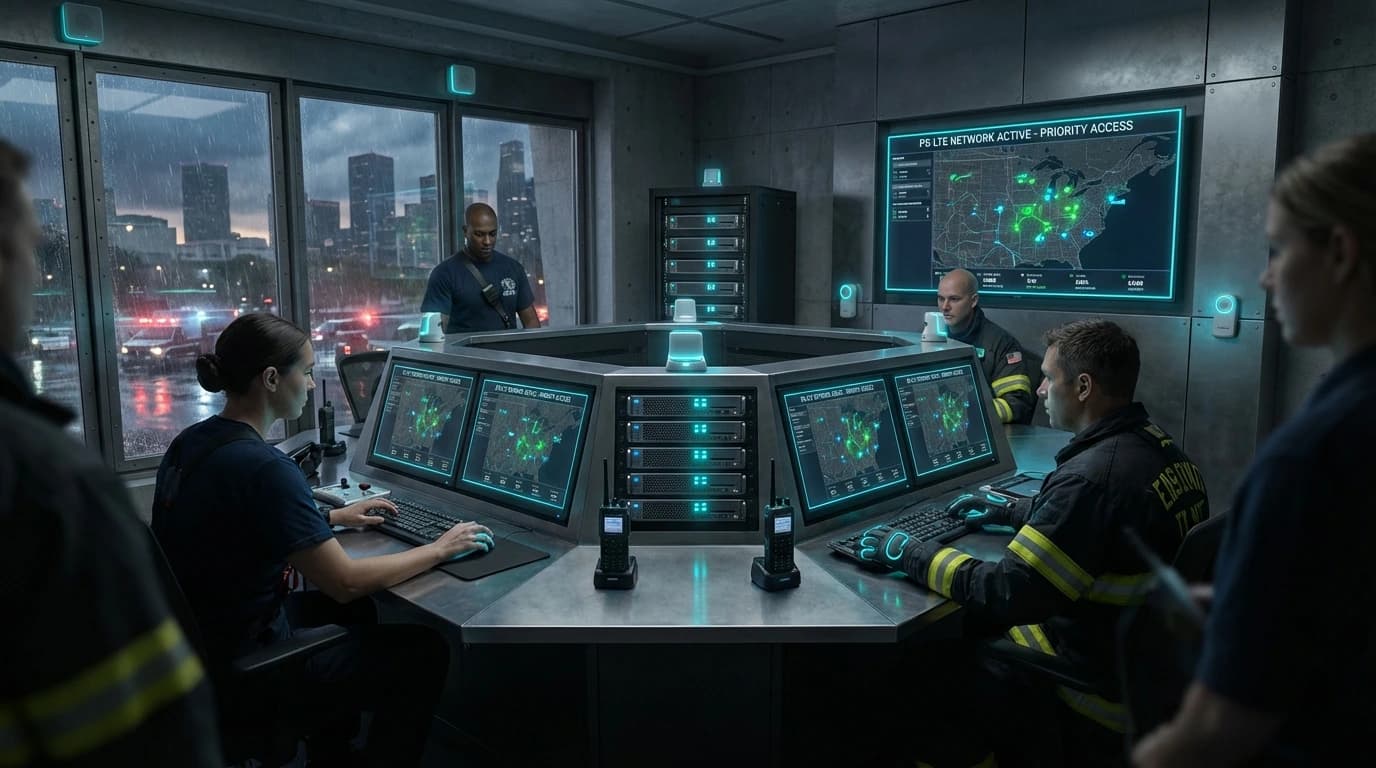
Emergency and Public Safety Networks, commonly known as PS-LTE (Public Safety Long-Term Evolution), represent a fundamental shift in how first responders communicate during critical incidents. Unlike commercial cellular networks that prioritise consumer traffic and can become congested or fail during emergencies, these dedicated systems are engineered specifically for mission-critical communications. The technology builds upon standard LTE and increasingly 5G infrastructure but incorporates hardened equipment, redundant power systems, and specialised protocols that ensure reliability when lives are at stake. Key technical features include quality-of-service guarantees that prioritise emergency traffic, push-to-talk functionality similar to traditional radio systems, and direct mode communication that allows devices to connect peer-to-peer when network infrastructure is unavailable. The networks also support rapid deployable units—portable cell sites that can be quickly transported to disaster zones to restore connectivity within hours rather than days.
The critical problem these networks address is the vulnerability of standard communication systems during the very moments when coordination is most essential. During major incidents such as hurricanes, earthquakes, or large-scale emergencies, commercial networks frequently become overloaded as civilians attempt to contact loved ones, or they may suffer physical damage to towers and fibre connections. This creates a dangerous communication gap precisely when police, fire, medical, and rescue personnel need reliable voice and data connectivity to coordinate response efforts, share situational awareness, and access critical databases. Traditional radio systems, while reliable, lack the bandwidth for modern needs such as streaming video from body cameras, accessing real-time building layouts, or coordinating multi-agency responses through shared applications. PS-LTE networks overcome these limitations by providing dedicated spectrum and infrastructure that remains operational and accessible exclusively to authorised emergency personnel, regardless of civilian network conditions.
Deployment of PS-LTE networks has accelerated globally over the past decade, with the United States' FirstNet programme representing one of the most comprehensive implementations, providing nationwide coverage for first responders. Similar initiatives have emerged across Europe, Asia, and other regions as governments recognise the strategic importance of resilient emergency communications. Beyond traditional disaster response, these networks are enabling new capabilities such as real-time video transmission from incident scenes, drone-based aerial surveillance during search and rescue operations, and integration with Internet of Things sensors that monitor infrastructure health. As climate change increases the frequency and severity of natural disasters, and as urban populations grow denser and more dependent on digital connectivity, the role of hardened public safety networks becomes increasingly vital. The ongoing evolution toward 5G-based public safety systems promises even greater capabilities, including ultra-low latency for remote medical procedures during transport and massive device connectivity for coordinating large-scale evacuations, positioning these networks as essential infrastructure for resilient communities.
The private partner selected to build and manage FirstNet, the US public safety network.
An independent authority within the U.S. Department of Commerce ensuring the deployment of the nationwide public safety broadband network.
Responsible for the Emergency Services Network (ESN), the UK's shift from Airwave (Tetra) to LTE.
A global leader in public safety and enterprise security.
A unit of Airbus Defence and Space providing advanced communication and collaboration solutions.

EE
United Kingdom · Company
The mobile network operator providing the 4G LTE infrastructure for the UK's Emergency Services Network.
Multinational telecommunications, information technology, and consumer electronics company.
Engineering company focusing on secure communications and medical technologies.
A global aerospace and defense technology innovator delivering end-to-end solutions.
Published forecasts about this technology, graded against what happened in Hindsight.
Public safety technology
This page is a narrower case of it.
Signals turns a topic into a sourced research record you can inspect and rerun. Your first scan is free, and this one starts with Emergency & Public Safety Networks (PS-LTE) already loaded, so edit it or scan as is.