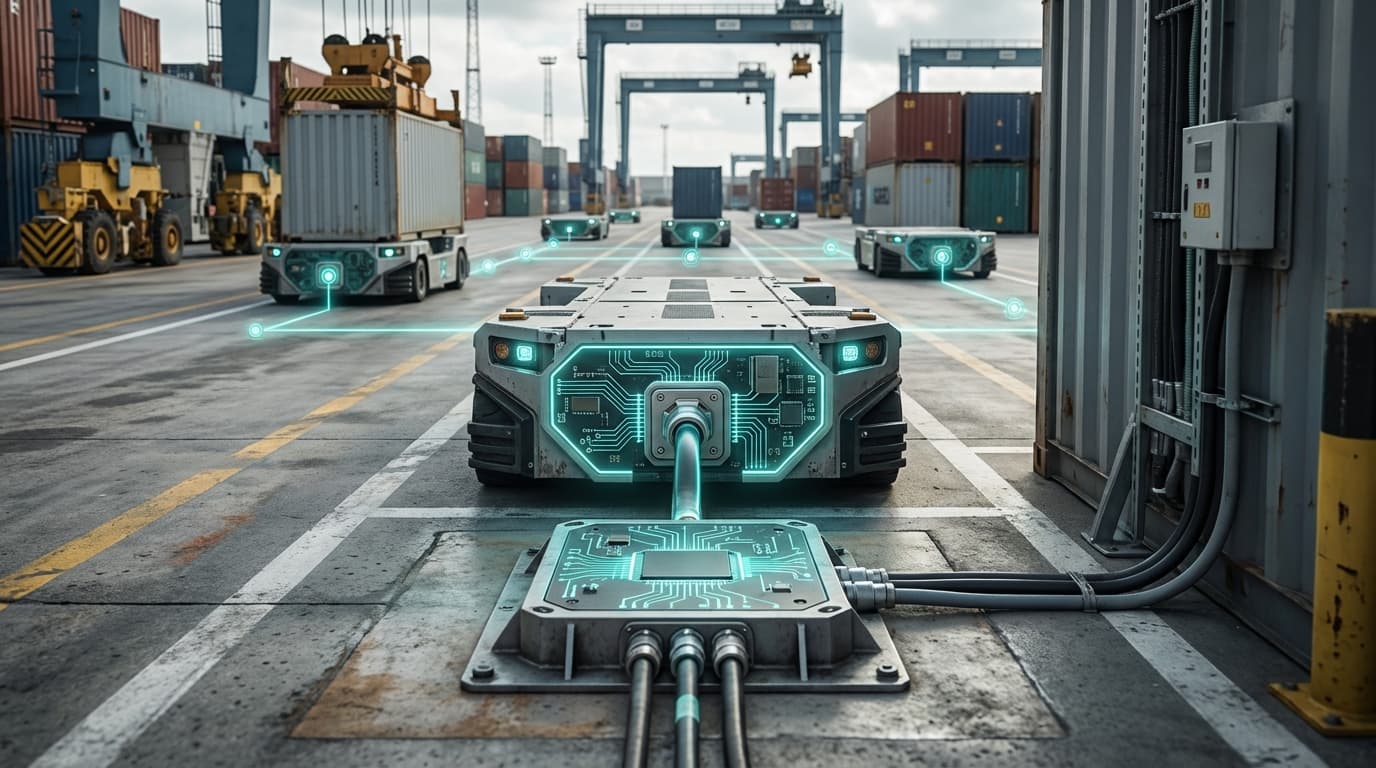
Machine-to-Machine Economic OS
A Machine-to-Machine Economic OS consists of protocols and software systems designed to coordinate fleets of autonomous vehicles, drones, sensors, or supply-chain robots through economic mechanisms, using microtransactions (small payments for services), congestion pricing (dynamic pricing based on demand), and shared incentives to facilitate cooperation and resource allocation among non-human economic actors. These systems enable machines to autonomously negotiate, pay for services, and coordinate activities while interoperating with legacy billing systems, energy grids, and enterprise resource planning (ERP) systems, creating an economic layer for the Internet of Things where machines can autonomously transact and coordinate.
This innovation addresses the need for coordination mechanisms in autonomous machine systems, where traditional centralized control may not scale. By using economic incentives, these systems can coordinate large fleets of autonomous machines. Companies and research institutions are developing these technologies.
The technology is particularly significant for enabling autonomous machine fleets, where economic coordination could enable new capabilities. As autonomous systems expand, economic coordination becomes increasingly important. However, ensuring security, managing complexity, and achieving interoperability remain challenges. The technology represents an important evolution toward autonomous machine coordination, but requires continued development to achieve the reliability and security needed for widespread use. Success could enable new models for autonomous machine coordination, but the technology must prove its security and reliability in real-world deployments.
Related Organizations

A platform for building and deploying autonomous agents that can communicate, negotiate, and work together across a decentralized network.

A Web3 network powering the Economy of Things (EoT) on Polkadot, enabling machines to render services and trade.
A network for building and running autonomous services (agents) that are co-owned and governed.

Develops the Tangle, a feeless distributed ledger specifically designed for the Internet of Things (IoT) data and value transfer.

Building a decentralized platform that connects real-world data from IoT devices to blockchain DApps.

A user-owned connected vehicle platform where drivers collect their car data and monetize it via a decentralized network.

Non-profit accelerating the energy transition using open-source digital technologies.

Steward of the Helium Network, a decentralized wireless infrastructure.

A decentralized data exchange protocol that allows data to be tokenized and sold while preserving privacy (Compute-to-Data).

Decentralized AI marketplace and developer of OpenCog Hyperon, a cognitive architecture for AGI.


Produces sensors and software connecting mobility, consumer goods, and industrial tech.
Supporting Evidence
Research this in Signals
Signals turns a topic into a sourced research record you can inspect and rerun. Your first scan is free, and this one starts with Machine-to-Machine Economic OS already loaded, so edit it or scan as is.