Envisioning is an emerging technology research institute and advisory.

LinkedInInstagramGitHub

2011 — 2026

research
  • Reports
  • Newsletter
  • Methodology
  • Origins
  • My Collection
services
  • Research Sessions
  • Signals Workspace
  • Bespoke Projects
  • Use Cases
  • Signal Scanfree
  • Readinessfree
impact
  • ANBIMAFuture of Brazilian Capital Markets
  • IEEECharting the Energy Transition
  • Horizon 2045Future of Human and Planetary Security
  • WKOTechnology Scanning for Austria
audiences
  • Innovation
  • Strategy
  • Consultants
  • Foresight
  • Associations
  • Governments
resources
  • Pricing
  • Partners
  • How We Work
  • Data Visualization
  • Multi-Model Method
  • FAQ
  • Security & Privacy
about
  • Manifesto
  • Community
  • Events
  • Support
  • Contact
  • Login
ResearchServicesPricingPartnersAbout
  1. Home
  2. Research
  3. Interface
  4. Real-Time Translation & Captioning

Real-Time Translation & Captioning

Instant speech translation and speaker-identified captions displayed on wearable devices
Back to InterfaceView interactive version

Real-time translation and captioning systems represent a convergence of automatic speech recognition, natural language processing, and neural machine translation technologies designed to eliminate language barriers in human communication. These systems operate by capturing spoken audio through microphones embedded in wearable devices or ambient environments, then processing this input through sophisticated AI models that transcribe speech into text, identify individual speakers, and translate content across languages—often supporting 89 or more language pairs. The technical achievement lies in achieving sub-second latency, meaning the delay between someone speaking and the translated text appearing is nearly imperceptible. This requires highly optimized neural networks that can handle the computational demands of simultaneous transcription and translation while accounting for diverse accents, regional dialects, background noise, and domain-specific terminology. Advanced implementations leverage edge computing architectures that run AI models directly on the device rather than relying on cloud connectivity, enabling offline functionality and reducing privacy concerns associated with transmitting conversations to remote servers.

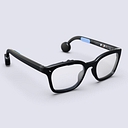
The primary challenge these systems address is the communication friction that exists in increasingly globalized contexts where people speaking different languages need to collaborate, conduct business, or access services. Traditional interpretation services are expensive, require advance scheduling, and create awkward communication delays that disrupt natural conversation flow. For accessibility applications, the technology solves a critical problem for deaf and hard-of-hearing individuals who previously relied on human captioners or struggled to follow fast-paced conversations in professional or social settings. When integrated into smart glasses or augmented reality headsets, translated text appears directly in the user's field of view, allowing them to maintain eye contact and natural body language while understanding foreign speech. This creates fundamentally new possibilities for international business negotiations, medical consultations with non-native speakers, educational settings with multilingual students, and tourism experiences where travelers can engage authentically with local communities without language constraints.

Early commercial deployments have emerged across several sectors, with international corporations piloting these systems for cross-border meetings and customer service applications. Tourism boards and hospitality providers are exploring wearable translation devices to enhance visitor experiences, while healthcare systems are testing the technology to improve communication with patients who speak minority languages. The technology builds on broader trends toward ambient computing and context-aware interfaces that anticipate user needs without requiring explicit commands. As neural translation models continue improving in accuracy and expanding language coverage—particularly for low-resource languages that historically lacked robust digital translation tools—these systems are positioned to become standard features in next-generation wearable devices. The trajectory points toward a future where language differences become increasingly transparent in daily interactions, fundamentally reshaping how humans collaborate across cultural and linguistic boundaries while simultaneously advancing accessibility for individuals with hearing impairments.


Technology Readiness Level
5/9Validated
Impact
3/5Medium
Investment
3/5Medium
Category
Software

Related Organizations

XRAI Glass logo
XRAI Glass

United Kingdom · Startup

98%

Develops software that turns AR smart glasses into real-time captioning devices for the deaf and hard of hearing.

Developer
Even Realities logo
Even Realities

China · Startup

95%

Develops the G1 digital glasses which feature a dedicated teleprompter and real-time translation display.

Developer
Timekettle logo
Timekettle

China · Company

92%

Hardware startup focusing on translation earbuds.

Developer
Brilliant Labs logo
Brilliant Labs

Singapore · Startup

90%

Creators of 'Frame', open-source AI glasses that include live translation capabilities powered by multimodal AI.

Developer
RayNeo logo
RayNeo

China · Startup

90%

An AR innovation brand (incubated by TCL) producing glasses like the X2 which feature live AI translation.

Developer
Solos logo
Solos

United States · Company

90%

Produces smart glasses (AirGo) integrated with ChatGPT for live translation and voice assistance.

Developer
Vuzix logo
Vuzix

United States · Company

88%

Supplier of smart glasses and Augmented Reality (AR) technologies.

Developer
DeepL logo
DeepL

Germany · Company

85%

Deep learning company specializing in language translation.

Developer
Speechmatics logo
Speechmatics

United Kingdom · Company

85%

Develops automatic speech recognition (ASR) technology capable of real-time transcription in many languages.

Developer

Supporting Evidence

Article

Speaking Our Languages: A Behind-the-Scenes Look at Live Translation on AI Glasses

Meta Quest Blog · Nov 14, 2025

Meta details the deployment of live translation features on Ray-Ban Meta glasses, supporting languages including English, French, German, Italian, Portuguese, and Spanish, marking a shift from prototype to consumer product.

Support 95%Confidence 100%

Article

Smart Glasses Translation Features: How Real-Time Language Tech Actually Works

RayNeo · Feb 16, 2026

Explains the integration of real-time translation technology into RayNeo smart glasses, highlighting the consumer availability of these features in 2026.

Support 89%Confidence 95%

Article

Real-time speech-to-speech translation

Google Research · Nov 19, 2025

Google Research introduces an end-to-end speech-to-speech translation model that achieves a 2-second delay, significantly improving over previous 4-5 second latencies and enabling more natural cross-language conversation.

Support 85%Confidence 100%

Connections

Software
Software
Emotion-Aware Translation AI

AI translation that preserves emotional tone and cultural context across languages

Technology Readiness Level
6/9
Impact
3/5
Investment
3/5
Software
Software
Voice-First AI Agents

Conversational AI systems that use natural language for hands-free interaction with devices and services

Technology Readiness Level
5/9
Impact
3/5
Investment
3/5

Book a research session

Bring this signal into a focused decision sprint with analyst-led framing and synthesis.
Research Sessions