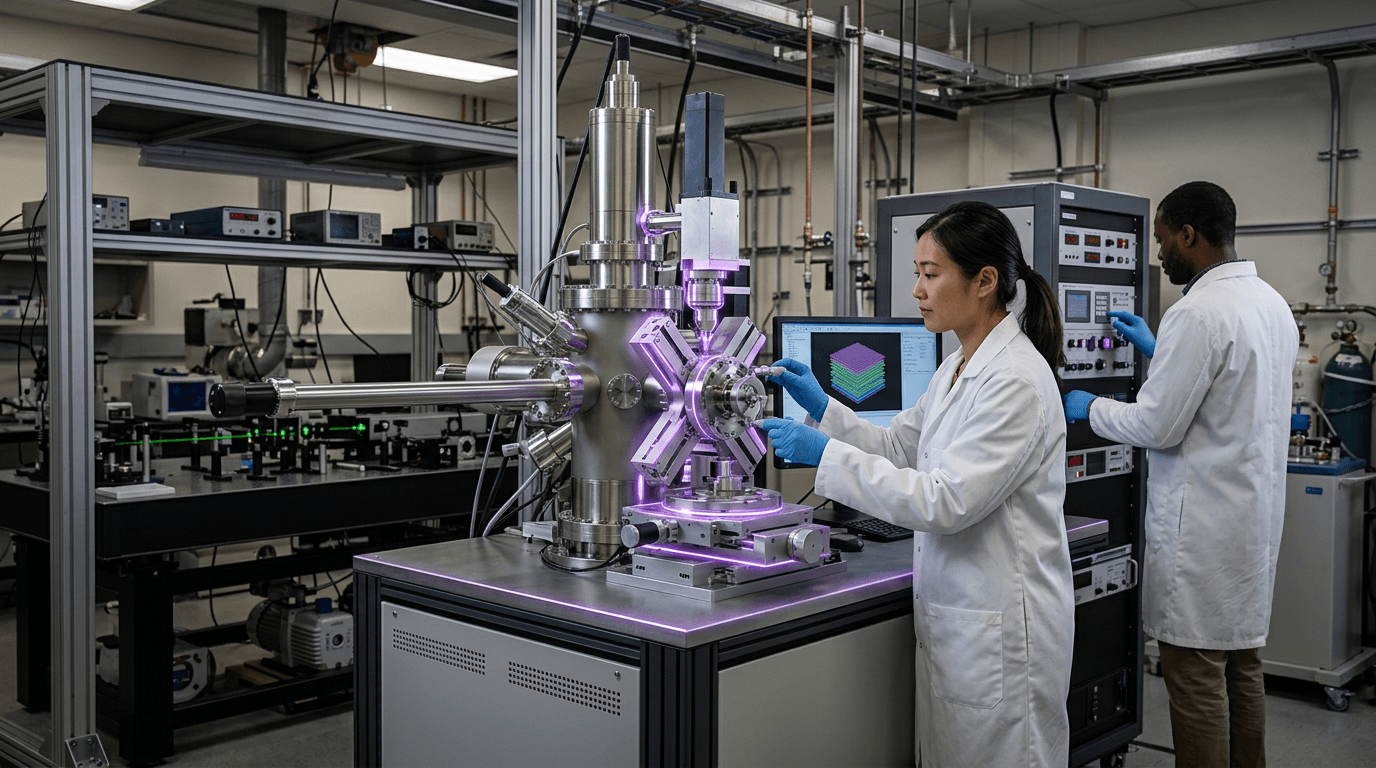
Twistronics
Twistronics exploits the twist angle between stacked two-dimensional materials—notably bilayer graphene—to control electronic properties. At certain "magic" angles (around 1.1° for twisted bilayer graphene), the material can exhibit correlated insulator and superconducting states, offering a tunable platform for exotic physics. The field emerged from observations of superconductivity and Mott insulation in twisted bilayer graphene in 2018. Applications could include tunable superconductors, topological phases, and novel electronic devices. Research remains largely fundamental; commercialization pathways are emerging.
Twistronics represents a new knob for materials design: twist angle, not only composition, determines electronic behavior. Significant challenges include reproducible fabrication of specific angles, scalability, and understanding the underlying physics. Research continues into other twisted 2D systems, magic-angle physics, and device integration. Twistronics is a rapidly evolving research frontier with potential for new electronic and quantum technologies.
Research this in Signals
Signals turns a topic into a sourced research record you can inspect and rerun. Your first scan is free, and this one starts with Twistronics already loaded, so edit it or scan as is.