


AI-Driven Spatial Biology Advances Precision Medicine
This page is a narrower case of it.
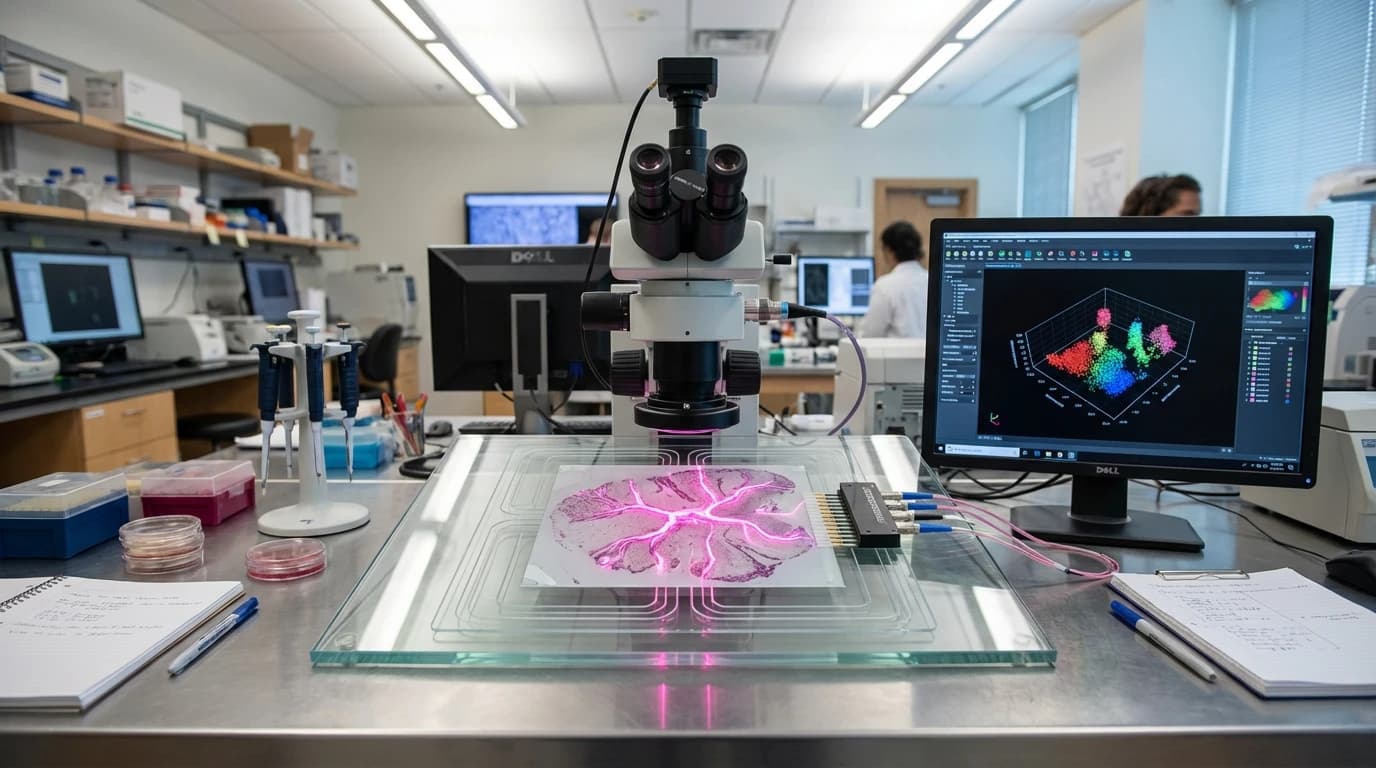
Spatial transcriptomics AI mapping uses deep learning pipelines that merge high-resolution histological imaging with RNA sequencing data to visualize gene expression patterns within the physical architecture of tissues, creating three-dimensional maps that show where specific genes are expressed in relation to tissue structure. This software enables researchers to map the 'cellular sociology' of complex tissue environments like tumor microenvironments or aging tissues, identifying localized drivers of processes like cellular senescence that bulk sequencing (which averages across entire samples) would miss, providing insights into how spatial organization affects biological processes.
This innovation addresses the limitation of traditional transcriptomics, where gene expression is measured in bulk samples without spatial context, losing important information about how location and cellular interactions affect gene expression. By preserving spatial information, these systems enable understanding of how tissue architecture and cellular neighborhoods influence biological processes. Companies like 10x Genomics, NanoString, and research institutions are developing these technologies.
The technology is particularly valuable for understanding complex tissues like tumors or aging organs, where spatial organization is critical to function and disease. As the technology improves, it could become standard for many types of tissue analysis. However, ensuring accuracy, managing data complexity, and integrating with existing workflows remain challenges. The technology represents an important advance in understanding tissue biology, but requires continued development to achieve the resolution and accuracy needed for all applications. Success could provide new insights into disease mechanisms and tissue biology, enabling better understanding of complex biological processes and potentially leading to new therapeutic approaches.
Market leader in spatial biology with the Visium and Xenium platforms for mapping gene expression in tissue context.
A biomedical and genomic research center that holds key patents for the use of CRISPR-Cas9 in eukaryotic cells.
United States · Company
Developer of the GeoMx Digital Spatial Profiler and CosMx Spatial Molecular Imager; acquired by Bruker.
A biotech company that uses federated learning to train AI models on distributed patient data without the data leaving hospitals.
Germany · Startup
Developers of the Molecular Cartography platform for high-resolution spatial transcriptomics.
United States · Startup
Commercializes MERSCOPE, a platform for MERFISH (Multiplexed Error-Robust Fluorescence in situ Hybridization) spatial transcriptomics.
Akoya Biosciences
United States · Company
Provides spatial biology solutions (PhenoCycler, PhenoImager) for high-parameter tissue analysis.
United States · Startup
Commercializes Slide-seq technology (Curio Seeker) for high-resolution spatial transcriptomics.
Germany · Research Lab
Intergovernmental research organization developing computational methods (e.g., MOFA, spatial analysis tools) for multi-omics.
United States · Company
Offers the Hyperion XTi Imaging System for spatial biology and high-plex imaging.
Published forecasts about this technology, graded against what happened in Hindsight.
AI-Driven Spatial Biology Advances Precision Medicine
This page is a narrower case of it.
Signals turns a topic into a sourced research record you can inspect and rerun. Your first scan is free, and this one starts with Spatial Transcriptomics AI Mapping already loaded, so edit it or scan as is.