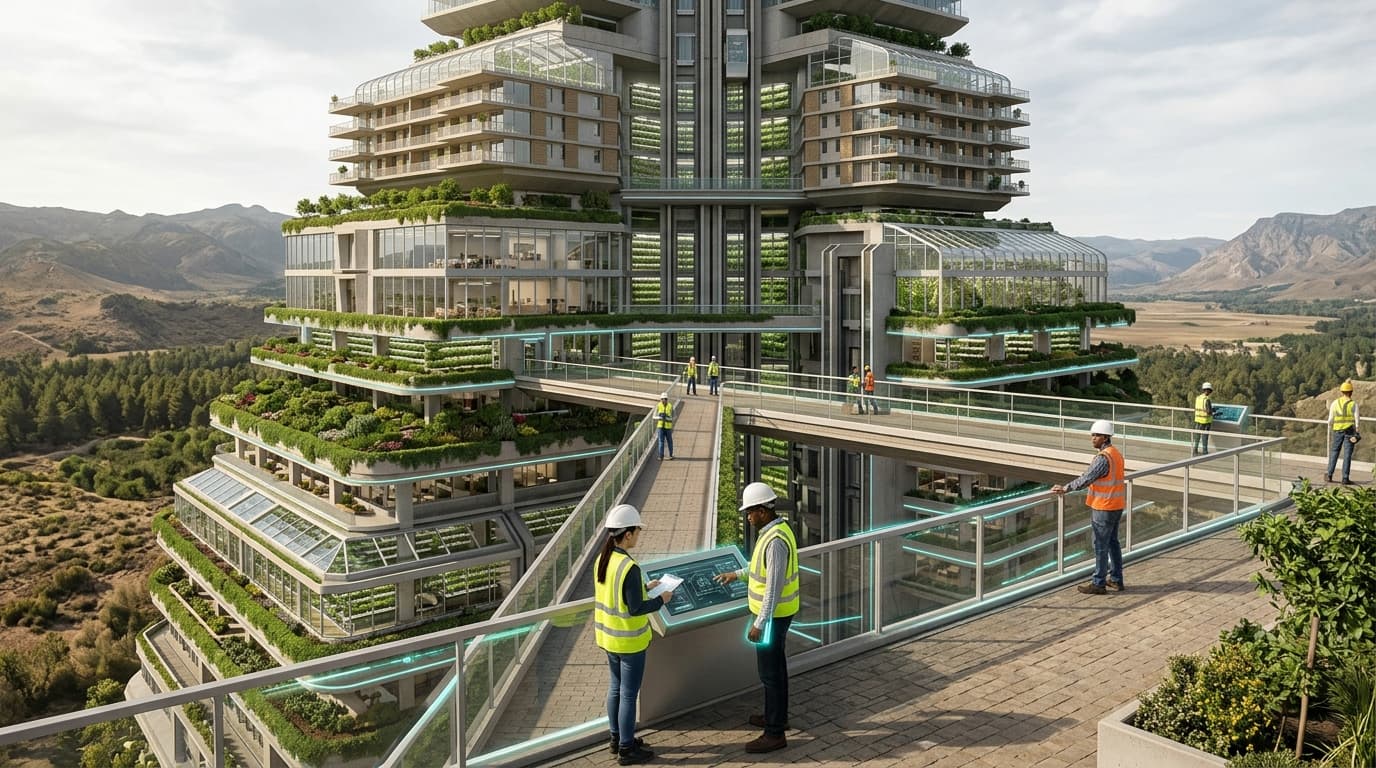
Arcology
Arcology—a portmanteau of "architecture" and "ecology"—describes hyper-dense, self-contained urban megastructures designed to house large populations within a single integrated building or complex. Pioneered by Paolo Soleri in the 1960s, the concept envisions vertical cities that minimize land use, internalize transportation, and integrate living, working, and agricultural functions in closed-loop systems. Arcology differs from conventional high-rises by emphasizing three-dimensional urbanism: mixed-use layers, internal transit, on-site food production, and resource recycling. Proposed benefits include dramatic reductions in per-capita energy use, elimination of automobile dependency, and preservation of surrounding land for wilderness or agriculture.
Urbanization faces mounting pressure from sprawl, traffic, and resource consumption. Arcology offers a theoretical alternative: compact, walkable environments where density enables efficiency. No full-scale arcology has been built; Arcosanti in Arizona remains an experimental prototype. Significant challenges include capital intensity, social acceptance of vertical living, fire and emergency egress at extreme scale, and the difficulty of creating genuinely self-sustaining systems. Research continues into modular construction for megastructures, integrated renewable energy and water recycling, and governance models for super-dense communities. As climate and housing pressures intensify, arcology persists as a provocative vision for sustainable hyper-urbanization, though realization remains decades away.
Research this in Signals
Signals turns a topic into a sourced research record you can inspect and rerun. Your first scan is free, and this one starts with Arcology already loaded, so edit it or scan as is.