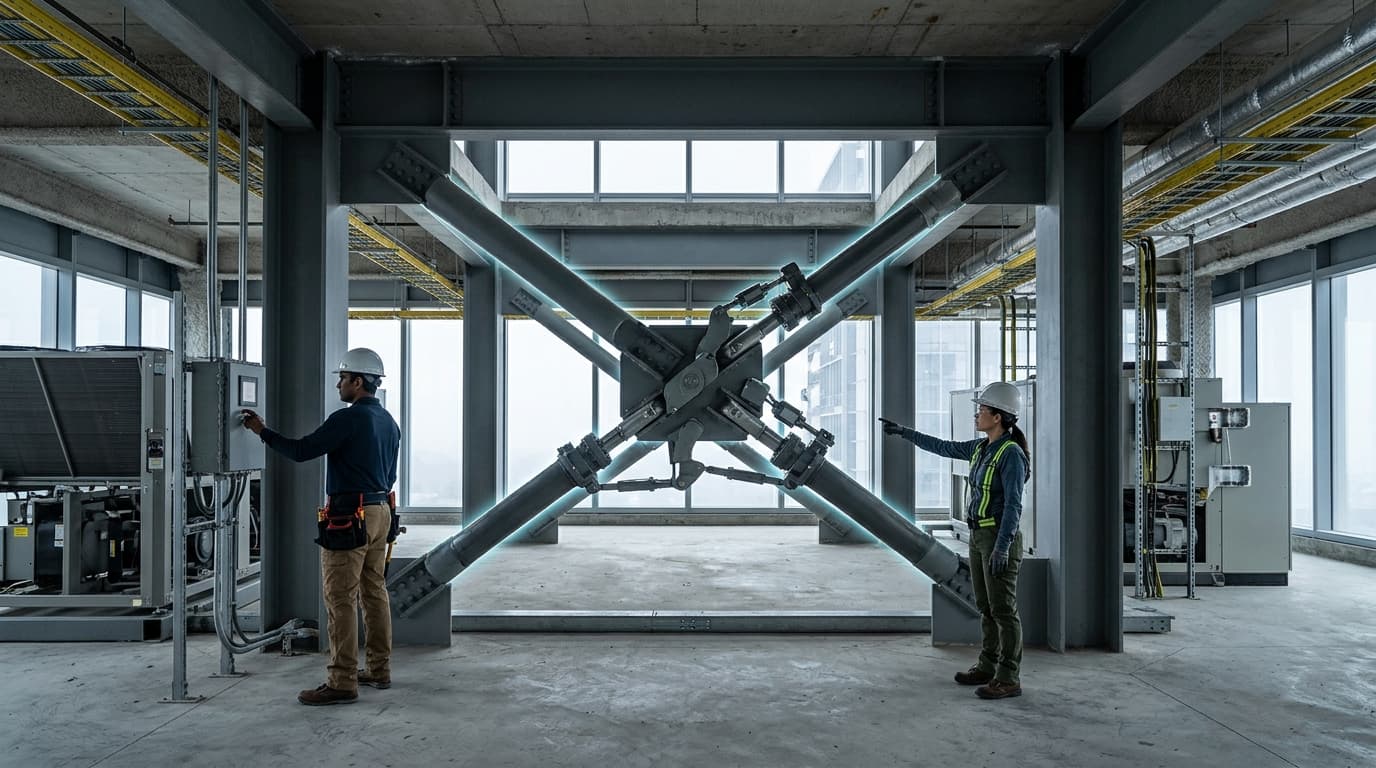
Active Structures
Active structures are buildings and infrastructure systems that dynamically respond to external conditions—wind, seismic loads, temperature, or occupancy—rather than relying solely on passive design. These systems incorporate sensors, actuators, and control algorithms to modify structural properties in real time, enabling lighter, more efficient designs and improved performance under variable loads. Applications range from adaptive façades that adjust solar shading to tuned mass dampers that reduce building sway, and extend to speculative concepts such as space fountains—structures that use continuously circulating streams of projectiles to support compressive loads, enabling extremely tall or massive structures. The technology draws from aerospace, robotics, and civil engineering to create structures that behave more like organisms than static objects.
The construction and aerospace sectors face persistent challenges in scaling built form: taller buildings require heavier frames, longer spans demand thicker members, and orbital structures face fundamental mass constraints. Active structures address these limits by shifting from static over-design to dynamic response, potentially reducing material use and enabling forms previously considered infeasible. Commercial adoption has begun in high-performance buildings and bridges where adaptive damping or bracing systems improve resilience. The more speculative concepts—space fountains, orbital rings, sky hooks—remain at TRL 2–3, requiring advances in materials, propulsion, and control. Research continues into integrated sensor-actuator networks, energy harvesting from structural motion, and control strategies that balance performance with reliability. As computational design and smart materials mature, active structures represent a frontier where buildings become responsive systems.
Research this in Signals
Signals turns a topic into a sourced research record you can inspect and rerun. Your first scan is free, and this one starts with Active Structures already loaded, so edit it or scan as is.