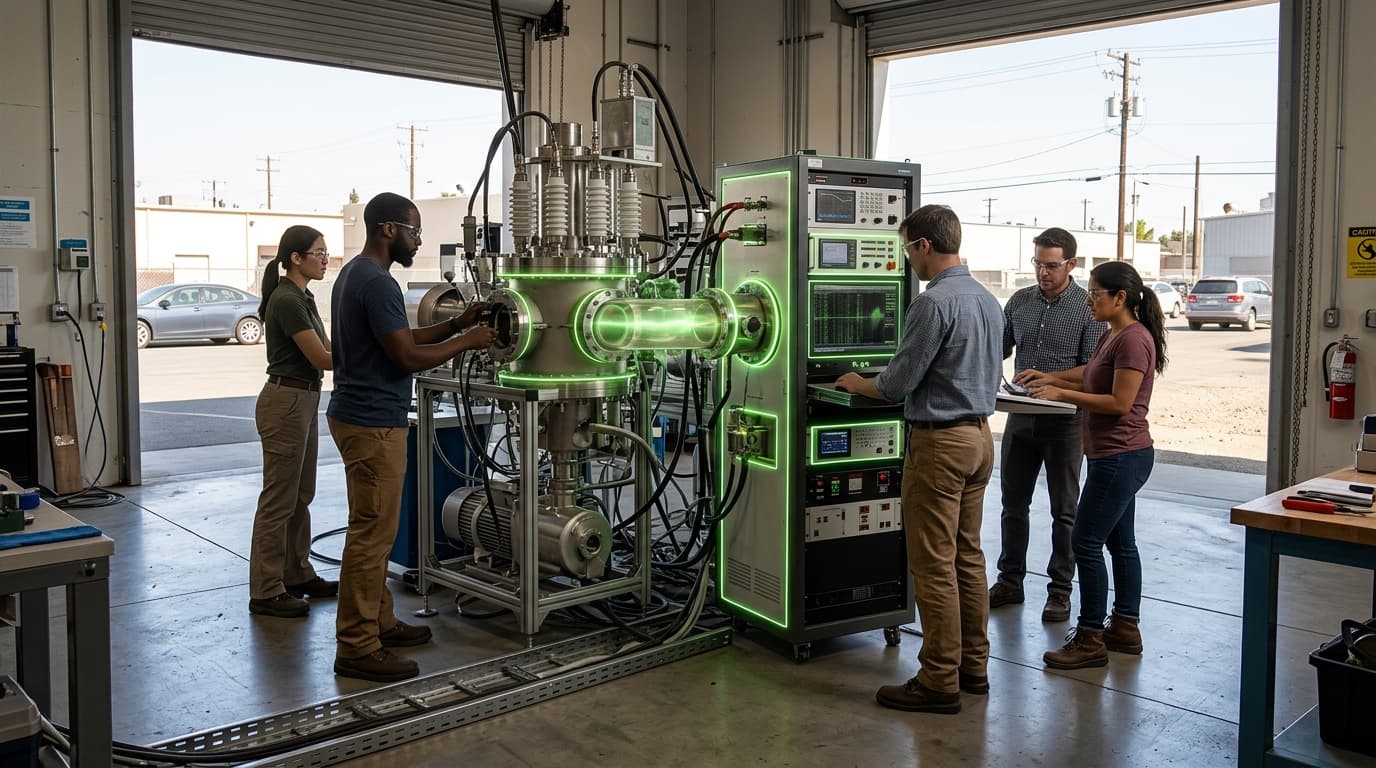
Sheared-Flow Z-Pinch Fusion
Geography: Americas · North America · United States
Zap Energy's approach to fusion uses a Z-pinch — an electrical current through plasma that creates a magnetic field that pinches the plasma into a dense, hot column. Traditional Z-pinch plasmas are inherently unstable, but Zap's innovation is 'sheared flow stabilization' — flowing plasma at different speeds at different radii to suppress instabilities, similar to how laminar flow stabilizes fluid dynamics.
The key advantage is simplicity: no superconducting magnets, no laser arrays, no external magnetic coils. The entire fusion system is relatively compact and could potentially be mass-manufactured. Zap Energy has raised over $200 million and is scaling its FuZE (Fusion Z-Pinch Experiment) to higher currents and temperatures approaching fusion conditions.
If Z-pinch fusion works at the required scale, it could offer the most economically viable path to fusion energy — a reactor small enough to be factory-built and deployed at industrial sites. The US-based company is one of the more unconventional fusion approaches receiving serious funding, representing the diversity of the American fusion ecosystem.
Research this in Signals
Signals turns a topic into a sourced research record you can inspect and rerun. Your first scan is free, and this one starts with Sheared-Flow Z-Pinch Fusion already loaded, so edit it or scan as is.