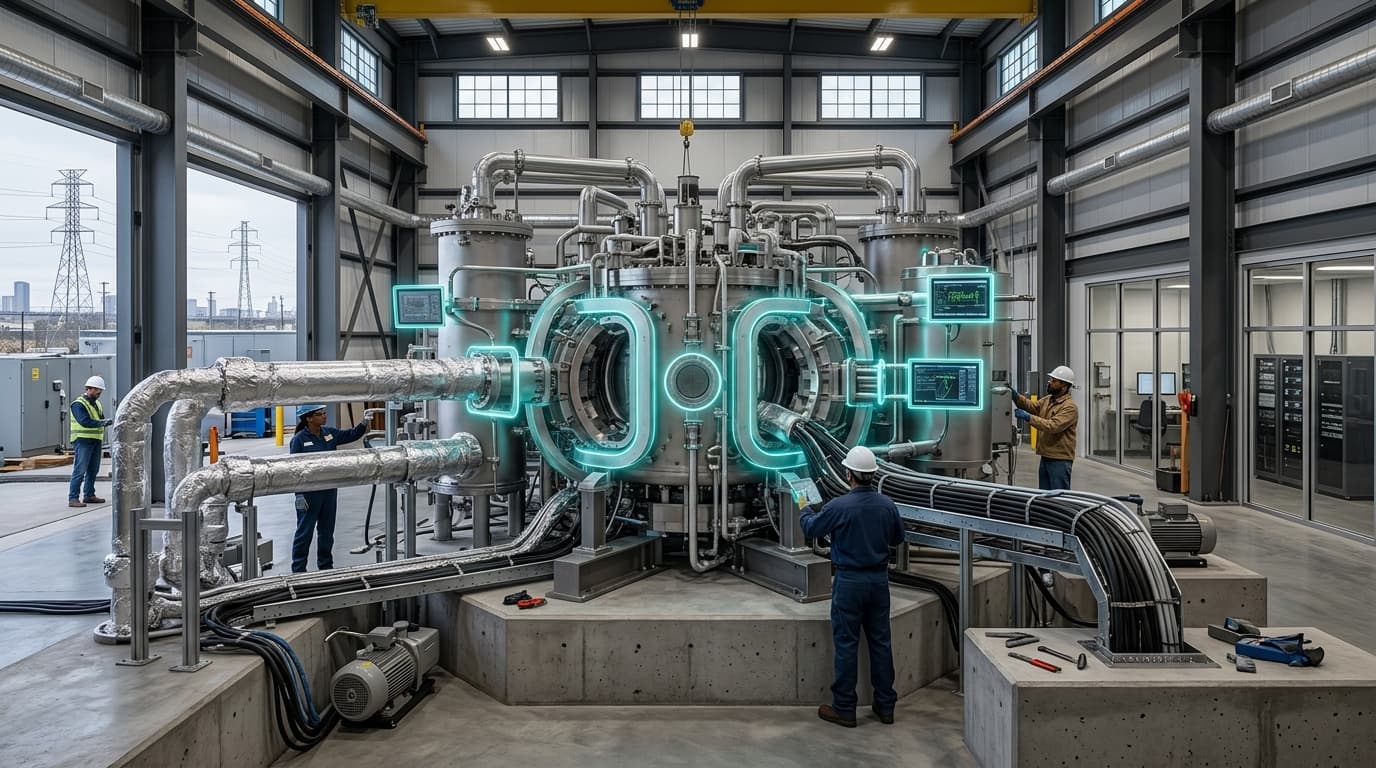
High-Temperature Superconducting Tokamak Fusion
Geography: Americas · North America · United States
Commonwealth Fusion Systems (CFS), spun out of MIT's Plasma Science and Fusion Center, is building SPARC — a compact tokamak designed to demonstrate net energy gain using high-temperature superconducting (HTS) magnets made from REBCO tape. These magnets generate far stronger magnetic fields than conventional superconductors, allowing the tokamak to be dramatically smaller and cheaper while achieving the same plasma conditions.
CFS demonstrated the world's most powerful HTS fusion magnet in 2021, validating the core physics. SPARC construction began in 2022 at Devens, Massachusetts, with operations expected by 2025-2026. The subsequent ARC/Da Vinci commercial reactor is designed to be grid-ready in the early 2030s, producing hundreds of megawatts of baseload power.
The HTS magnet breakthrough is significant beyond fusion: the same technology enables more compact MRI machines, particle accelerators, and power transmission cables. CFS has raised over $2 billion from investors including Bill Gates' Breakthrough Energy Ventures, Google, and Tiger Global. The tokamak approach has decades of physics validation behind it, making CFS arguably the most technically conservative fusion bet — and therefore one of the most credible.
Research this in Signals
Signals turns a topic into a sourced research record you can inspect and rerun. Your first scan is free, and this one starts with High-Temperature Superconducting Tokamak Fusion already loaded, so edit it or scan as is.