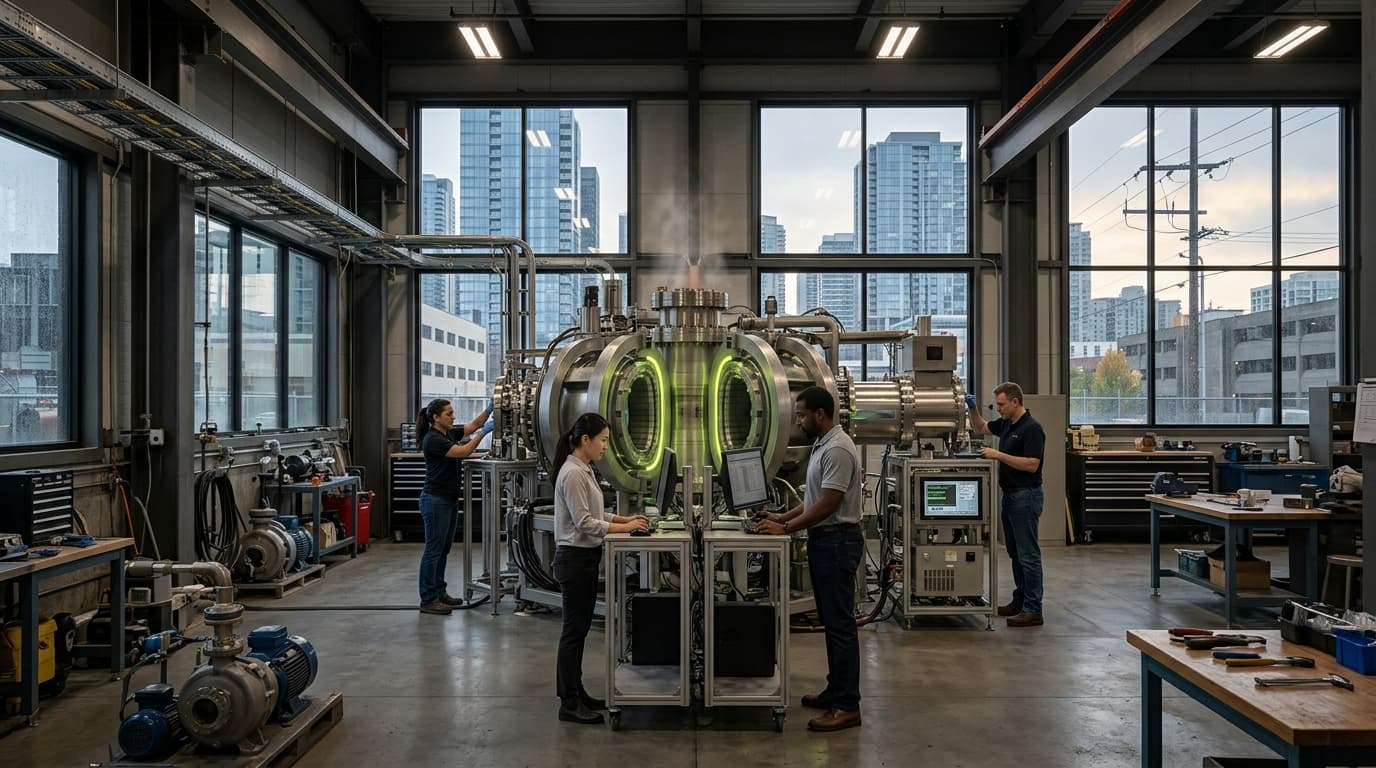
Compact Fusion Energy (Field-Reversed Configuration)
Geography: Americas · North America · United States
Helion Energy is pursuing fusion via field-reversed configuration (FRC), firing plasma rings from both ends of a linear chamber to collide and compress at the center. Unlike tokamak designs, Helion's approach is compact, pulsed, and designed for direct electricity conversion. Their Polaris prototype is the seventh-generation machine, and the company has broken ground on the Orion commercial plant. Helion uses deuterium-helium-3 fuel, which produces fewer neutrons than conventional fusion approaches.
Fusion energy would be transformative: essentially unlimited clean energy with no carbon emissions, no long-lived radioactive waste, and fuel derived from water. The private fusion sector has attracted over $10 billion in investment, with Helion alone raising over $1 billion plus $1.8 billion in milestone-linked commitments. Sam Altman serves as chairman, and Microsoft has signed a power purchase agreement for fusion electricity by 2028.
The competitive landscape includes Commonwealth Fusion Systems (tokamak with high-temperature superconducting magnets), TAE Technologies (proton-boron-11), and Zap Energy (sheared-flow Z-pinch). The US leads in private fusion investment but faces competition from Chinese state-backed programs. A working fusion reactor would reshape global energy geopolitics, potentially making hydrocarbon resources strategically irrelevant.
Research this in Signals
Signals turns a topic into a sourced research record you can inspect and rerun. Your first scan is free, and this one starts with Compact Fusion Energy (Field-Reversed Configuration) already loaded, so edit it or scan as is.