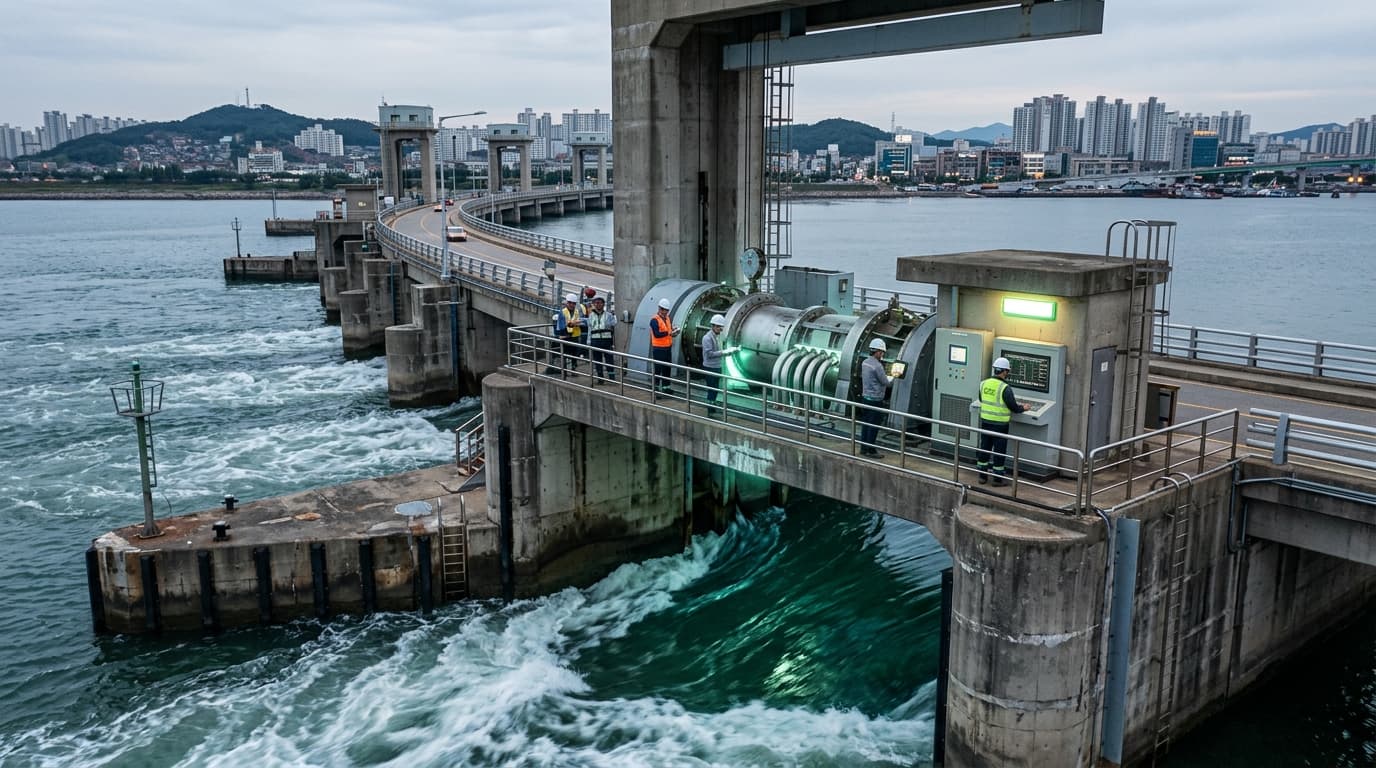
Tidal Barrage Power Generation
Geography: Asia Pacific · East Asia · South Korea
The Sihwa Lake Tidal Power Station in Ansan, completed in 2011, is the world's largest tidal power installation at 254 MW capacity, surpassing France's 240 MW Rance station that held the record for 45 years. The facility uses 10 submerged bulb turbines that generate electricity from tidal flows through a 12.7 km seawall on Korea's west coast, which has tidal ranges of 7-9 meters — among the highest in the world. The station also rehabilitated the previously polluted Sihwa Lake by restoring tidal water exchange.
Korea's west coast, with its deeply indented rias, wide tidal ranges, and many-sized inlets, represents one of the richest tidal energy resources globally. The government has invested in tidal current turbine prototypes and oscillating water column (OWC) wave power plants, allocating $6.9 million in 2024 specifically for developing green hydrogen production using ocean energy. Research institutes are developing pilot wave and tidal stream farms as part of a broader strategy to build coastal renewable electricity generation.
Tidal energy is one of the most predictable renewable energy sources — unlike wind and solar, tides follow exact astronomical cycles, making tidal power perfectly dispatchable. Korea's experience operating the world's largest tidal facility gives it unique operational data and engineering expertise. While tidal barrage technology itself is mature, Korea's next-generation ocean energy program targets combining tidal stream, wave, and offshore wind technologies in integrated coastal energy farms — a concept that leverages the shipbuilding industry's offshore engineering capabilities.
Research this in Signals
Signals turns a topic into a sourced research record you can inspect and rerun. Your first scan is free, and this one starts with Tidal Barrage Power Generation already loaded, so edit it or scan as is.