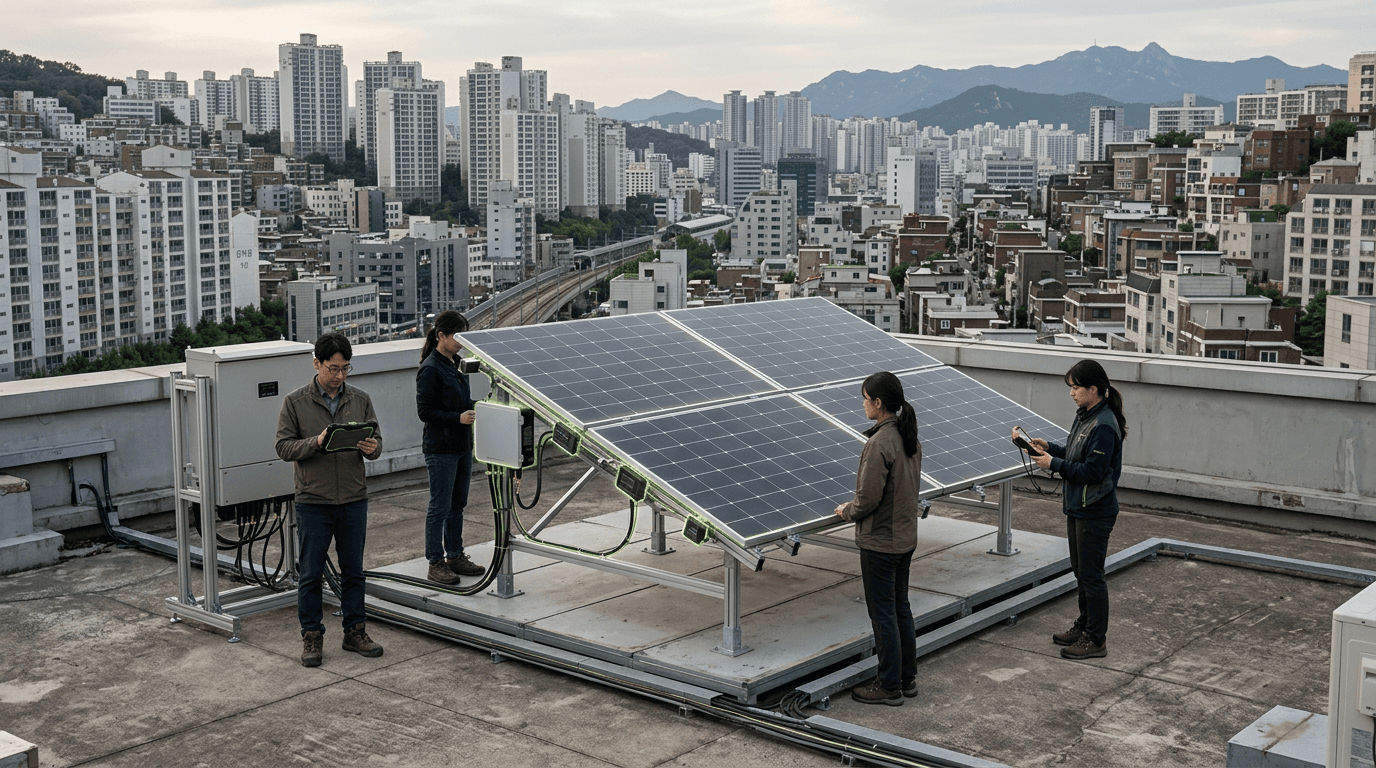
Perovskite-Silicon Tandem Solar Cells
Geography: Asia Pacific · East Asia · South Korea
Hanwha Qcells set a world record of 28.6% conversion efficiency on full-area M10-sized perovskite-silicon tandem solar cells — the first time this efficiency level was achieved on an industry-standard wafer format rather than a small lab sample. The result, independently verified by Fraunhofer ISE, demonstrates that perovskite-silicon tandems can be manufactured at commercial scale. Meanwhile, UNIST (Ulsan National Institute of Science and Technology) continues to push single-junction perovskite efficiency records and has published breakthrough work on perovskite stability, the technology's Achilles heel.
Perovskite-silicon tandems layer a perovskite absorber on top of a conventional silicon cell, with each layer capturing different parts of the solar spectrum. The theoretical efficiency limit (~43%) far exceeds silicon alone (~29%), and practical cells are already beating the best single-junction silicon panels commercially available. The challenge is durability — perovskite materials degrade when exposed to moisture, heat, and UV light. Korean researchers are addressing this through encapsulation innovation and novel perovskite compositions with improved intrinsic stability.
The Korean government allocated KRW 33.6 billion ($22.8 million) for perovskite-silicon tandem R&D, targeting 28%-efficient commercial modules by 2030. Hanwha Qcells is uniquely positioned as both a record-setting research institution and one of the world's largest solar manufacturers (with major factories in Korea, Malaysia, and Georgia, USA), giving it a direct path from lab to gigawatt-scale production. If Korean companies commercialize tandems first, they could leapfrog Chinese dominance in conventional silicon panels.
Research this in Signals
Signals turns a topic into a sourced research record you can inspect and rerun. Your first scan is free, and this one starts with Perovskite-Silicon Tandem Solar Cells already loaded, so edit it or scan as is.