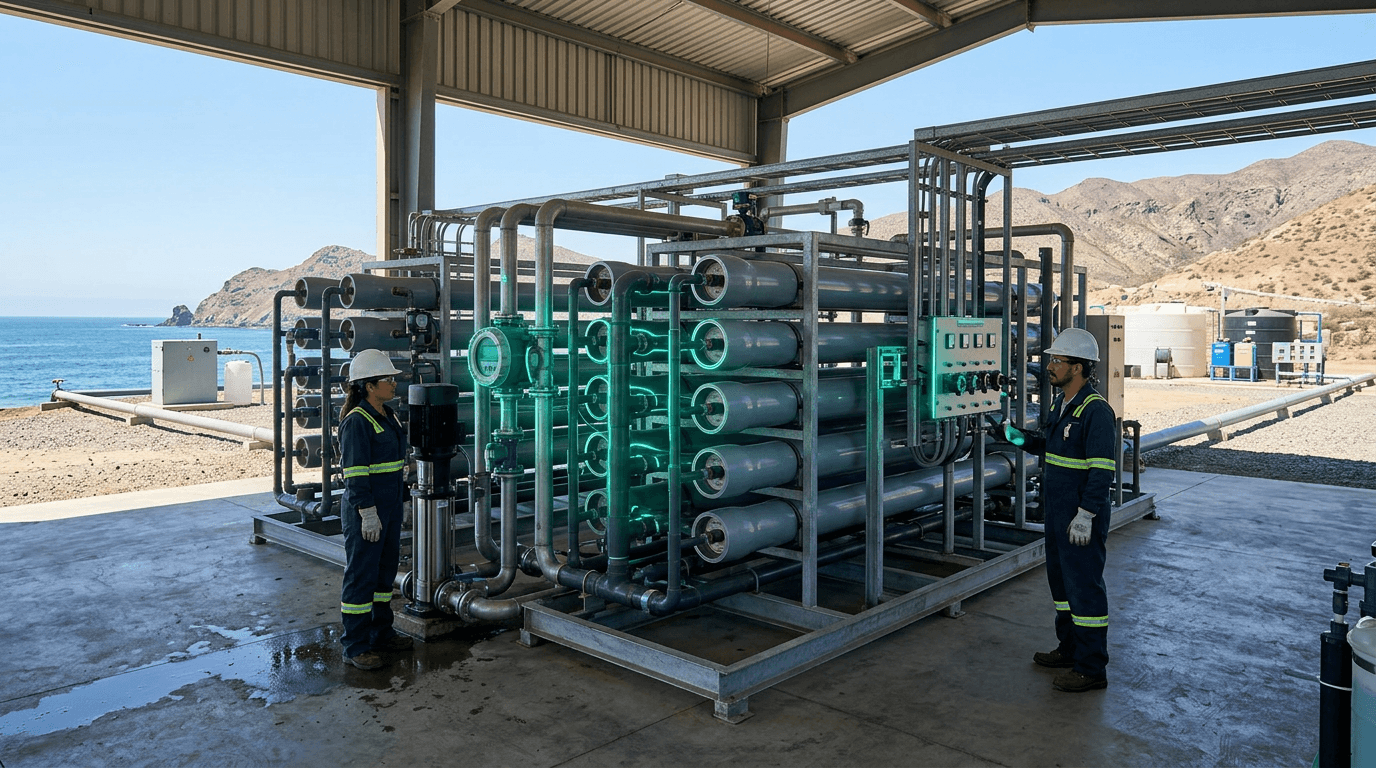
Seawater & Brackish Water Desalination
Geography: Americas · South America · Latin America
Northern Mexico faces a severe water crisis: aquifer depletion, climate change-driven drought, and population growth in cities like Monterrey, Tijuana, and Hermosillo are creating existential water stress for over 30 million people. Reverse osmosis desalination — both seawater desalination for coastal cities and brackish water treatment for inland areas — is emerging as a critical technology. Baja California operates desalination plants that supplement municipal water supplies, with expansion planned to address growing demand.
The technology challenge is energy cost: desalination is energy-intensive (3-5 kWh per cubic meter for seawater RO), which in Mexico's grid translates to significant operating expenses. Innovation focuses on energy recovery devices that capture pressure from the brine reject stream, solar-powered desalination leveraging northern Mexico's abundant irradiance, and membrane technology improvements that reduce fouling and extend operational life.
Water security is arguably Mexico's most critical infrastructure challenge of the next decade. The 2022 Monterrey water crisis — when the country's second-largest city faced weeks of rationing — demonstrated the vulnerability. Desalination technology, coupled with water reuse and smart distribution systems, represents the technological response to a problem that climate change will only intensify. The investment required is massive, but the alternative — chronic water shortages in Mexico's industrial heartland — is economically devastating.
Research this in Signals
Signals turns a topic into a sourced research record you can inspect and rerun. Your first scan is free, and this one starts with Seawater & Brackish Water Desalination already loaded, so edit it or scan as is.