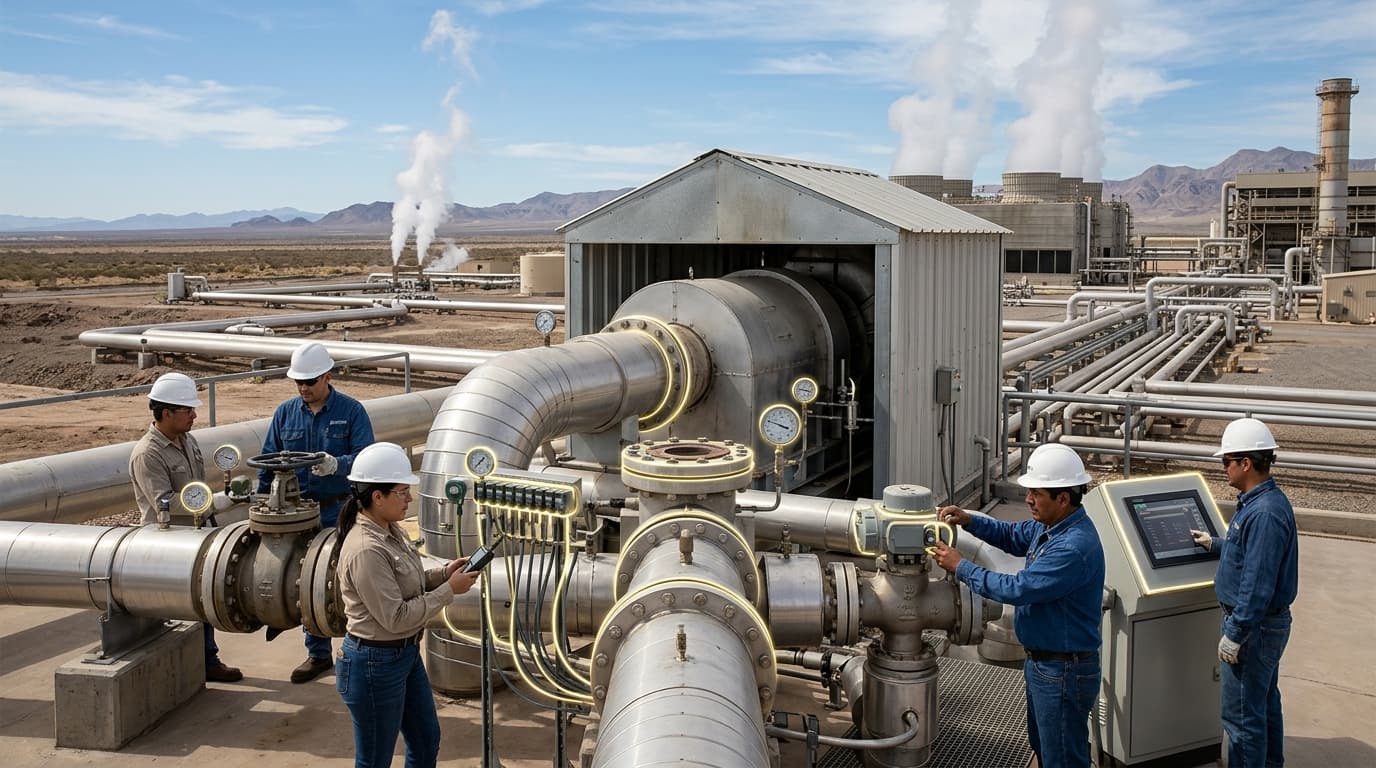
Cerro Prieto Geothermal Complex
Geography: Americas · South America · Latin America
The Cerro Prieto Geothermal Power Station, located in the Mexicali Valley of Baja California, is one of the largest geothermal electricity generation complexes on Earth. Operated by CFE (Comisión Federal de Electricidad), the complex comprises five units built between 1973 and 2000, with a total installed capacity of approximately 720 MW and an effective operating capacity around 570 MW. The facility taps into a liquid-dominated hydrothermal reservoir at depths of 1,500–3,000 meters, exploiting the tectonic activity along the boundary between the Pacific and North American plates.
Cerro Prieto's significance extends beyond its raw capacity. It demonstrated that large-scale geothermal development was commercially viable in developing countries, establishing Mexico as a global leader in geothermal energy — the country ranks fourth worldwide in installed geothermal capacity. The complex provides baseload renewable power to the Baja California grid, displacing fossil fuel generation in a region with limited hydroelectric resources. Scientific studies suggest the reservoir could support expansion to over 1,300 MW with proper reinjection management, though reservoir pressure decline has been a persistent challenge.
Strategically, Cerro Prieto represents both a proven asset and a cautionary tale. The facility's declining output from some older units highlights the importance of reservoir stewardship — lessons now being applied across Mexico's geothermal portfolio, including newer sites in Michoacán and Puebla. As Mexico seeks to increase its renewable energy share while maintaining energy sovereignty under CFE's state-controlled model, geothermal remains a uniquely controllable baseload resource that doesn't depend on weather or imported technology.
Research this in Signals
Signals turns a topic into a sourced research record you can inspect and rerun. Your first scan is free, and this one starts with Cerro Prieto Geothermal Complex already loaded, so edit it or scan as is.