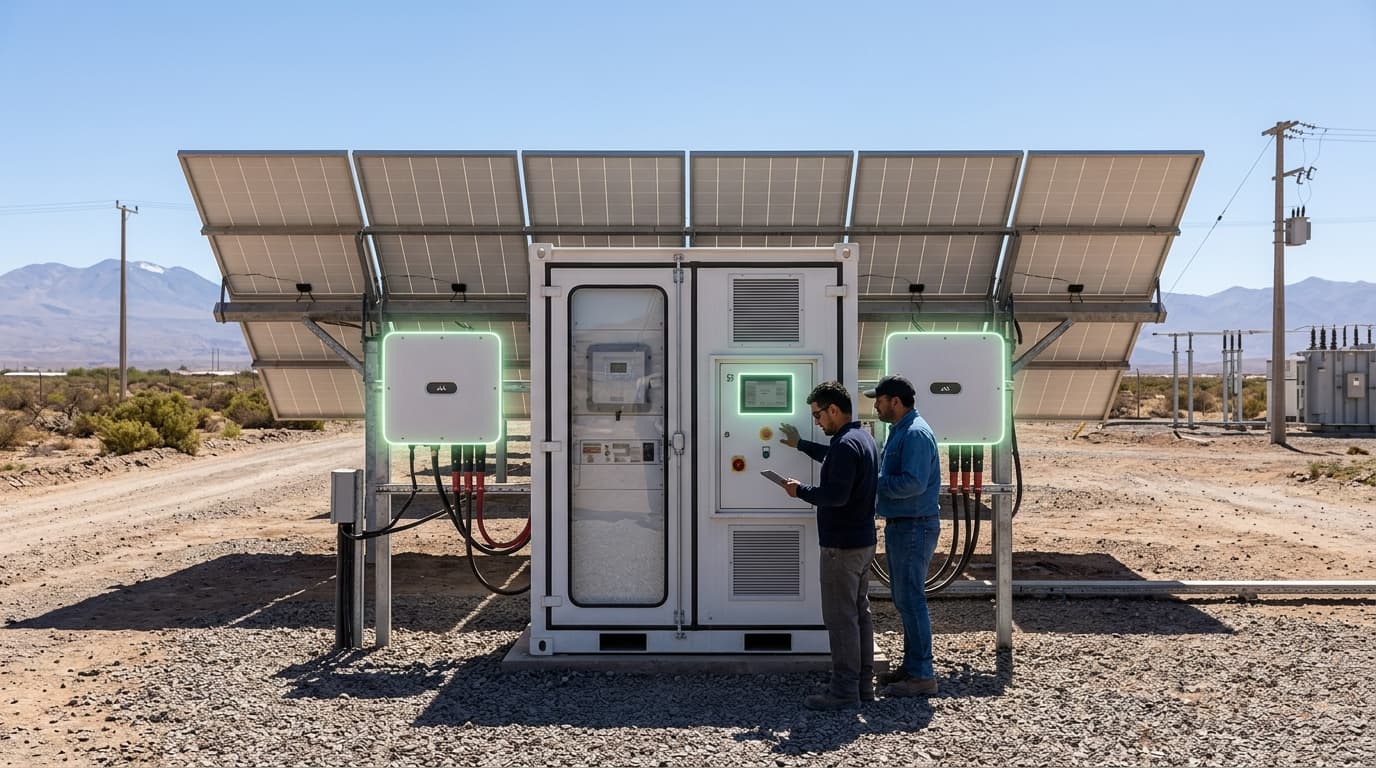
Utility-Scale Solar PV with Battery Storage
Geography: Americas · South America · Latin America
Chile has become one of the world's most aggressive deployers of utility-scale solar photovoltaics paired with lithium iron phosphate (LFP) battery storage. The Atacama Desert's extraordinary solar irradiance — over 3,500 kWh/m²/year, among the highest on Earth — makes solar the cheapest form of electricity generation in Chile. By early 2025, the first phases of major PV-plus-storage projects (Quillagua and Víctor Jara) were being tested, combining hundreds of megawatts of PV with gigawatt-hour-scale battery systems.
The technology integration is sophisticated: bidirectional inverters manage the flow between PV arrays, battery banks, and the grid; energy management systems optimize charge/discharge cycles based on spot electricity prices, weather forecasts, and grid frequency signals; and modular container-based battery installations allow capacity to be added incrementally. Chile's LFP battery deployments benefit from the technology's superior cycle life and thermal stability in desert conditions.
Chile far exceeded its goal of 20% renewable generation by 2025, already surpassing 40%. The technical challenge has shifted from generation to transmission and storage: how to move solar power from the northern desert to demand centers in Santiago and the mining regions, and how to store enough energy to maintain reliability through cloudy periods and nighttime demand peaks. Chile's experience with large-scale PV-storage integration provides a real-world proving ground for technologies that the entire global energy transition depends on.
Research this in Signals
Signals turns a topic into a sourced research record you can inspect and rerun. Your first scan is free, and this one starts with Utility-Scale Solar PV with Battery Storage already loaded, so edit it or scan as is.