Concentrated Solar Power with Thermal Storage
Geography: Americas · South America · Latin America
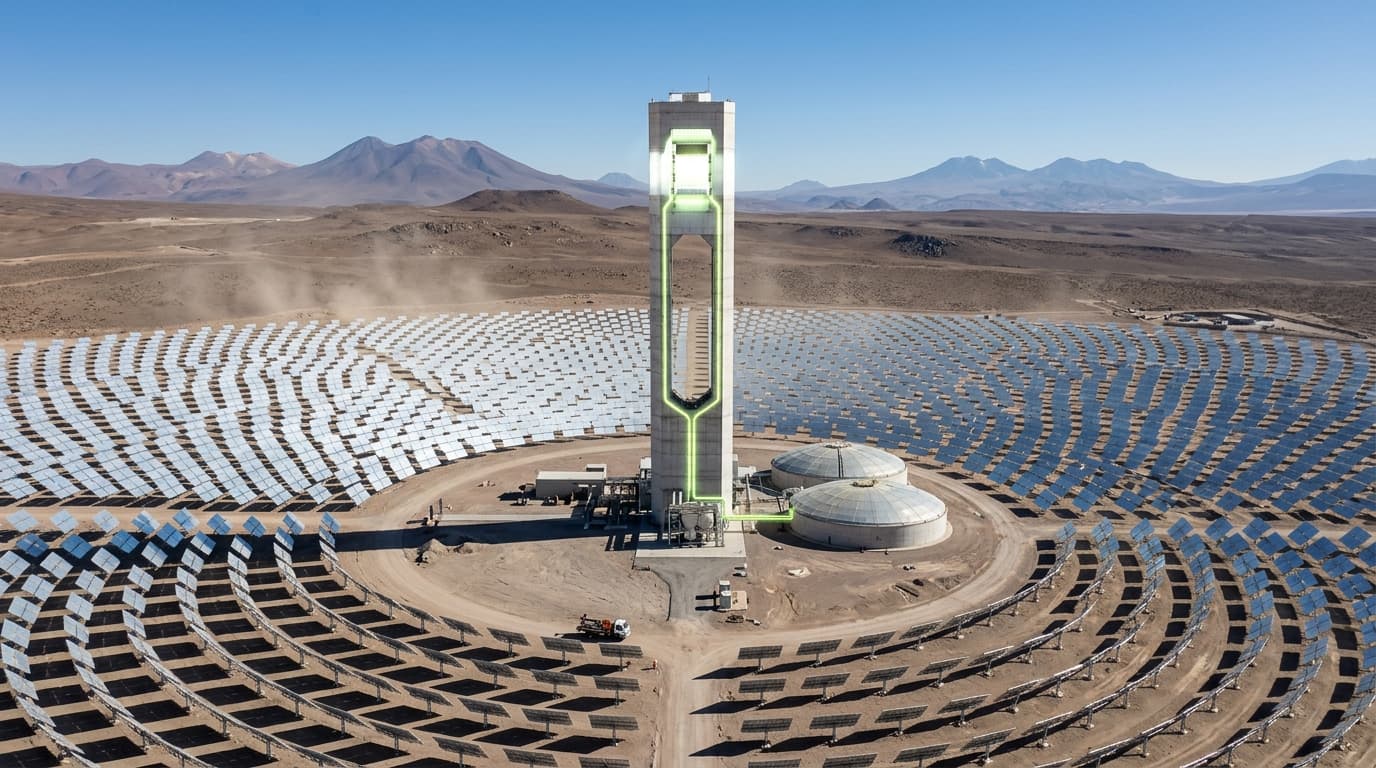
Chile's Cerro Dominador project, located in the Atacama Desert's Antofagasta region, is South America's first concentrated solar power (CSP) plant — a 110 MW solar tower that uses thousands of heliostats to focus sunlight onto a central receiver, heating molten salt to 565°C. The thermal storage enables 17.5 hours of electricity generation without sunlight, making it effectively a 24/7 dispatchable solar power plant. Combined with an adjacent 100 MW photovoltaic array, the total complex delivers 210 MW.
The Atacama Desert offers the world's highest direct normal irradiance (DNI) — over 3,500 kWh/m²/year — making it the optimal location on Earth for CSP technology. The Oasis de Atacama complex is expanding further, with a third phase adding 231 MW of solar capacity and 1.3 GWh of storage, expected to be fully operational in late 2025. When all seven planned phases are complete, it will be Latin America's largest solar complex.
CSP's strategic value lies in dispatchability — unlike photovoltaic solar, which drops to zero at sunset, CSP with thermal storage can deliver power on demand. This makes it directly competitive with natural gas peaker plants and essential for grid stability as Chile approaches 100% renewable electricity. The technology is more expensive per watt than PV, but the storage is dramatically cheaper than batteries at multi-hour durations. Chile's CSP experience is being studied by countries across the sunbelt as a model for renewable baseload power.
Research this in Signals
Signals turns a topic into a sourced research record you can inspect and rerun. Your first scan is free, and this one starts with Concentrated Solar Power with Thermal Storage already loaded, so edit it or scan as is.