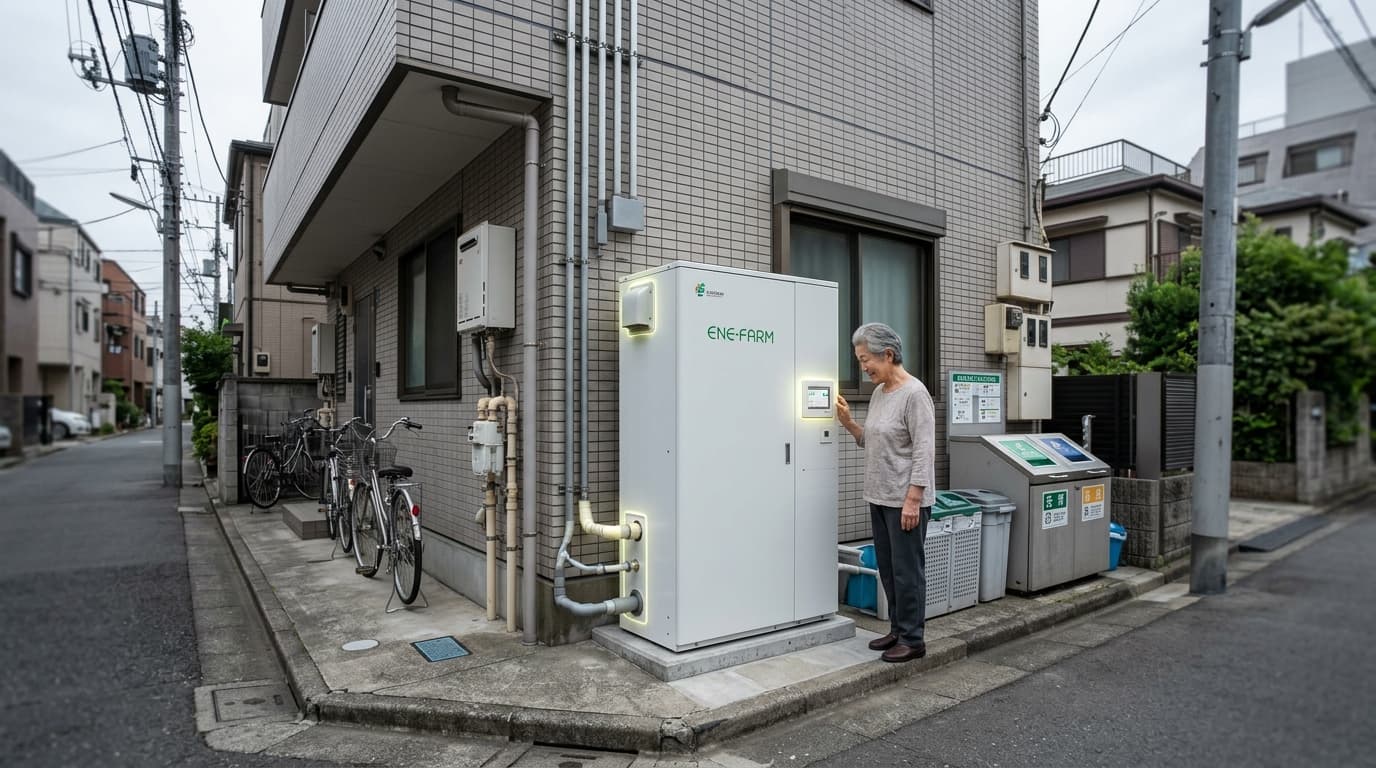
Residential Fuel Cell Cogeneration (ENE-FARM)
Geography: Asia Pacific · East Asia · Japan
Japan's ENE-FARM is the world's first and only mass-deployed residential fuel cell cogeneration system, with over 500,000 units installed in Japanese homes since its 2009 commercial launch. Manufactured by Panasonic (PEFC type) and Aisin/Kyocera (SOFC type), ENE-FARM extracts hydrogen from city gas (natural gas) and generates electricity and heat simultaneously, achieving up to 97% total energy efficiency. Each unit produces approximately 700W of electricity and enough hot water for a typical Japanese household, reducing CO2 emissions by about 1.3 tonnes per year compared to grid electricity plus gas water heating.
The technology represents a uniquely Japanese approach to distributed energy: rather than relying on centralized grid decarbonization alone, ENE-FARM turns each home into a micro power plant. The units are installed by gas utilities (Tokyo Gas, Osaka Gas) as part of their service offering, creating an integrated energy management ecosystem. Japan's gas infrastructure — 30 million gas-connected households — provides the distribution channel. The latest SOFC models operate at 55% electrical efficiency, approaching the performance of utility-scale gas turbines but at household scale.
While ENE-FARM has not achieved export success (due to the unique Japanese gas distribution model), the underlying technology — compact, efficient fuel cell stacks for distributed generation — is foundational for the hydrogen economy. The manufacturing experience from 500,000+ units has driven fuel cell costs down by over 80% since 2009, creating a technology learning curve that benefits Toyota's automotive fuel cells, Panasonic's commercial fuel cell systems, and Japan's broader hydrogen strategy. ENE-FARM proves that fuel cells can be reliable, long-lived consumer products — not just laboratory demonstrations.
Research this in Signals
Signals turns a topic into a sourced research record you can inspect and rerun. Your first scan is free, and this one starts with Residential Fuel Cell Cogeneration (ENE-FARM) already loaded, so edit it or scan as is.