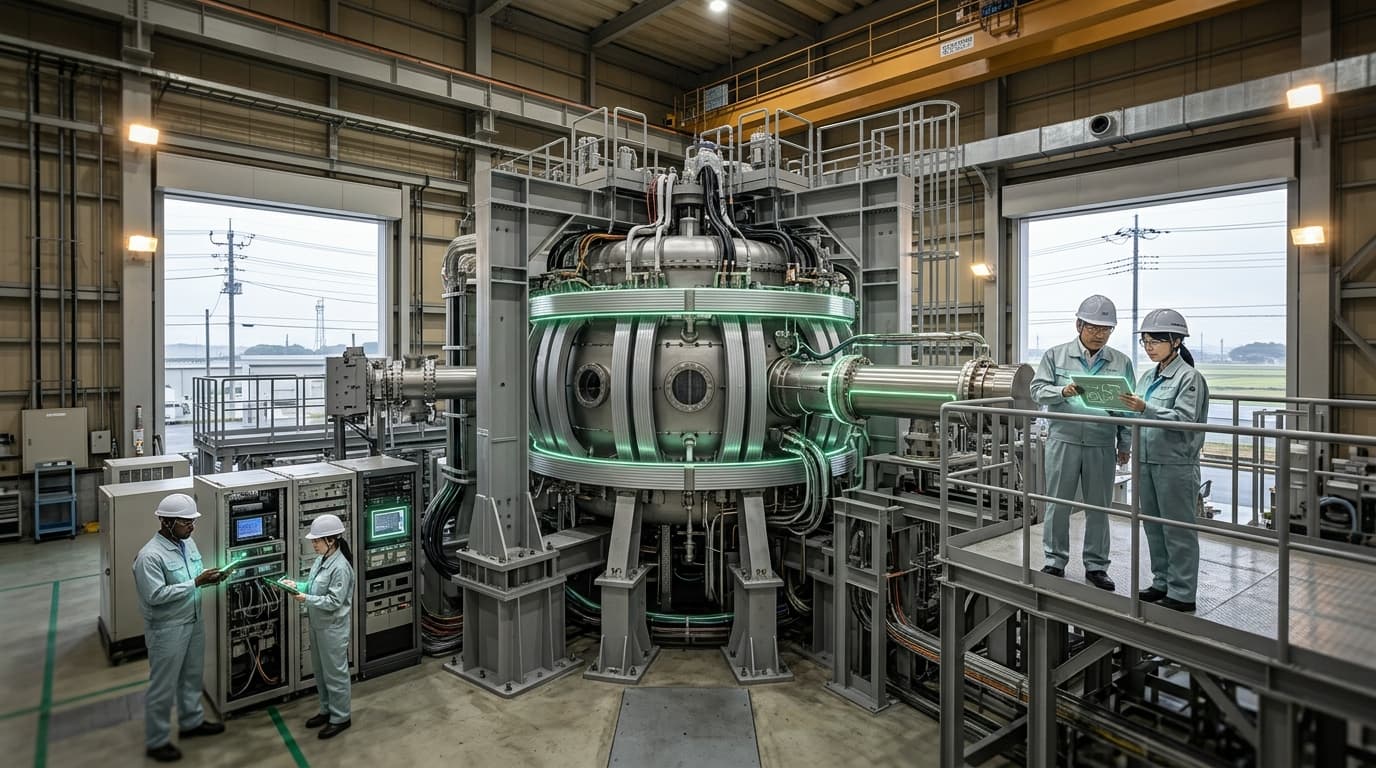
Fusion Research (JT-60SA Tokamak)
Geography: Asia Pacific · East Asia · Japan
JT-60SA, located at the National Institutes for Quantum Science and Technology (QST) in Naka, is the world's largest superconducting tokamak fusion device and the flagship of the Japan-EU Broader Approach Agreement supporting ITER. The device achieved first plasma in October 2023 and is undergoing upgrades for full deuterium experiments beginning in 2026. JT-60SA is designed to investigate plasma configurations and operating scenarios for both ITER and future fusion power plants.
Japan's fusion research program is among the world's oldest and most comprehensive, dating to the JT-60 device in 1985. The upgrade to JT-60SA incorporated superconducting magnets (niobium-titanium and niobium-tin), achieving plasma volumes and confinement times that will provide critical data for ITER operation. Princeton Plasma Physics Laboratory is partnering on diagnostic systems, making JT-60SA a truly international facility.
While commercial fusion remains decades away, JT-60SA positions Japan as an essential partner in the global fusion enterprise. Japanese companies — Mitsubishi Heavy Industries, Toshiba, Hitachi — are key suppliers of ITER components (superconducting magnets, remote handling, heating systems), creating an industrial fusion supply chain that will be valuable when the technology matures. Japan has explicitly stated its ambition to build a demonstration fusion power plant by the 2050s.
Research this in Signals
Signals turns a topic into a sourced research record you can inspect and rerun. Your first scan is free, and this one starts with Fusion Research (JT-60SA Tokamak) already loaded, so edit it or scan as is.