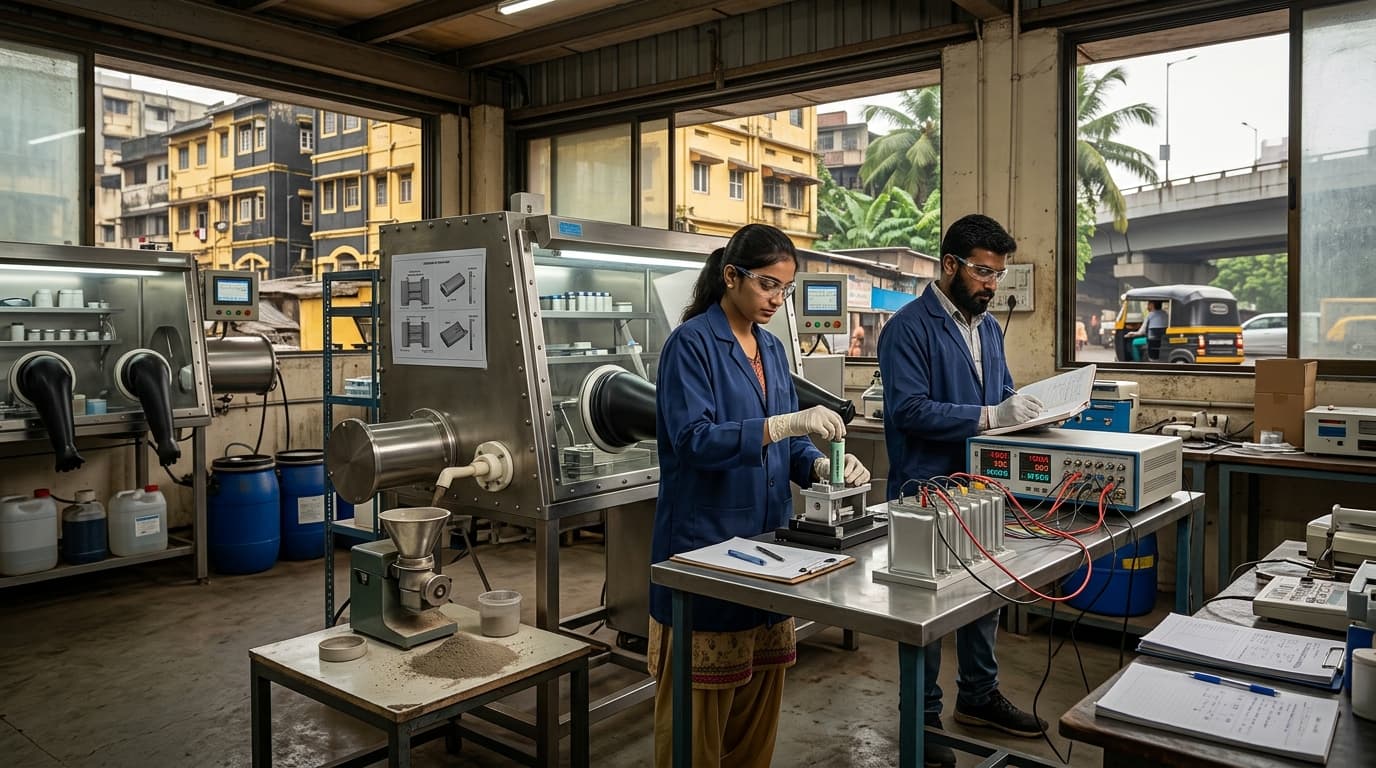
Sodium-Ion Battery Cell Development
Geography: Asia Pacific · South Asia · India
India is emerging as an unexpected player in sodium-ion battery development, driven by strategic necessity. India has virtually no domestic lithium reserves but has abundant sodium (from salt) and agricultural waste that can be converted into hard carbon anodes. Naxion Energy launched India's first sodium-ion energy storage systems in December 2025, targeting telecom towers, EV fleet operators, and specialty vehicle manufacturers. Rechargion showcased its sodium-ion cell technology at the CSIR-Startup Conclave in 2025. Indi Energy specializes in sodium-ion batteries using hard carbon derived from agricultural and biowaste — turning India's crop residue problem into a battery materials advantage.
Sodium-ion batteries offer several advantages over lithium-ion for Indian conditions: they work across wider temperature ranges (critical for India's extreme heat), use more abundant and cheaper materials, don't require cobalt (mostly sourced from conflict zones), and can be manufactured with existing lithium-ion production equipment with minimal modifications. While sodium-ion has lower energy density than lithium-ion (making it less suitable for premium EVs), it's ideal for stationary energy storage, electric three-wheelers, and grid stabilization — all massive markets in India.
India's sodium-ion push is strategically important because it reduces dependence on lithium supply chains dominated by Australia, Chile, and China. As India deploys hundreds of gigawatt-hours of energy storage for its renewable energy targets (500 GW by 2030), sodium-ion batteries could provide a domestic, cost-effective storage solution. Several Indian research institutions (IITs, CSIR labs) are developing novel electrode materials and manufacturing processes, potentially giving India a technology edge in a battery chemistry that's still in its early commercialization phase globally.
Research this in Signals
Signals turns a topic into a sourced research record you can inspect and rerun. Your first scan is free, and this one starts with Sodium-Ion Battery Cell Development already loaded, so edit it or scan as is.