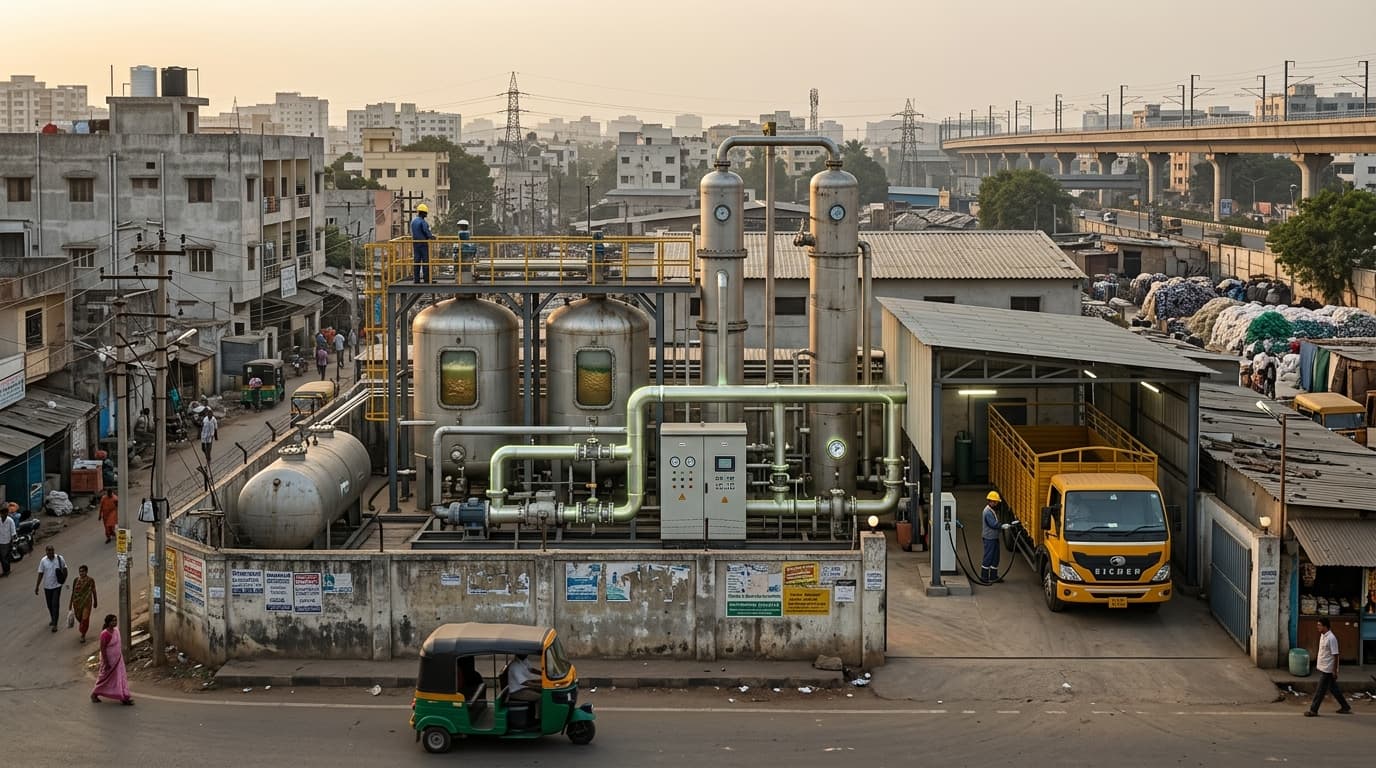
Compressed Biogas (CBG) from Agricultural Waste
Geography: Asia Pacific · South Asia · India
India is building a massive compressed biogas ecosystem through the SATAT (Sustainable Alternative Towards Affordable Transportation) and GOBARdhan (Galvanising Organic Bio-Agro Resources) schemes. CBG — chemically identical to natural gas — is produced by anaerobic digestion of organic waste including cattle dung (from India's 300+ million cattle), crop residues, municipal solid waste, and sewage sludge. The government has introduced a mandatory CBG Blending Obligation (CBO) starting in 2025-26, scaling from 1% to 5% blending with natural gas by 2028-29, creating guaranteed demand.
India's CBG opportunity is uniquely large because of its agricultural waste abundance. The country generates approximately 500 million tonnes of crop residue annually, much of which is currently burned in the open — causing severe air pollution across North India every winter. Converting this waste to CBG simultaneously solves three problems: air pollution from stubble burning, energy import dependence (India imports ~50% of its natural gas), and farmer income (feedstock payments). The SATAT scheme targets establishment of 5,000 CBG plants, with Central Financial Assistance of Rs 175 crore per plant for units above 600 tonnes per annum.
The CBG value chain also produces organic fertilizer (digestate) as a byproduct, reducing dependence on imported chemical fertilizers. This circular economy model — waste to energy plus fertilizer — is particularly suited to India's agricultural economy. Several Indian companies including Verbio India, GPS Renewables, and Torrent Gas are investing in large-scale CBG plants. If India achieves its CBG targets, it would become one of the world's largest producers of upgraded biogas, with potential for export as bio-LNG.
Research this in Signals
Signals turns a topic into a sourced research record you can inspect and rerun. Your first scan is free, and this one starts with Compressed Biogas (CBG) from Agricultural Waste already loaded, so edit it or scan as is.