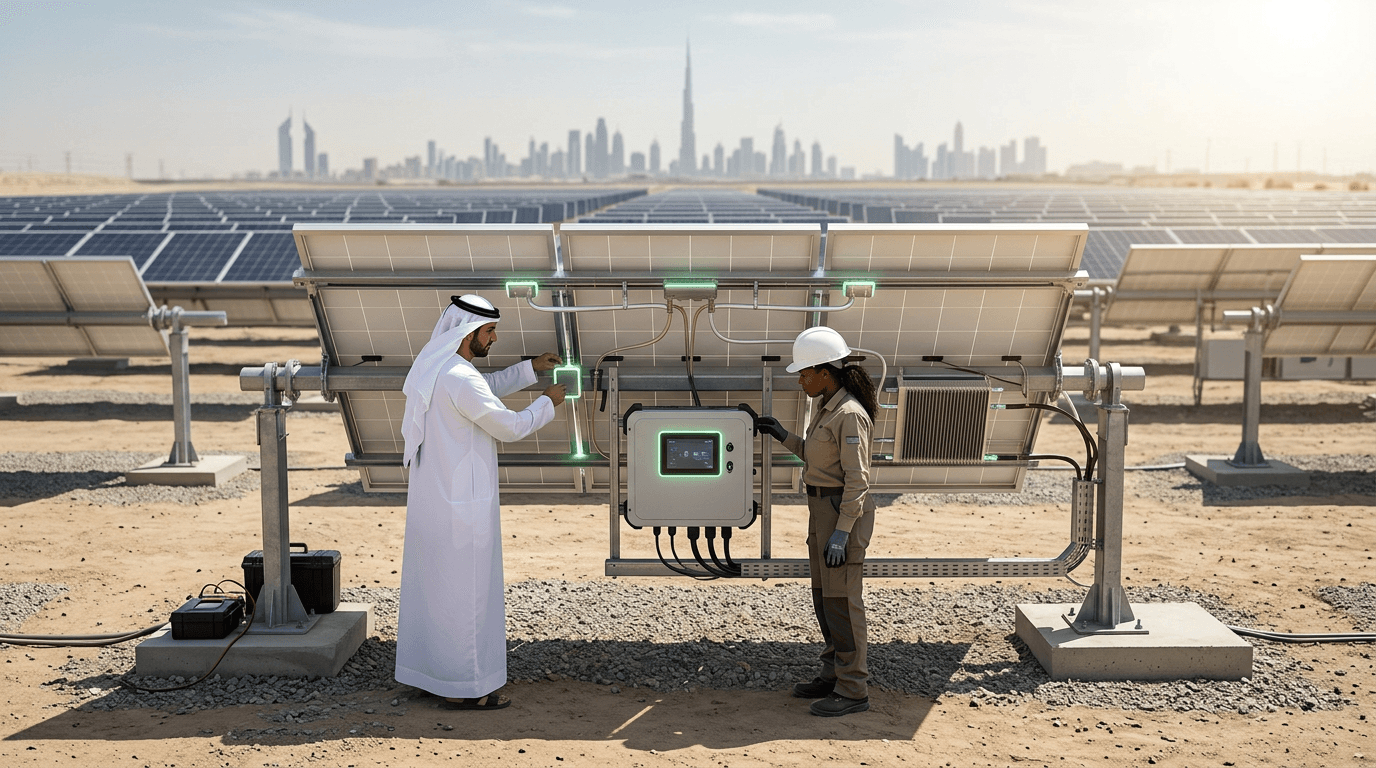
Extreme-Heat Solar PV Innovation
Geography: Emea · Middle East · Gulf States
Standard solar panels lose approximately 0.5% efficiency for every degree Celsius above 25°C, which means Gulf installations operating at 50°C+ lose 12-15% of rated output. Gulf research institutions — including Masdar Institute (now part of Khalifa University), KAUST in Saudi Arabia, and Qatar Environment and Energy Research Institute — are developing specialized PV technologies including anti-soiling coatings, bifacial panels for desert albedo capture, and heat-resistant cell architectures.
This research addresses a paradox: the world's sunniest regions face the highest thermal penalties on solar performance. Solutions developed for Gulf conditions — dust mitigation, thermal management, UV-resistant encapsulants — are directly applicable to the expanding solar markets of India, Australia, and sub-Saharan Africa.
The commercial implications are significant. As global solar deployment accelerates into increasingly harsh environments, Gulf-developed technologies for extreme conditions become exportable intellectual property, shifting the region from energy commodity exporter to clean energy technology provider.
Research this in Signals
Signals turns a topic into a sourced research record you can inspect and rerun. Your first scan is free, and this one starts with Extreme-Heat Solar PV Innovation already loaded, so edit it or scan as is.