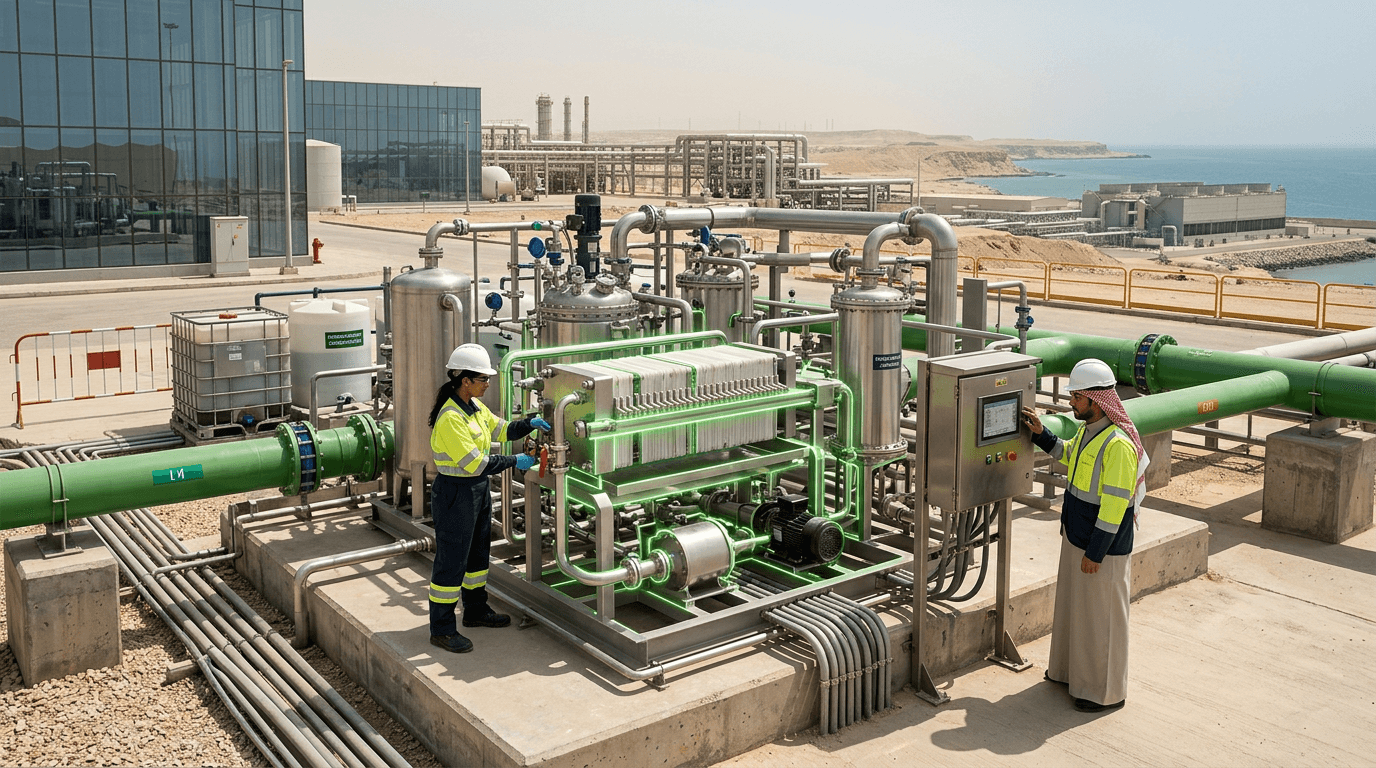
Desalination Brine Mineral Extraction
Geography: Emea · Middle East · Gulf States
Gulf desalination plants produce millions of cubic meters of hypersaline brine daily, currently discharged into the sea with significant ecological damage to marine ecosystems. The Saudi Water Authority published a 2025 report proposing brine mining as a practical pathway to recover sodium, potassium, magnesium, and critically, lithium from this waste stream. KAUST researchers and international partners are developing selective extraction membranes and crystallization processes that can isolate high-value minerals from complex brine chemistry.
The economics are compelling: the global critical minerals market exceeds $300 billion, and desalination brine contains measurable concentrations of minerals essential for batteries (lithium), fertilizers (potassium), and industrial chemicals (magnesium, bromine). The Gulf's massive desalination volumes — Saudi Arabia alone processes over 7.5 million cubic meters daily — create a potentially significant mineral supply chain from what is currently a waste product. Revenue from mineral recovery could offset desalination operating costs by 15-30%.
Strategically, brine mining positions the Gulf at the intersection of two critical global challenges: water scarcity and critical mineral supply chains. If commercially viable extraction of lithium from desalination brine scales, it provides an alternative to traditional hard-rock and evaporation pond mining, with lower environmental footprint and continuous production. The technology could transform every desalination plant worldwide into a mineral source, with Gulf states holding both the largest brine volumes and the deepest expertise to develop the technology.
Research this in Signals
Signals turns a topic into a sourced research record you can inspect and rerun. Your first scan is free, and this one starts with Desalination Brine Mineral Extraction already loaded, so edit it or scan as is.