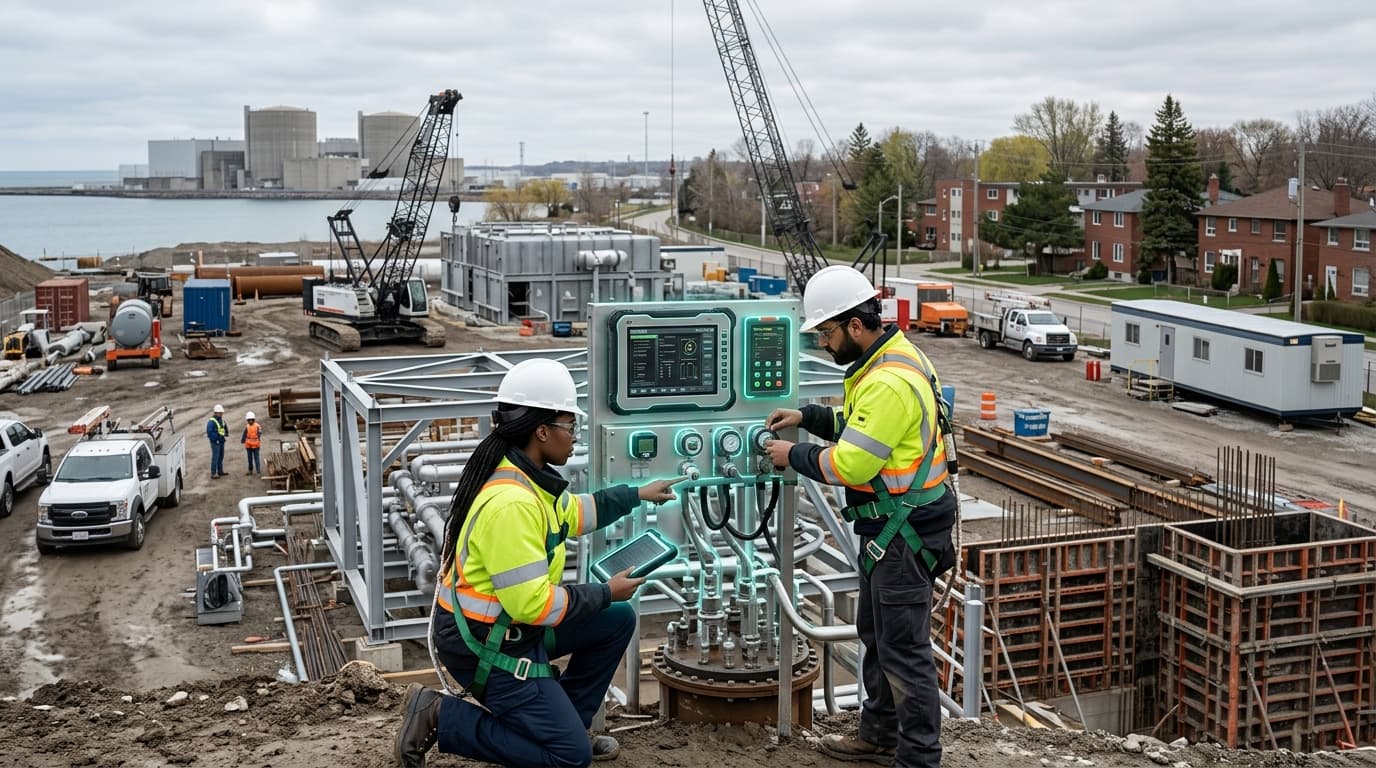
Grid-Scale Small Modular Reactors (BWRX-300)
Geography: Americas · North America · Canada
Ontario Power Generation (OPG) received a Licence to Construct from the Canadian Nuclear Safety Commission in April 2025 for the first grid-connected small modular reactor (SMR) in North America — a GE Vernova Hitachi BWRX-300 unit at the Darlington site in Ontario. The 300 MW boiling water reactor uses passive safety systems that require no operator intervention or external power during emergencies, a fundamental simplification over conventional large reactors. GE Vernova announced a dedicated Canadian BWRX-300 Engineering and Service Centre in Durham region to support the project and future deployments.
SMRs matter because they solve the two problems that have stalled nuclear energy for decades: cost and construction risk. The BWRX-300's modular design allows factory fabrication of major components, reducing on-site construction time and cost overruns that plagued projects like Vogtle in the US. At 300 MW, each unit can be deployed incrementally — utilities add capacity as needed rather than committing to multi-billion-dollar gigawatt-scale plants. Canada's early licensing and construction positions it as the reference site for a reactor design that Finland, Sweden, and Poland are also evaluating.
Strategically, Canada building the Western world's first grid-connected SMR establishes regulatory precedent, supply chain capability, and operational experience that will influence global nuclear deployment for decades. The BWRX-300's potential applications extend beyond grid electricity to industrial heat for mining operations, hydrogen production, and district heating in northern communities. With AI data centres driving unprecedented electricity demand, SMRs offer the only zero-carbon baseload technology that can be sited near data centres without the land requirements of wind and solar farms.
Research this in Signals
Signals turns a topic into a sourced research record you can inspect and rerun. Your first scan is free, and this one starts with Grid-Scale Small Modular Reactors (BWRX-300) already loaded, so edit it or scan as is.