Biodiversity-Positive Infrastructure
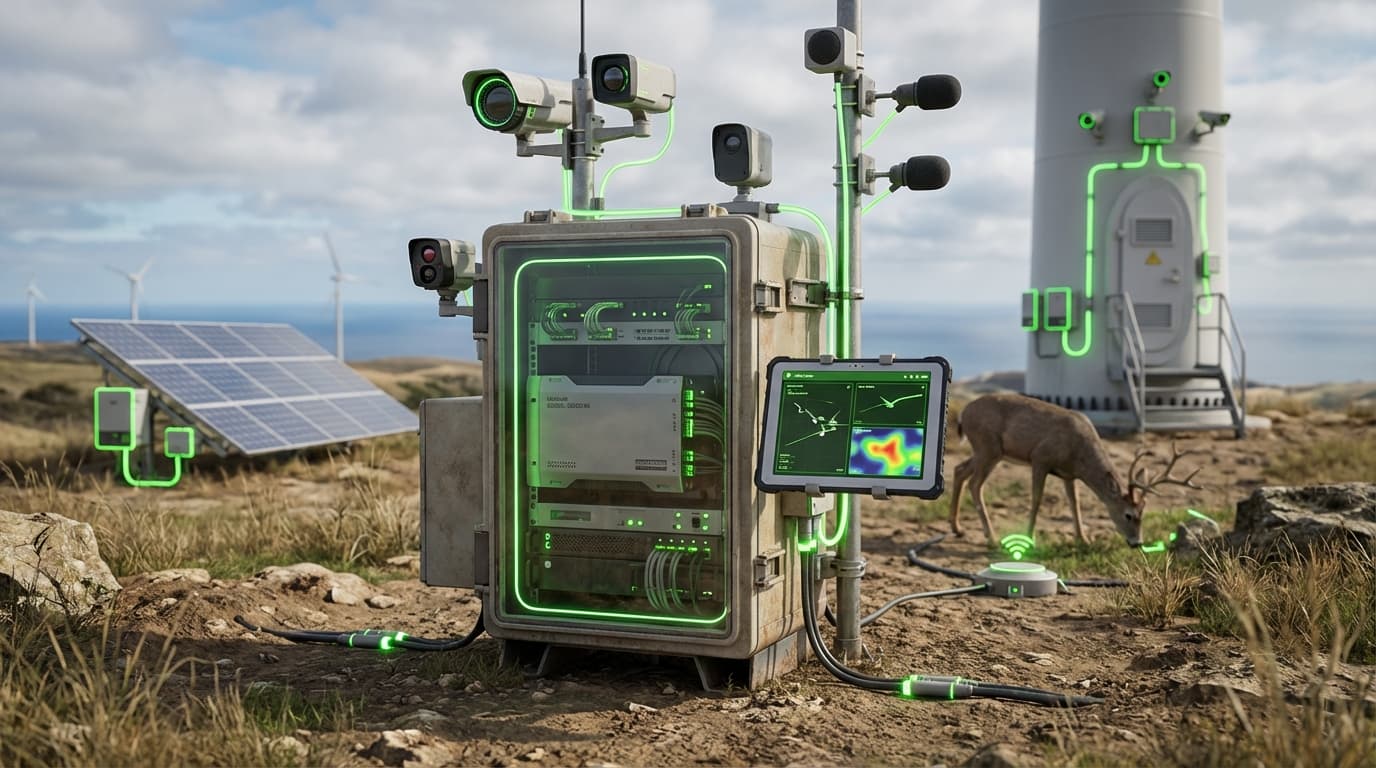
The expansion of renewable energy infrastructure, particularly wind and solar farms, has created an unintended conflict between climate action and biodiversity conservation. Wind turbines pose significant collision risks to birds and bats, while large-scale solar installations can disrupt local ecosystems and wildlife corridors. Traditional mitigation approaches—such as seasonal shutdowns or blanket curtailment policies—often prove economically prohibitive or insufficiently targeted, forcing energy developers to choose between environmental impact and operational efficiency. Biodiversity-Positive Infrastructure represents a fundamental shift in this paradigm, employing advanced sensing technologies and artificial intelligence to enable renewable energy facilities that actively protect and even enhance local wildlife populations rather than merely minimizing harm.
This approach integrates multiple detection systems—including smart cameras with computer vision algorithms, acoustic sensors, radar arrays, and ultrasonic monitoring devices—to create comprehensive awareness of wildlife activity around energy installations. Machine learning models trained on vast datasets can distinguish between species, predict flight paths, and assess collision risk in real-time, triggering automated responses such as turbine curtailment, acoustic deterrents, or visual warnings precisely when and where needed. Some systems incorporate thermal imaging for nocturnal species detection, while others use bioacoustic analysis to identify bat echolocation calls or bird vocalizations. The technology extends beyond collision prevention to encompass habitat monitoring, migration pattern analysis, and ecosystem health assessment, providing energy operators with detailed environmental intelligence that informs both immediate operational decisions and long-term site management strategies. This granular, data-driven approach allows facilities to maintain high capacity factors while dramatically reducing wildlife impacts compared to conventional mitigation methods.
Early deployments at wind farms across Europe and North America indicate that these intelligent systems can reduce bird and bat fatalities by seventy to ninety percent while curtailing turbines less than five percent of operational time, demonstrating that environmental protection and energy production need not be mutually exclusive. Research programs are expanding the technology's scope to include pollinator-friendly solar farm designs with integrated habitat corridors, underwater acoustic systems for offshore wind installations that protect marine mammals, and predictive models that optimize facility siting based on migration routes and breeding grounds. As renewable energy deployment accelerates globally, biodiversity-positive infrastructure represents an essential evolution in sustainable development—one that recognizes energy transition and ecosystem preservation as complementary rather than competing objectives, ultimately contributing to both climate resilience and the broader goal of reversing biodiversity loss in the Anthropocene era.
Related Organizations

Develops an autonomous aerial detection system using cameras and AI to detect protected bird species and curtail wind turbines in real-time.

Provides AI-powered software that uses existing infrastructure cameras to monitor bird activity and collision risk at offshore wind farms.

Offers self-working systems for bird and bat monitoring and mortality mitigation at wind farms using cameras and acoustic deterrents.

Maintains the efficiency charts for solar cells and conducts foundational research on perovskite stability.

Manufactures 3D radar systems to detect and track bird movements for avian protection at wind farms and airports.

Provides ultrasonic bat deterrent systems designed to reduce bat mortality at wind energy facilities.

A knowledge management system and research hub hosted by Pacific Northwest National Laboratory focusing on the environmental effects of wind and marine energy.
Nonprofit organization working with the wind industry to develop and test ultrasonic acoustic deterrents.

Ørsted
Denmark · Company
Global leader in offshore wind that has committed to a net-positive biodiversity impact for all new projects from 2030.

Creates bioacoustics monitoring systems and software to track bats, birds, and other wildlife.

Renewable energy consultancy and service provider offering biodiversity monitoring and environmental impact services.
Supporting Evidence
Research this in Signals
Signals turns a topic into a sourced research record you can inspect and rerun. Your first scan is free, and this one starts with Biodiversity-Positive Infrastructure already loaded, so edit it or scan as is.