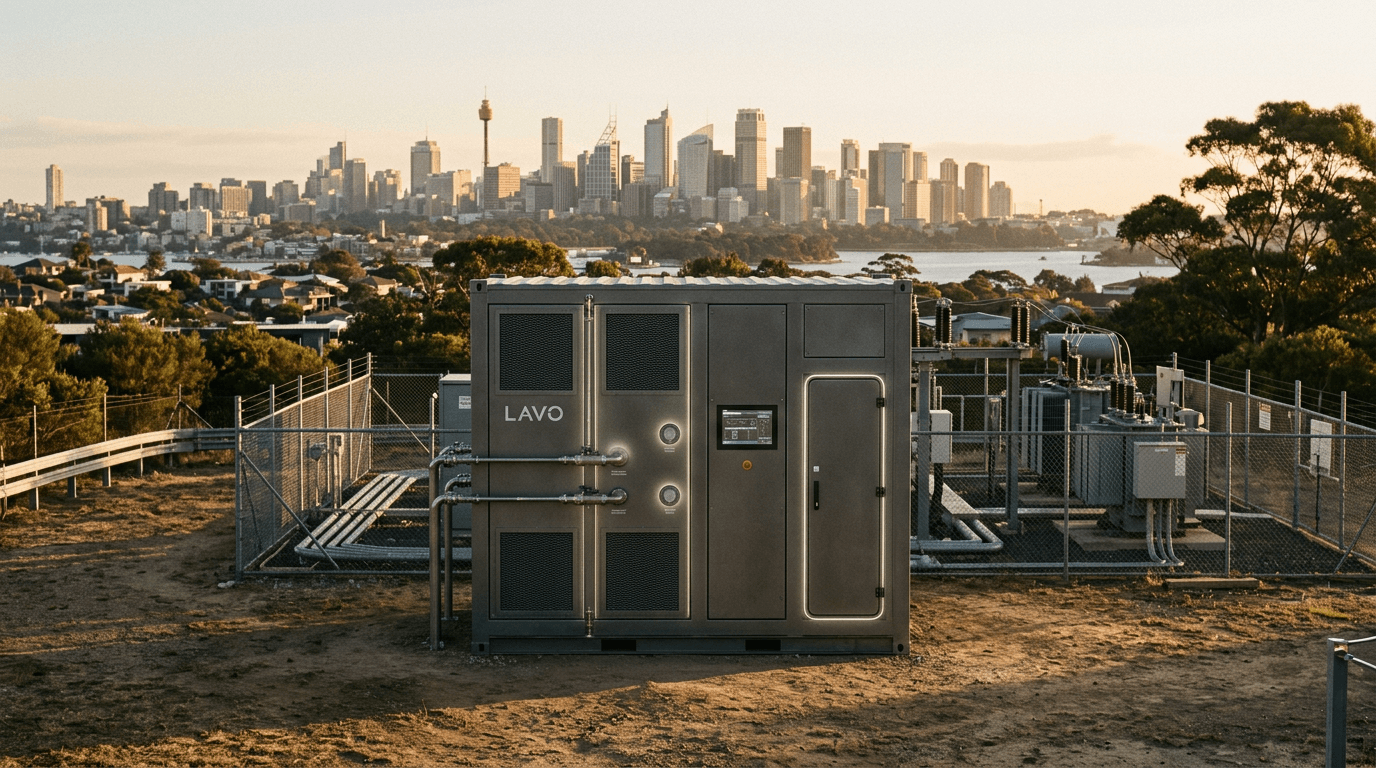
Metal Hydride Hydrogen Storage
Geography: Asia Pacific · Oceania · Australia New Zealand
LAVO, an Australian company working with UNSW research spanning over a decade, has developed a hydrogen energy storage system that uses electrolysis to split water, then stores hydrogen in solid-state metal hydride canisters rather than as compressed gas. The system stores over 40kWh of electricity — enough to power an average Australian home for two days — and can scale for commercial and industrial applications. The technology enables long-duration storage (days to weeks) without the degradation issues of lithium-ion batteries.
Conventional hydrogen storage requires either high-pressure tanks (700 bar) or cryogenic cooling to -253°C, both expensive and potentially dangerous for residential use. Metal hydride storage operates at near-ambient conditions, absorbing hydrogen into the crystal lattice of metal alloys at low pressures. This makes it inherently safer and more energy-dense by volume than compressed gas, opening applications in homes, remote communities, and telecommunications backup power.
For Australia, where rooftop solar penetration is among the world's highest but grid storage remains insufficient, LAVO represents a path to energy independence at the household level. The technology's avoidance of lithium, cobalt, and other contested battery minerals gives it a supply chain security advantage. Government backing through the Department of Industry underscores its strategic relevance, though commercial pricing (approximately AU$30,000) remains a barrier to mass adoption.
Research this in Signals
Signals turns a topic into a sourced research record you can inspect and rerun. Your first scan is free, and this one starts with Metal Hydride Hydrogen Storage already loaded, so edit it or scan as is.