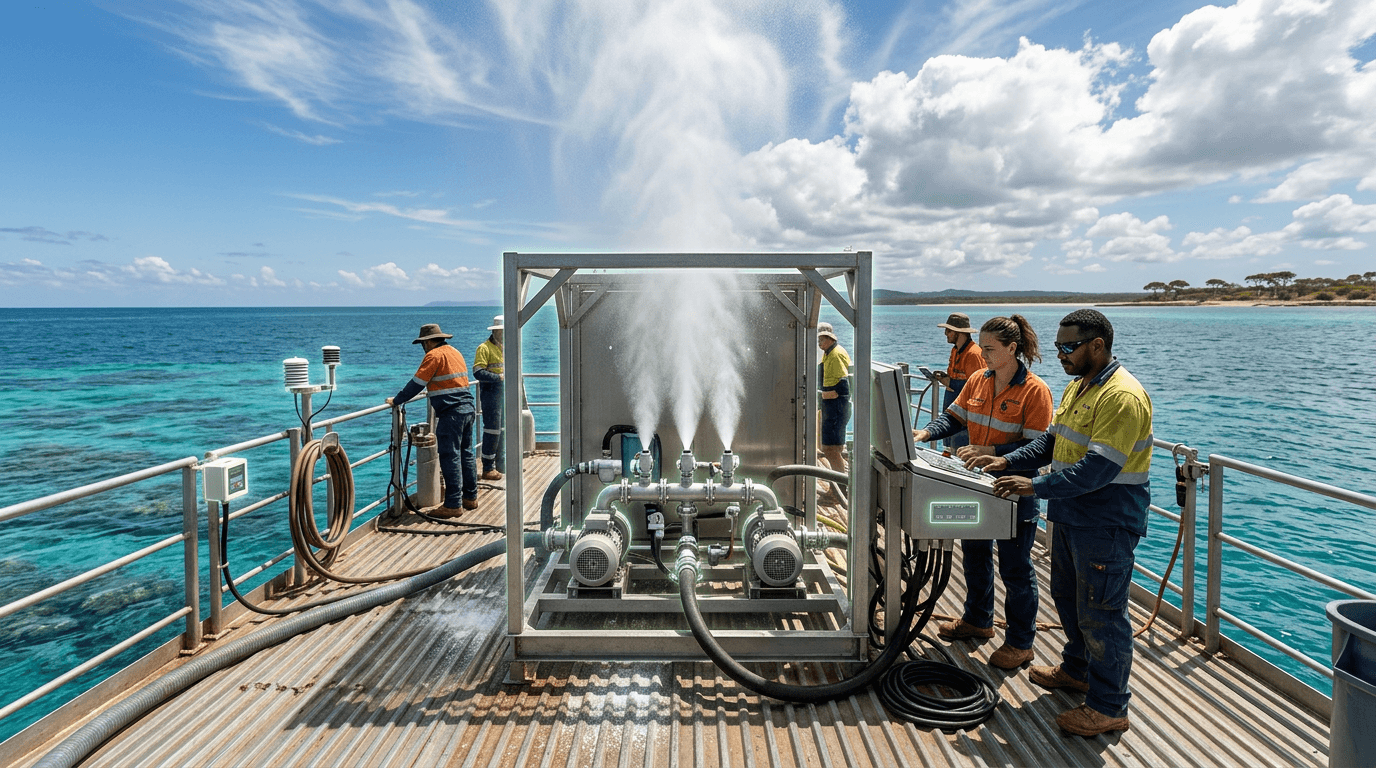
Marine Cloud Brightening for Reef Protection
Geography: Asia Pacific · Oceania · Australia New Zealand
The Reef Restoration and Adaptation Program (RRAP) is investigating marine cloud brightening as an intervention to reduce thermal stress on the Great Barrier Reef during heatwave events. The technique involves spraying ultra-fine sea-salt particles from boats or shore-based nozzles into low-level clouds over the reef, increasing cloud droplet concentration and reflectivity (the Twomey effect). This reflects more sunlight before it reaches the ocean surface, potentially reducing water temperatures by 0.5-1°C in treated areas.
Marine cloud brightening is one of several 'solar radiation management' approaches being explored globally, but Australia's application is unique in targeting localized ecosystem protection rather than global climate intervention. Field trials over the Great Barrier Reef have demonstrated measurable increases in cloud reflectivity, though the downstream temperature effects at reef scale are still being quantified. The technology is conceived as an emergency intervention during mass bleaching events, not a permanent solution.
This is among the most controversial technologies in the radar, sitting at the intersection of climate engineering and conservation. Critics argue it treats symptoms rather than causes, while proponents note that without intervention tools, the reef may not survive long enough for global emissions reduction to take effect. Australia's willingness to research and test cloud brightening reflects the urgency of the threat — the Great Barrier Reef has experienced six mass bleaching events since 1998, with intervals shortening. The governance frameworks being developed for these interventions will likely become global templates.
Research this in Signals
Signals turns a topic into a sourced research record you can inspect and rerun. Your first scan is free, and this one starts with Marine Cloud Brightening for Reef Protection already loaded, so edit it or scan as is.