Coral Larval Restoration Technology
Geography: Asia Pacific · Oceania · Australia New Zealand
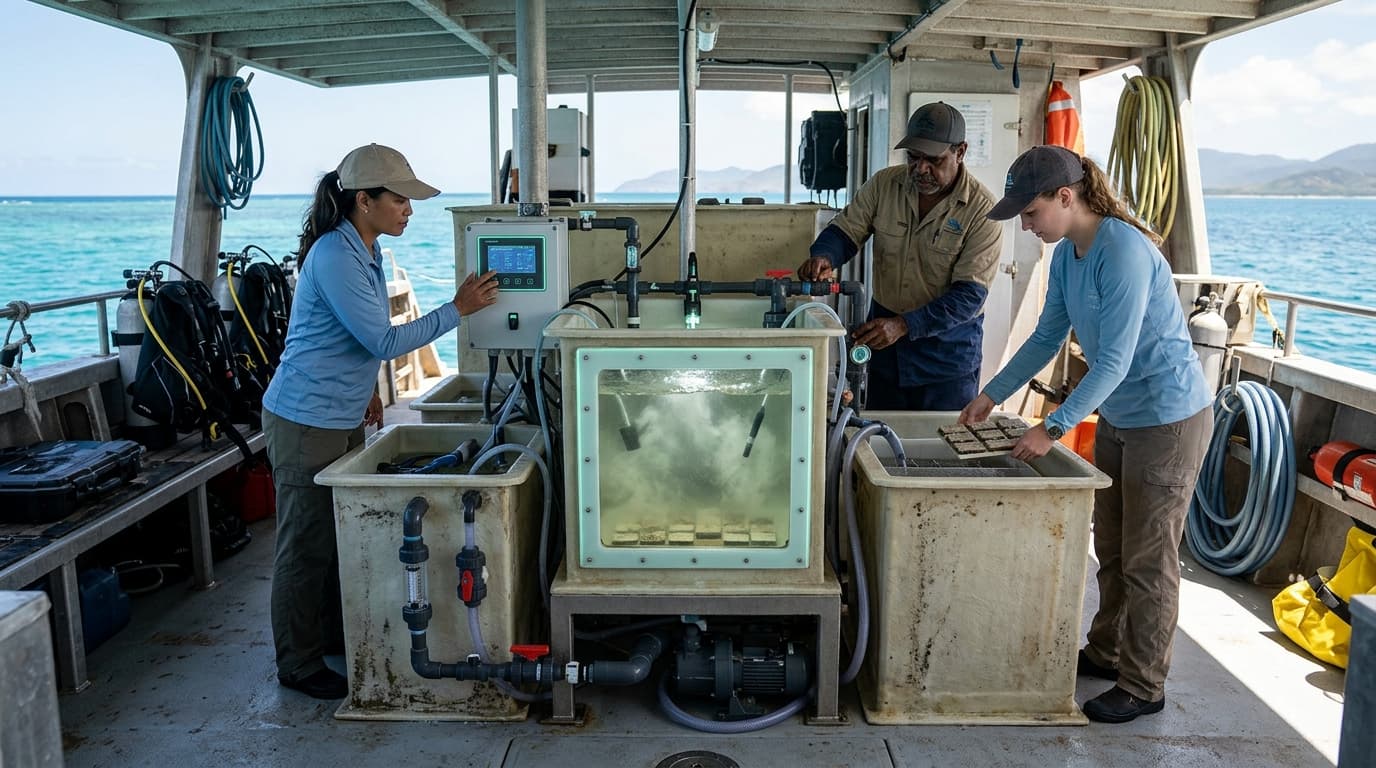
CSIRO and Southern Cross University developed the 'larval seedbox' — a coral restoration technology that captures millions of coral larvae during natural spawning events and concentrates them onto degraded reef areas using specially designed settlement devices. Field trials on the Great Barrier Reef in November 2025 demonstrated a 56-fold increase in coral settlement rates compared to natural processes. The Australian Institute of Marine Science deployed 44,608 seeding devices across three reef sites in the 2025-26 season.
The Great Barrier Reef, valued at AU$56B annually through tourism and ecosystem services, has experienced six mass bleaching events since 1998, with back-to-back events in 2024 and 2025 destroying coral faster than it can recover naturally. Previous restoration approaches — manually transplanting coral fragments — could treat only tiny reef areas. Larval seeding at scale, combined with the Reef Restoration and Adaptation Program's (RRAP) portfolio of interventions including heat-tolerant coral breeding and cloud brightening, represents the first realistic attempt at ecosystem-scale reef restoration.
Strategically, Australia is investing hundreds of millions into reef science that no other nation needs at this scale, generating unique intellectual property in marine ecosystem restoration, heat-stress genomics, and underwater automation. This expertise is exportable to tropical reef nations worldwide. The program also serves as a live testbed for large-scale ecological intervention technologies — whether those insights apply to reefs, forests, or other threatened ecosystems.
Research this in Signals
Signals turns a topic into a sourced research record you can inspect and rerun. Your first scan is free, and this one starts with Coral Larval Restoration Technology already loaded, so edit it or scan as is.