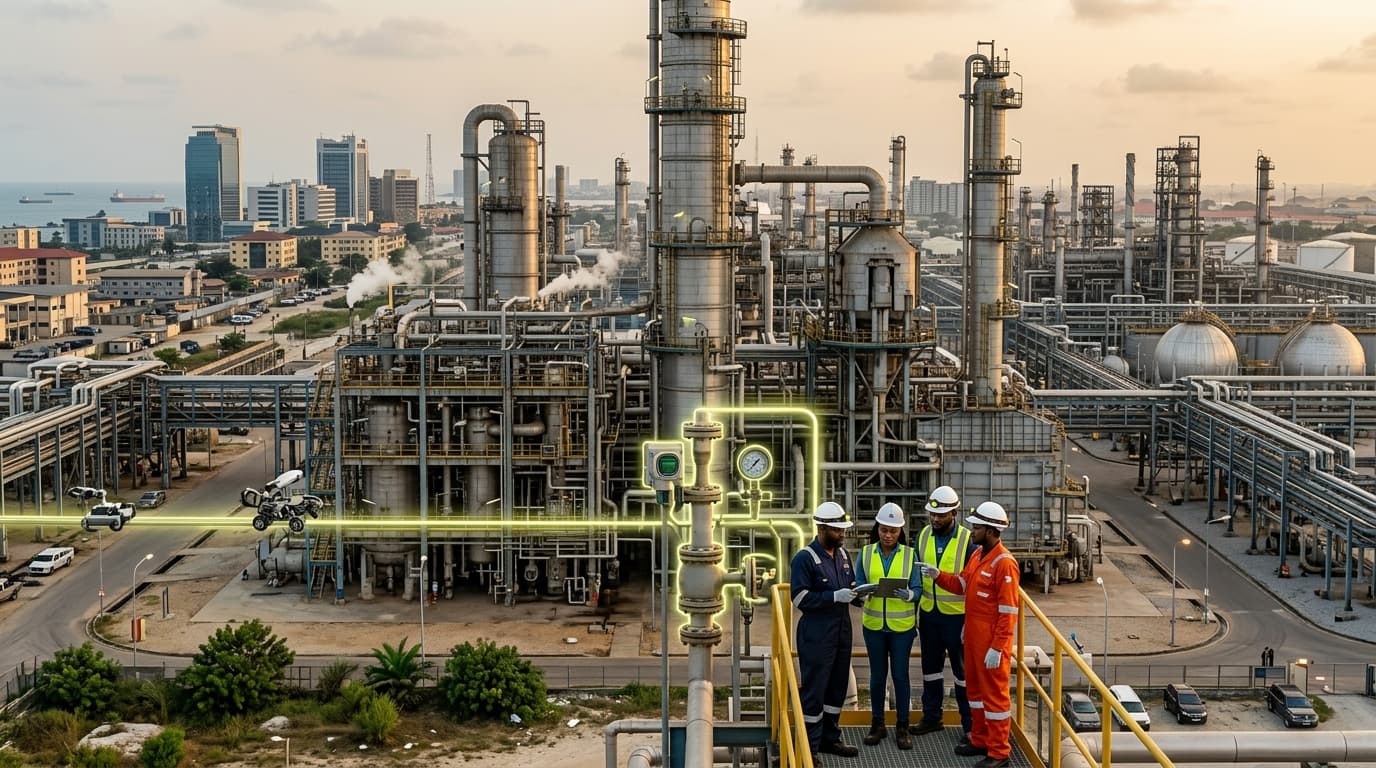
Single-Train Mega-Refinery Technology
Geography: Emea · Africa · Africa
The Dangote Petroleum Refinery in Lekki, Lagos, is the world's largest single-train (single crude distillation unit) refinery at 650,000 barrels per day capacity, with Honeywell contracted to double capacity to 1.4 million bpd. The $20 billion facility includes a 900 KTPA polypropylene plant, a fertilizer complex, and sub-sea pipeline infrastructure. It processes Nigerian crude into petrol, diesel, jet fuel, and petrochemical feedstocks — products that Africa's largest oil producer paradoxically imported for decades because it lacked refining capacity.
The technological achievement is the single-train design itself: rather than building multiple parallel processing units (the conventional approach), the entire refinery operates through one integrated distillation and cracking train. This reduces capital cost per barrel of capacity, simplifies operations, and allows economies of scale that make Nigerian-refined fuel cost-competitive with imports. The facility includes the latest hydrocracking and fluid catalytic cracking technology, meeting Euro V fuel specifications that most African refineries cannot achieve.
The strategic impact on African energy sovereignty is transformative. Nigeria spent $23 billion annually importing refined petroleum products despite being Africa's largest oil producer. The Dangote Refinery eliminates this dependency and creates export potential across West Africa. The expansion to 1.4M bpd would make it the world's largest refinery by capacity. It demonstrates that Africa can deploy and operate world-class industrial infrastructure at the frontier of scale.
Research this in Signals
Signals turns a topic into a sourced research record you can inspect and rerun. Your first scan is free, and this one starts with Single-Train Mega-Refinery Technology already loaded, so edit it or scan as is.