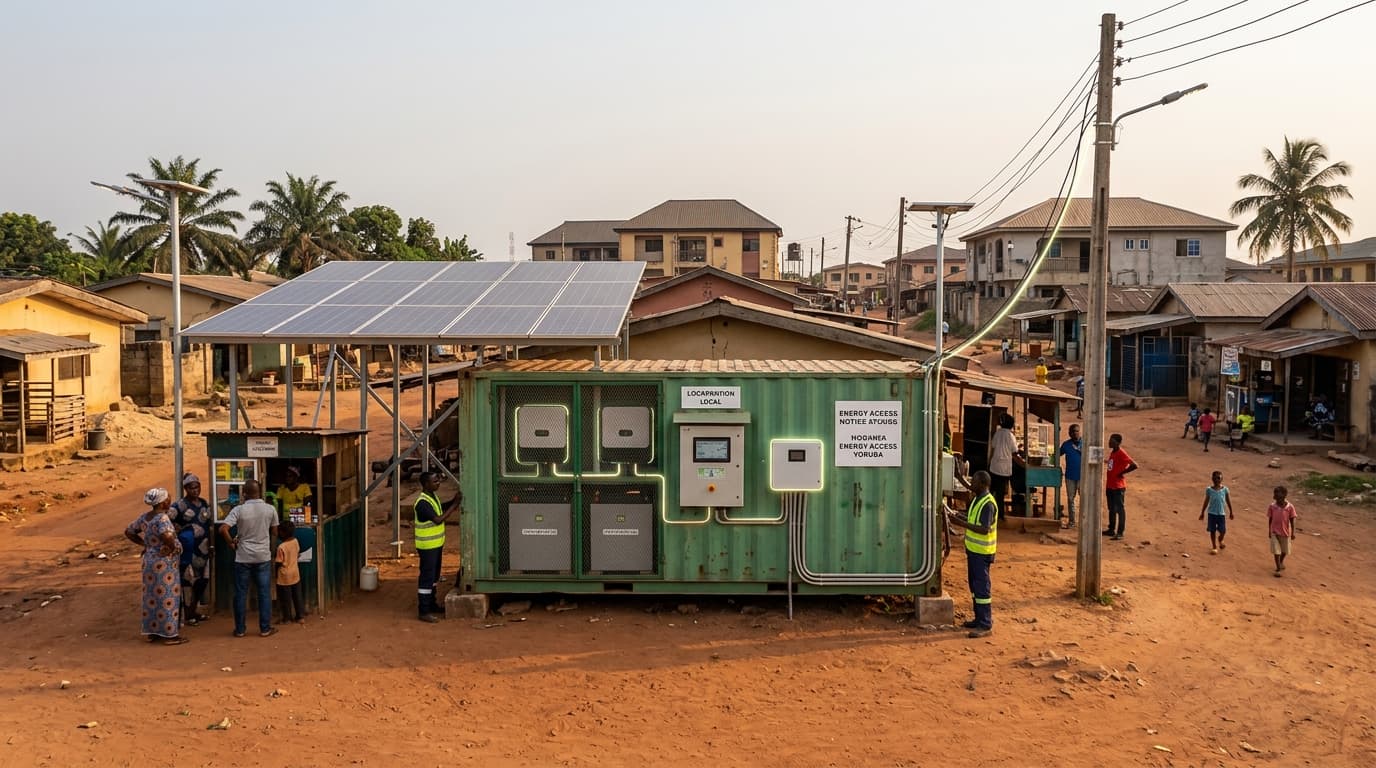
Containerized Solar Mini-Grid Systems
Geography: Emea · Africa · Africa
Containerized solar mini-grids are self-contained power generation and distribution systems that can electrify a village of 500-5,000 people without connection to any national grid. Companies like Husk Power Systems, PowerGen, and Arnergy ship pre-configured solar panel arrays, battery storage, and smart metering equipment in standard shipping containers, reducing deployment time from months to weeks. Nigeria alone has over 200 operational mini-grids with thousands more planned.
Nigeria's national grid reaches only about 40% of the population and suffers chronic instability — average grid uptime is as low as 6 hours per day in many areas. Mini-grids bypass this entirely, providing reliable 24/7 power at costs competitive with diesel generators (which currently power much of Nigeria's economy). Smart metering allows prepaid electricity consumption via mobile money, similar to the PAYG solar model.
The mini-grid model represents Africa's approach to energy infrastructure: skip the centralized grid entirely and build distributed generation. The World Bank estimates Africa needs 160,000 mini-grids to achieve universal electricity access by 2030. This is not a temporary solution — it may be how most of rural Africa is permanently electrified, creating a fundamentally different energy architecture than the centralized grids of the 20th century.
Research this in Signals
Signals turns a topic into a sourced research record you can inspect and rerun. Your first scan is free, and this one starts with Containerized Solar Mini-Grid Systems already loaded, so edit it or scan as is.