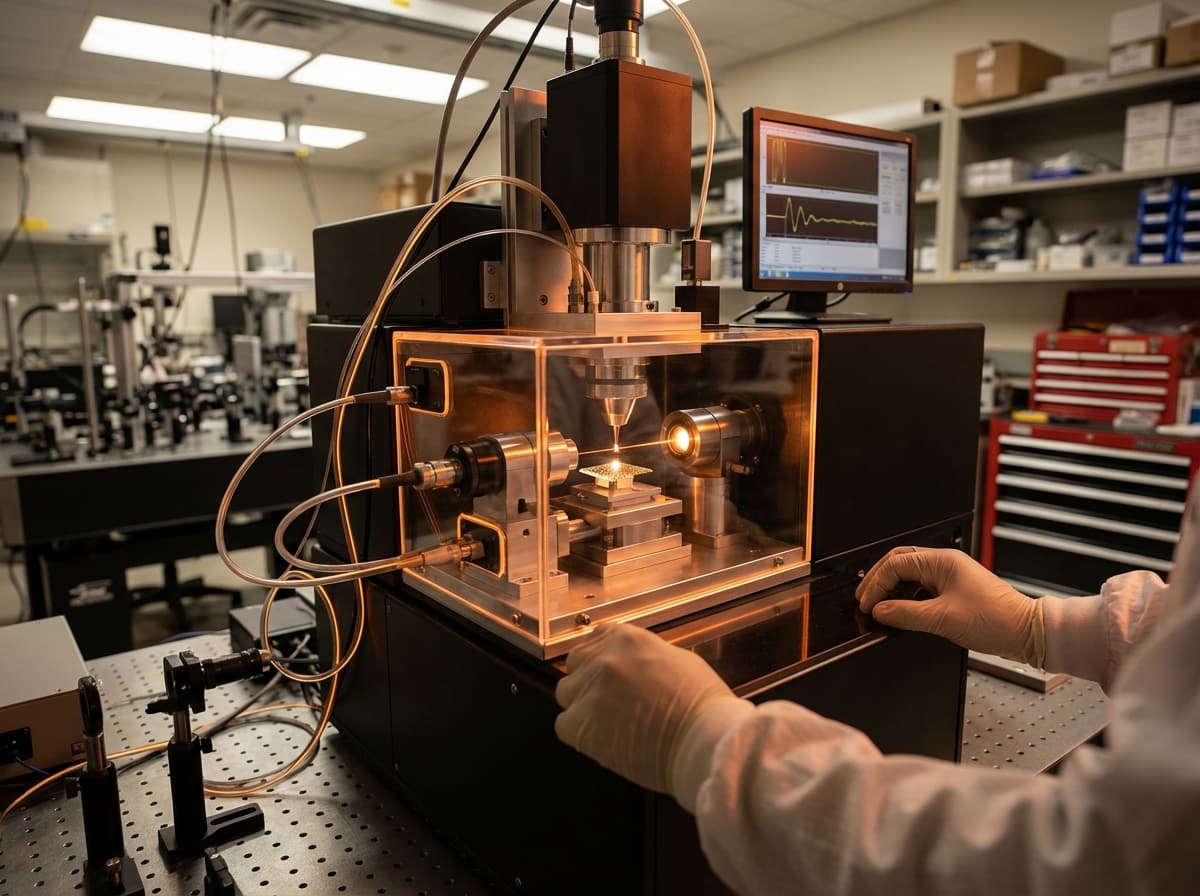
Femtosecond Laser Micro-Processing
Femtosecond laser micro-processing represents a fundamental shift in precision manufacturing, employing laser pulses that last mere quadrillionths of a second to remove material with unprecedented control. Unlike conventional laser systems that rely on thermal ablation—where material is melted or vaporized through sustained heat transfer—femtosecond lasers deliver energy so rapidly that the target material is ejected before thermal diffusion can occur. This phenomenon, known as "cold ablation," happens because the pulse duration is shorter than the time required for heat to propagate beyond the immediate interaction zone. The underlying mechanism involves multiphoton absorption, where the intense electric field of the ultrashort pulse breaks molecular bonds directly, transforming solid material into plasma almost instantaneously. This process operates at the micron and sub-micron scale, enabling features as small as a few micrometers with minimal collateral damage to adjacent structures.
The manufacturing challenges addressed by this technology are particularly acute in industries where thermal damage represents a critical failure mode. Traditional machining methods struggle with heat-sensitive materials like thin glass substrates used in consumer electronics, biodegradable polymers for medical implants, and delicate organic materials in flexible displays. Conventional laser cutting often creates heat-affected zones that compromise material properties, introduce microcracks, or alter chemical composition—problems that can render components unusable in high-precision applications. Femtosecond processing eliminates these thermal side effects, enabling manufacturers to work with materials previously considered too fragile for laser machining. This capability unlocks new design possibilities in sectors ranging from medical devices to automotive fuel systems, where precision tolerances measured in micrometers directly impact product performance and reliability.
Current deployments span multiple high-value manufacturing sectors, with particularly strong adoption in medical device fabrication and automotive component production. Manufacturers employ femtosecond systems to drill microscopic holes in fuel injector nozzles, where hole diameter and edge quality directly influence combustion efficiency and emissions performance. In the medical field, the technology enables the creation of intricate patterns in cardiovascular stents and the precise cutting of intraocular lenses without inducing stress fractures. Surface texturing applications leverage femtosecond pulses to create micro- and nano-scale patterns that control wettability, with industrial implementations ranging from self-cleaning surfaces to enhanced adhesion in composite bonding. Research directions point toward integration with additive manufacturing processes and the development of higher-power systems capable of scaling from prototype to volume production, suggesting that cold ablation will become increasingly central to advanced manufacturing as industries demand ever-tighter tolerances and work with progressively more sensitive material systems.
Related Organizations

German research institute specializing in laser technology, developing advanced process monitoring for L-PBF and DED.

A pioneer in femtosecond optical parametric amplifiers (OPAs) and Yb-based femtosecond laser sources.

Industrial laser leader offering Laser Metal Deposition (LMD) machines and heads.

A digital analytics platform that helps companies track user behavior and product usage.

A major manufacturer of engineered materials and optoelectronic components, including VCSELs for 3D sensing (formerly II-VI).

Develops laser micromachining workstations and systems for the semiconductor, photovoltaic, and medical device markets.

Specializes in extremely high-precision laser machines, often utilizing femtosecond lasers for athermal processing.

Supplier of high-performance fiber lasers and photonic crystal fibers.

Global market leader in energy storage products and services, and digital applications for renewables and storage.

A division of Georg Fischer, providing machine tools including laser texturing and micromachining units.

Develops femtosecond fiber lasers and 3D manufacturing systems.

Spin-off from DESY and Helmholtz Institute Jena, developing high-power femtosecond lasers.
Supporting Evidence
Research this in Signals
Signals turns a topic into a sourced research record you can inspect and rerun. Your first scan is free, and this one starts with Femtosecond Laser Micro-Processing already loaded, so edit it or scan as is.